



One specialist stays with you from your first call through funding.
September, 2026
A structured settlement is an arrangement that pays compensation from a legal claim over time, following an agreed schedule. Payments can arrive monthly, annually or on specific future dates. A life insurance annuity commonly funds them.
You can also receive some cash upfront and structure the rest. That gives you money for current expenses while setting aside payments for later needs.
The important details are how much you receive, when it arrives, how long payments continue and what happens if your circumstances change.
How Does a Structured Settlement Work?
The payment plan has been agreed upon as part of the resolution of the claim. Here’s how a common annuity-funded arrangement works.
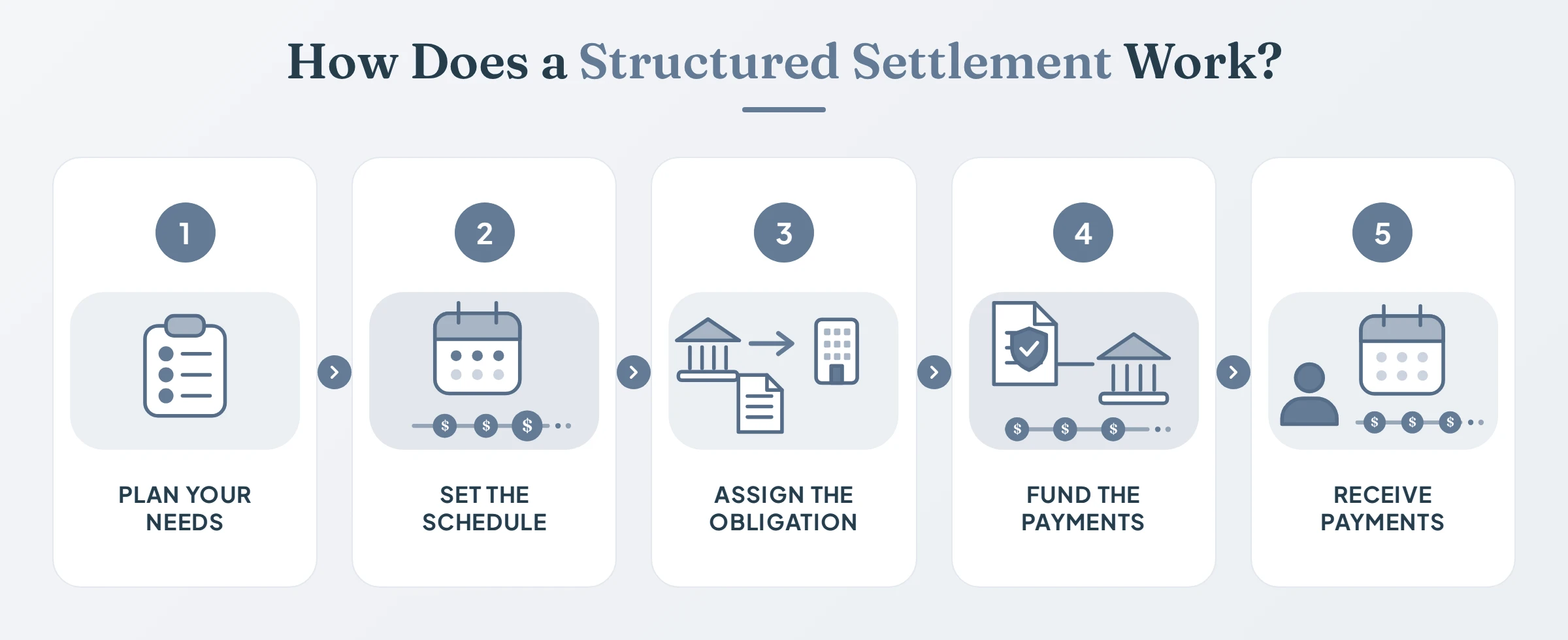
1. Work Out Your Financial Needs
Your attorney and settlement consultant help assess medical costs, living expenses, lost income and other needs. You decide how much cash you need now and which expenses future payments should cover.
Legal fees, liens and other deductions also matter. The amount available to you may differ from the gross settlement amount.
2. Agree on the Payment Schedule
The settlement documents specify payment amounts, dates and duration. Your plan might include monthly income, a future payment for education, or payments that increase at an agreed rate.
Those details need attention before the documents are finalized. Flexibility is greatest during the design phase.
3. Assign the Payment Obligation
In a qualified assignment, the defendant or its insurer transfers the obligation to make future payments to an assignment company. Internal Revenue Code Section 130 sets the conditions for this tax-favored assignment.
Some arrangements are unassigned, meaning the original obligor retains responsibility. Buying an annuity and transferring the legal obligation are separate steps.
4. Fund the Future Payments
The assignment company commonly purchases an annuity from a life insurance company. It typically owns the funding contract, while you receive the scheduled payments.
Your right to those payments does not give you the same withdrawal rights as someone buying a retail annuity. The IRS discusses this ownership distinction in its guidance on periodic-payment arrangements.
5. Receive the Scheduled Payments
Payments begin on the agreed date. A traditional fixed annuity provides the scheduled amounts under its contract, backed by the issuing insurer’s financial strength and ability to pay claims.
Keep the settlement agreement, assignment documents, annuity information and payment schedule together. You’ll need them to check your rights or resolve a payment question.
A Structured Settlement Payment Example
Here’s a hypothetical schedule combining immediate cash with guaranteed payments over a fixed period.
| When the Money Arrives | Payment | Total |
|---|---|---|
| At settlement | One upfront payment of $40,000 | $40,000 |
| Each month for 10 years | $1,500 × 120 payments | $180,000 |
| At the end of year 10 | One additional payment of $30,000 | $30,000 |
| Total scheduled payments, including upfront cash | — | $250,000 |
The future payments total $210,000. Adding the $40,000 upfront gives a nominal total of $250,000.
That number is not an annuity quote or the amount needed today to fund the schedule. Timing, interest rates and contract features affect the funding price. Fees and taxes have not been estimated in this illustration.
A cash offer for selling those future payments would be another calculation, based on the specific rights being transferred and the buyer’s pricing.
Who Receives Structured Settlements?
Structured settlements are used to resolve claims involving:
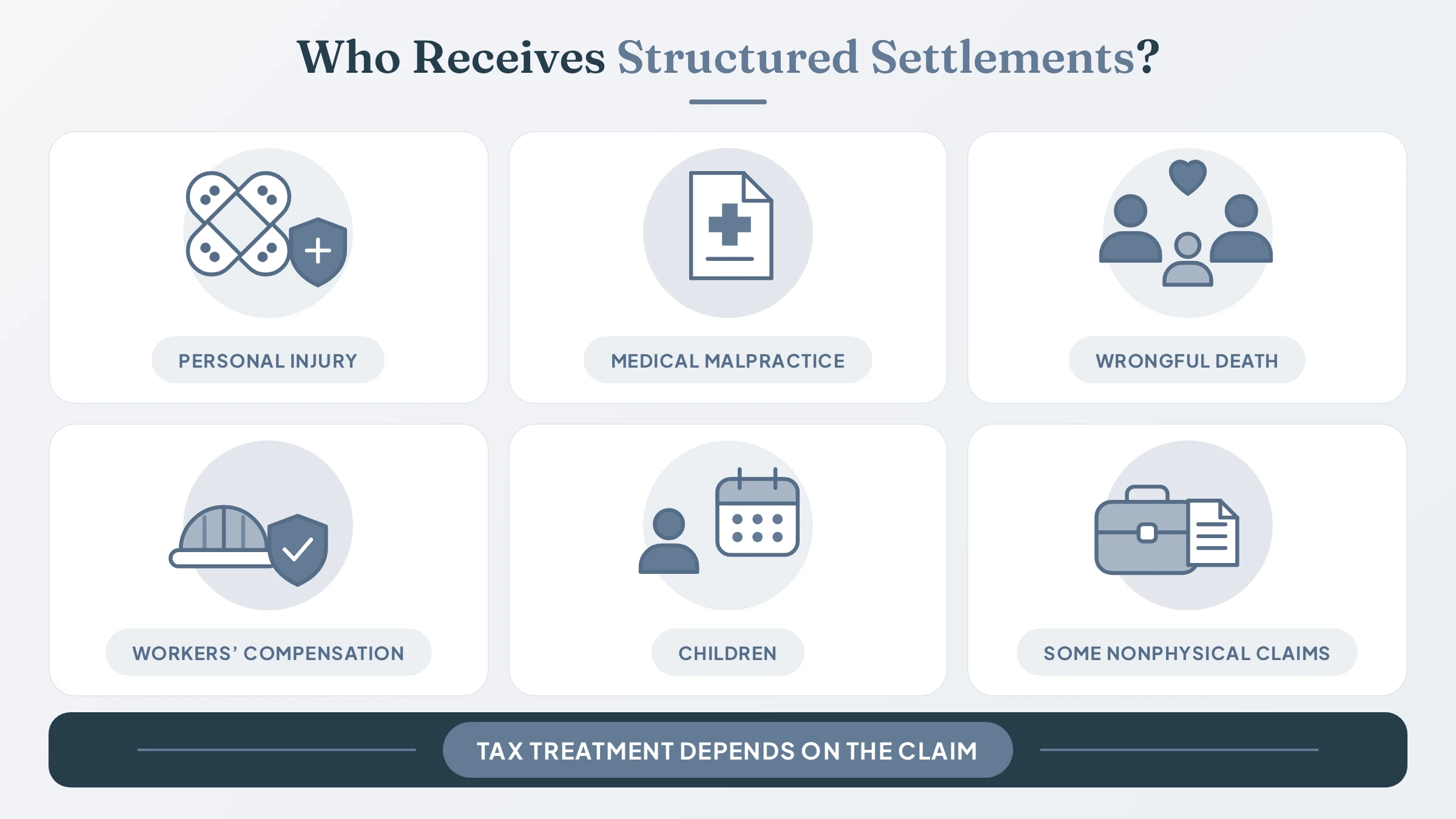
- Personal injuries: Compensation after car accidents, unsafe premises or other injuries.
- Medical malpractice: Payments addressing harm caused by negligent medical care.
- Wrongful death: Financial support for eligible surviving family members.
- Workers’ compensation: Payments related to qualifying workplace injuries or occupational illnesses.
Children can receive structured payments too. Their schedules may account for care costs, education and expenses after they reach adulthood.
Periodic payment arrangements are available for certain nonphysical claims, including employment disputes. Their tax treatment differs from qualifying physical-injury settlements. Receiving money over time does not automatically make it tax-free.
Which Payment Options Are Available?
The schedule can combine several features. The Society of Actuaries describes these payment designs, including fixed periods, life-contingent payments and scheduled lump sums.
Regular Payments
Monthly, quarterly or annual payments can help cover recurring expenses. The amount and frequency are agreed at the outset.
Deferred and Larger Payments
Payments can start later or include larger sums on specified dates. These can address anticipated expenses such as education or future care.
A future lump sum is part of the original schedule. It is different from selling payments later for immediate cash.
Payments for Life or a Fixed Period
A guaranteed fixed-period arrangement pays for an agreed number of years. Life-contingent payments depend on the recipient remaining alive.
Some lifetime arrangements include a guaranteed period. Check both the payment duration and any survival condition.
Scheduled Payment Increases
The original schedule can include predetermined increases. A fixed annual increase does not necessarily match actual inflation, so ask how purchasing power could change.
What Happens After the Recipient Dies?
The answer depends on the payment design.
Remaining guaranteed payments may continue to a named beneficiary or estate. Payments contingent solely on the recipient’s survival generally stop at death. A lifetime arrangement with a guaranteed period can include both features.
The insurer’s contract and beneficiary provisions determine what continues, who receives it and whether any permitted death-benefit acceleration applies.
Ask about this before signing, especially if a spouse, child or other dependent will rely on the money.
Structured Settlement vs. Lump Sum
A structured settlement spreads compensation across agreed dates. An all-cash settlement gives you the proceeds upfront. A hybrid combines cash now with scheduled payments later.
| Consideration | Structured payments | All-cash settlement | Cash plus structured payments |
|---|---|---|---|
| Immediate access | Payments available as scheduled | Settlement proceeds available upfront | Cash portion available upfront |
| Future income | Agreed payment schedule | Depends on how you manage the money | Agreed schedule for the structured portion |
| Investment decisions | Funding handled through the arrangement | You choose how to save or invest | You manage the cash portion |
| Changing plans | Original payment terms are generally fixed | Greater spending and investment flexibility | Flexibility applies to the cash portion |
| Federal injury-damages exclusion | Can apply to qualifying damages | Can apply to qualifying damages | Can apply to qualifying damages |
A structure can help cover recurring care costs or replace income over time. Cash can cover a substantial immediate expense, such as adapting a home after an injury.
A hybrid lets you address both. First, account for current costs and deductions, then compare actual payment proposals for the money available to structure.
Compare funding amounts, payment dates, guarantees and total future benefits together. A larger nominal payout spread over decades is not the same as more cash available today.
Benefits of Structured Settlements
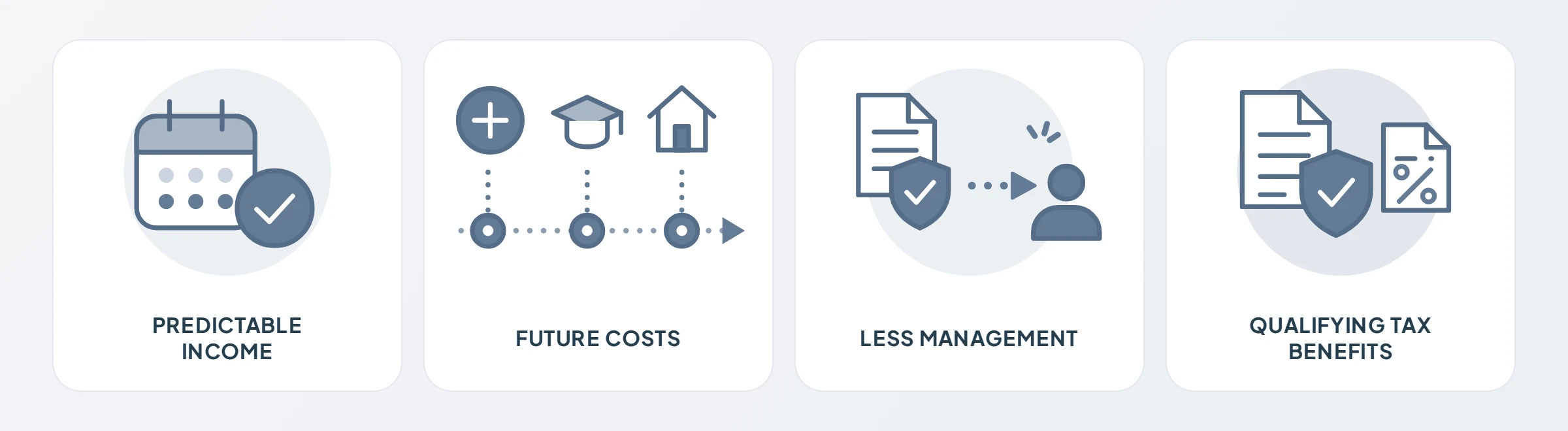
Predictable Income
Scheduled payments make it easier to plan around recurring expenses. You know when the money is due and, under a fixed design, how much arrives.
Planning for Future Costs
The schedule can reserve payments for expected treatment, education or other milestones. Money assigned to those future dates is less readily available for unrelated spending today.
Less Investment Management
A traditional fixed annuity does not require you to select investments to generate each scheduled payment. That reduces the ongoing investment decisions attached to the structured portion.
Tax Advantages for Qualifying Damages
Qualifying periodic damages can retain their federal income-tax exclusion. The legal basis of the claim and the arrangement determine the treatment.
There is also recent research on recipients’ experiences. Among annuity recipients in MetLife’s 2025 Personal Injury Settlement Study:
- 94% associated monthly payments with financial security.
- 79% reported an improved standard of living.
- 76% reported greater confidence in financial decisions.
The Harris Poll surveyed 503 U.S. adults for MetLife, including recipients or guardians who were offered cash or annuity options for personal-injury settlements of at least $25,000. Those figures describe the annuity subgroup’s self-reported experiences; they do not guarantee the same result for every recipient.
Drawbacks You Should Consider

Limited Access to Future Money
A fixed schedule can leave you short of cash when an unexpected expense arrives. Future payments are not a savings account you can freely withdraw from.
Terms That Are Hard to Change
Qualified-assignment payments cannot be accelerated, deferred, increased or decreased by the recipient. A later transfer of payment rights is a separate transaction.
Inflation and Opportunity Costs
Fixed payments can buy less as prices rise. Predetermined increases may help, but may not keep pace with inflation.
The structure also limits your ability to invest that money elsewhere. Annuity pricing reflects investment yields; the tradeoff is investment control and access, not an absence of all growth.
Dependence on the Issuing Insurer
An insurer’s financial strength matters. Contractual guarantees are not the same as a federal guarantee, and the FDIC does not insure annuities.
State guaranty association protections may apply after insurer insolvency, subject to eligibility and coverage limits. Texas’s insurance regulator explains one state’s system.
A Costly Route to Later Cash
Selling payment rights generally produces less cash than the total future payments transferred. You also give up the income attached to those rights.
Are Structured Settlements Tax-Free?
Qualifying compensatory damages for personal physical injury or physical sickness are generally excluded from gross income for federal tax purposes under IRC Section 104(a)(2). Qualifying workers’ compensation has a separate exclusion under Section 104(a)(1).
The payment format alone does not decide the tax result.
| What the payment represents | General federal treatment |
|---|---|
| Qualifying physical-injury or physical-sickness compensatory damages | Generally excluded, whether paid periodically or as a lump sum |
| Qualifying statutory workers’ compensation | Generally excluded under Section 104(a)(1) |
| Nonphysical emotional-distress or employment damages | Generally taxable, subject to applicable exceptions |
| Punitive damages or separately awarded interest | Generally taxable; limited exceptions require specific review |
IRS Publication 4345 provides additional details, including medical expense recoveries and emotional distress payments. Prior deductions that produced a tax benefit can affect the exclusion. Section 104(c) also contains a narrow wrongful-death exception for certain punitive damages.
A tax-free cash award and later investment earnings are separate things. Earnings generated after you receive and invest the cash are not automatically covered by the injury-damages exclusion.
Have a tax professional review mixed damages, interest and state-tax treatment before agreeing to the arrangement.
When Is Court Approval Required?
Approval rules depend on the claim, the recipient, and the jurisdiction.
Settlements involving children or people who lack legal capacity often require judicial approval and protective handling of the proceeds. An annuity is not automatically mandatory. California Probate Code Section 3611 permits several court-directed arrangements, including restricted accounts, annuities and specified trusts.
Those original settlement rules differ from state Structured Settlement Protection Acts, which govern subsequent transfers of payment rights.
Public Benefits Need Separate Planning
Tax-free treatment does not automatically protect eligibility for SSI or Medicaid.
The Social Security Administration’s settlement rules distinguish countable income from qualifying exclusions and certain trust arrangements. Coordinate the payment plan with an attorney who understands the benefits you receive. A structure alone is not a special needs trust.
Which Laws Govern Structured Settlements?
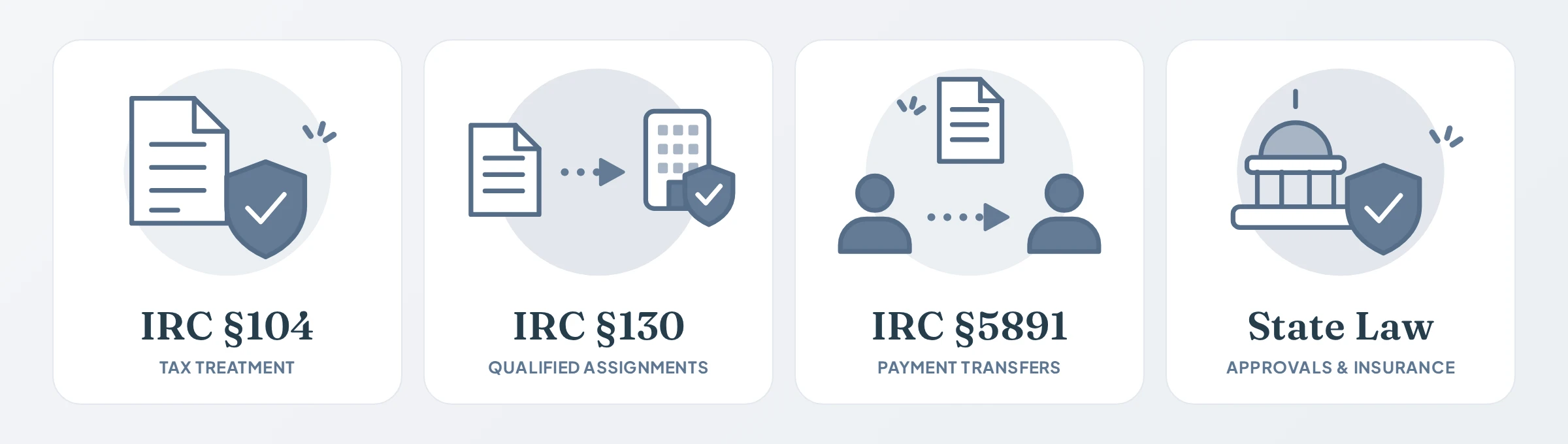
The main federal provisions do different jobs:
- IRC Section 104: Determines whether qualifying damages or workers’ compensation are excluded from income.
- IRC Section 130: Sets the requirements for qualified assignments and eligible funding assets.
- IRC Section 5891: Governs the federal excise tax on structured-settlement factoring transactions, meaning certain transfers of payment rights.
Public Law 97-473, commonly called the Periodic Payment Settlement Act of 1982, was enacted on January 14, 1983. It clarified the federal treatment of periodic injury damages and added Section 130.
State laws separately address matters such as settlement approval, insurance regulation and payment-rights transfers.
Questions to Ask Before Signing
Bring these questions to your attorney and settlement consultant:
- What remains after fees and liens? Start with the amount actually available for your needs.
- How much cash do I need now? Account for immediate care, housing changes and other large expenses.
- Which payments are guaranteed? Check amounts, dates, duration and survival conditions.
- What happens after my death? Confirm beneficiaries and any guaranteed period.
- How will prices affect my budget? Compare fixed payments with realistic future costs.
- What are the tax and benefits consequences? Review the claim’s damages and any SSI, Medicaid or trust considerations.
- Who is legally responsible for paying me? Identify the obligor, assignment company and annuity issuer.
Keep the final schedule in writing. A payment plan should be specific enough that you can match every promised payment to a date and amount.
Can You Sell Structured Settlement Payments?
Eligible payment rights may be sold for a lump sum through a transfer that satisfies the applicable legal requirements. You may transfer selected payments and retain others, subject to the agreement and law.
The original annuity schedule generally continues; transferred payments are redirected to the buyer. This is not an early withdrawal from your own annuity.
State transfer laws generally require advance approval and disclosures. Federal Section 5891 regulations impose a 40% excise tax on the acquirer’s factoring discount unless the advance qualified-order exception applies. The factoring discount means the total future payments acquired minus the amount paid for them. That is not a 40% income tax charged to the seller.
Before considering a sale, the CFPB recommends checking the price, costs, alternatives and effects on benefits. Get independent legal and tax advice. Eligibility and tax consequences depend on your payment rights and arrangement.
Read more about selling structured settlement payments.
FAQs About Structured Settlements
Is a Structured Settlement an Annuity?
The settlement is the legal payment arrangement. An annuity is an insurance contract commonly used to fund it. Other funding arrangements exist. A retail annuity purchased with cash you already received is a different transaction.
Do All Structured Settlements Last for Life?
No. Payments may run for a fixed period, depend on survival, or combine a guaranteed period with lifetime income. The agreement and funding contract specify the duration.
Can I Change My Payment Schedule?
You cannot simply request a different schedule under a qualified assignment. Selling eligible payment rights later redirects those payments through a separate transfer; it does not ordinarily rewrite the annuity contract.
Can I Structure Cash Already Received?
Discuss structuring before finalizing the settlement and receiving funds. Actual or constructive receipt can affect the arrangement. Wood LLP explains why settlement timing matters. Buying an annuity afterwards does not automatically recreate the original structure’s tax treatment.
Is There a Standard Settlement Amount?
There is no single payout amount that applies to every structure. Your claim, available funding and chosen terms determine the schedule. Request an actual proposal, and distinguish the funding premium from the nominal total of future payments.
Are These Government Disability Payments?
No. A structured settlement arises from the resolution of a legal claim. It is separate from government SSI and SSDI payments, even when the underlying claim involves a disabling injury.
Have Questions About Your Existing Payments?
MySettlement brings 25 years of experience to conversations about settlement payments. Share your payment schedule and talk with our team about your options for selling eligible payment rights.
You’ll receive a free, no-obligation quote. Take time to review the numbers and how a sale would affect the income you keep.
This page provides general information. Your settlement documents and circumstances determine the applicable legal, tax and financial treatment.