
Best Structured Settlement Companies in the USA
Not sure who to trust with your settlement payments? This guide covers the top 5 companies, a side-by-side comparison, real stats, and what to watch out for before you sign anything.



One specialist stays with you from your first call through funding.
September, 2026
Need cash before your next payment arrives?
A structured settlement can give you steady payments over time. But life does not always follow the schedule in your settlement documents. A medical bill, a home repair, or another major expense may come up before your next payment does.
Selling some future payments can put cash in your hands sooner. The trade-off is important: you receive less than the total value of the payments you give up. This guide explains how the process works, why people consider a sale, and how five structured settlement companies compare.
What Is a Structured Settlement?
A structured settlement is compensation paid in installments over an agreed schedule instead of one lump sum. It often follows a personal injury claim. Payments may be monthly, yearly, or set for specific future dates. The agreement controls the schedule. An annuity may fund those payments, or an obligated party may pay them under the settlement.
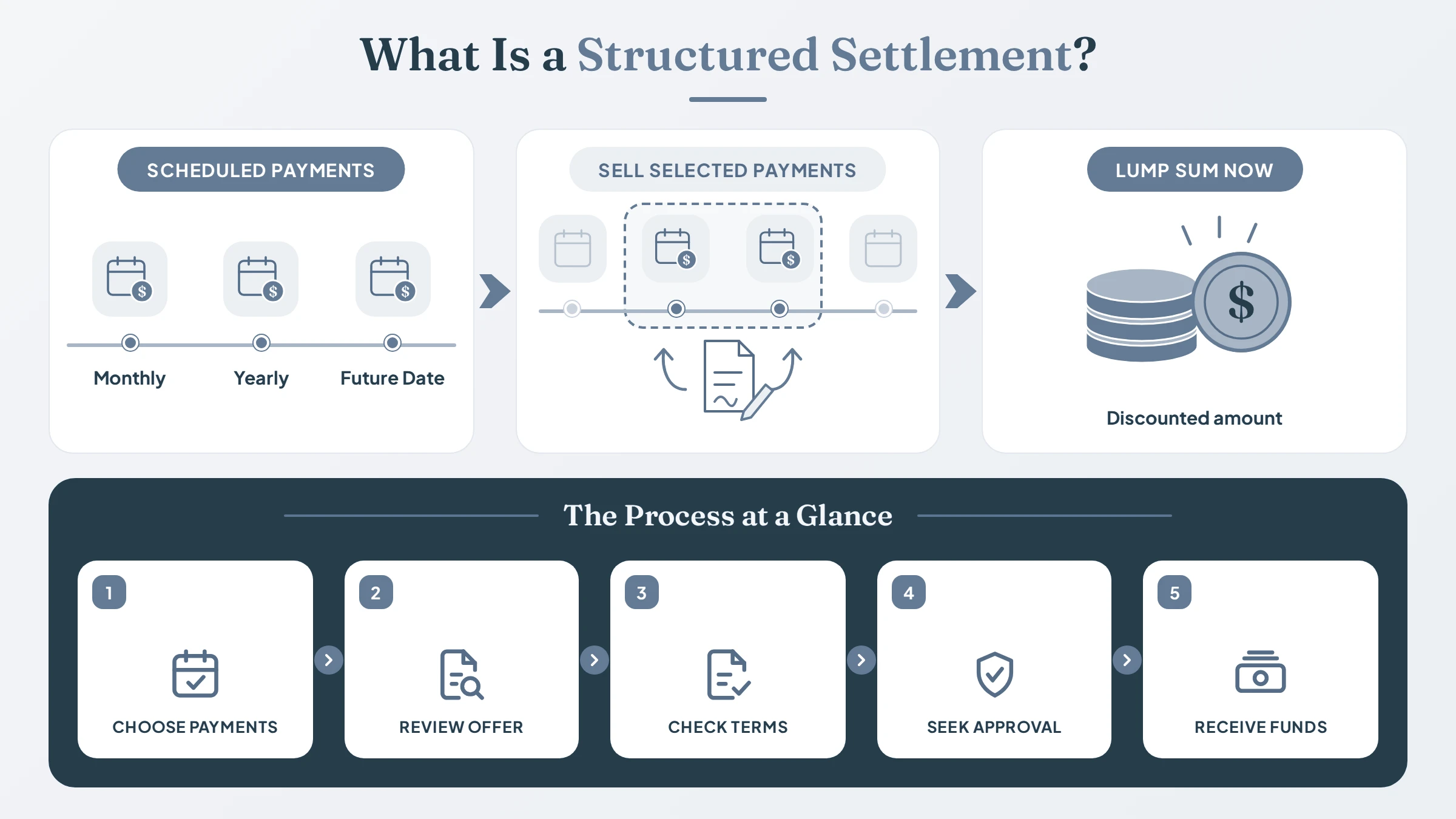
A sale, sometimes called a factoring transaction, transfers some or all of your payment rights to a buyer. The buyer gives you one discounted lump sum now and receives the payments listed in the transfer agreement.
The Process at a Glance
- You choose which future payments you may want to sell.
- A company reviews your settlement documents and makes an offer.
- You review the amount, costs, discount rate, and payment rights being transferred.
- The company files for any approval required by the law that applies to your settlement.
- If approved and the other conditions are met, the buyer pays the agreed amount.
Now you know the number. Ready to act on it?
Most buyers won’t tell you what your settlement is actually worth. Now you know. Let’s get you a real offer.
Why Would Someone Sell a Structured Settlement?
Selling is a personal decision. It can help with a specific need, but the money you receive today comes at the cost of future income. Here are a few reasons people look into it:
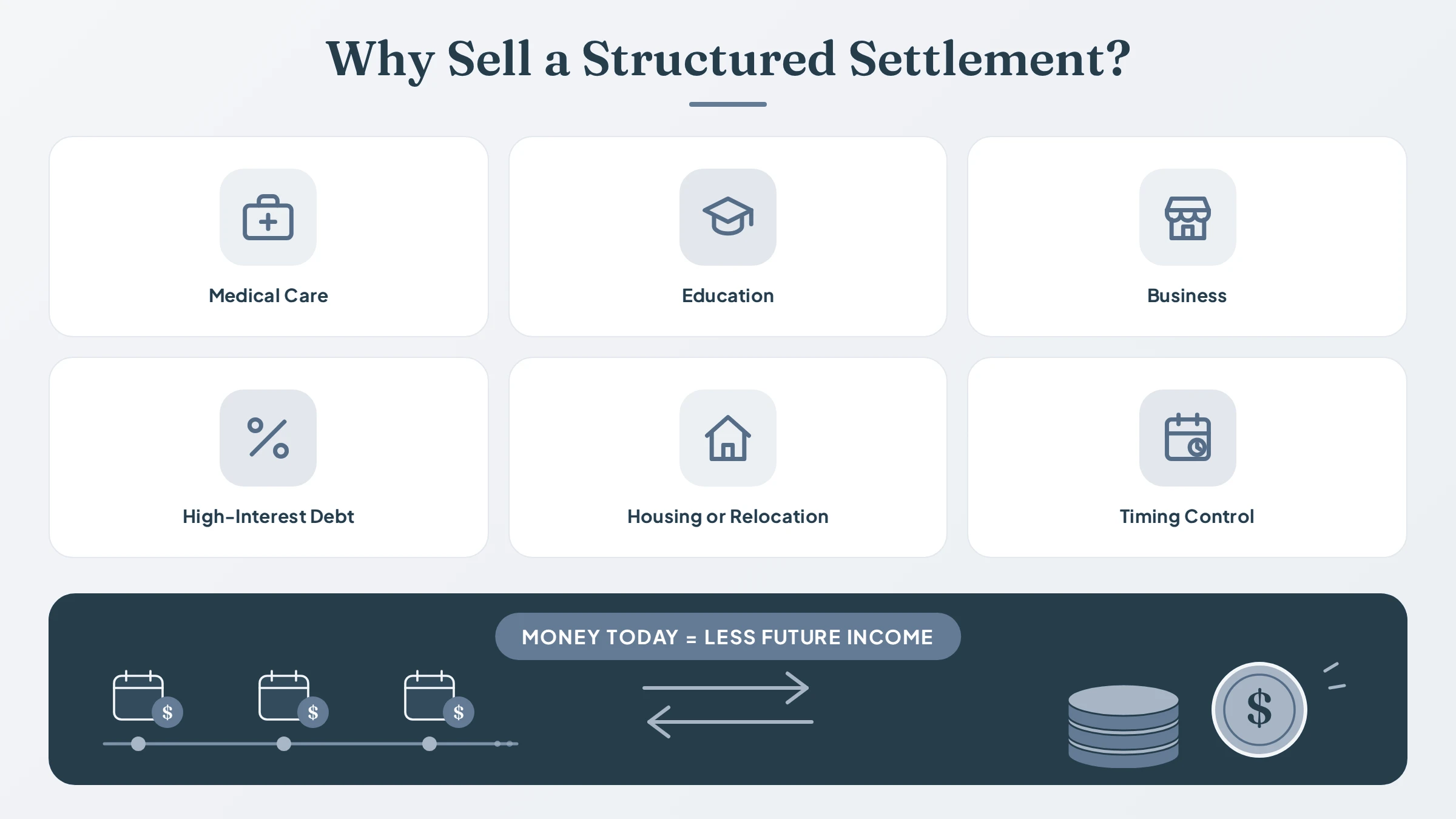
Medical Care
You may need to cover treatment, equipment, or care costs that cannot wait for future installments.
Education
Tuition, training, or housing costs can arrive all at once, even when your settlement pays gradually.
A Business Opportunity
Startup costs or equipment may require more cash upfront than your payment schedule provides.
High-Interest Debt
A lump sum could help pay down costly balances, but compare the sale’s full cost with other ways to manage the debt.
Housing or Relocation
A down payment, urgent repair, or move may require a larger amount at once.
More Control Over Timing
Your priorities may have changed since you arranged the settlement.
Best Structured Settlement Companies
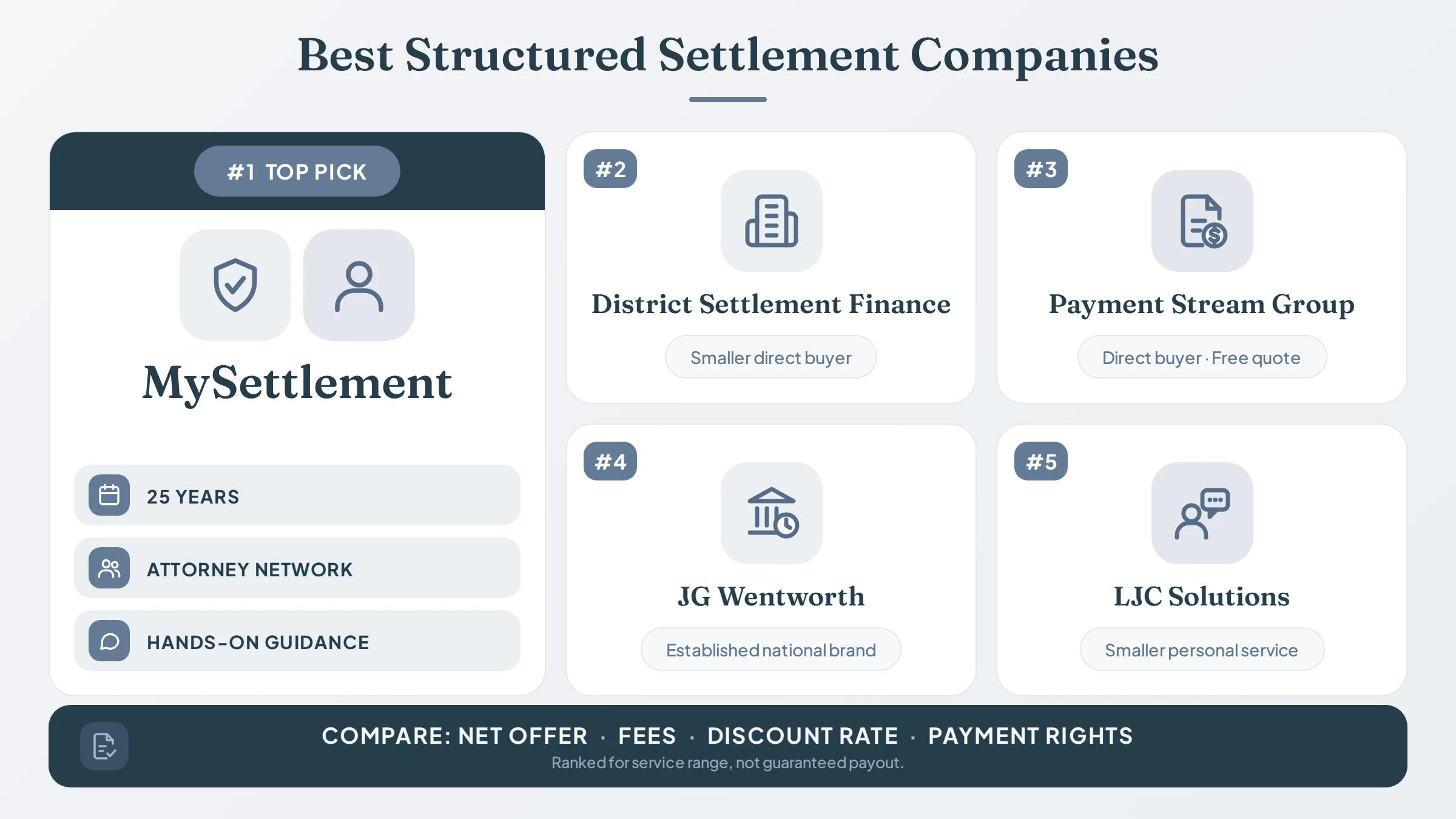
Multiple companies offer structured settlement buying services but only a few stand out.
1. MySettlement
MySettlement offers help with structured settlement payment sales, annuity options, and pre-settlement funding. We purchase structured settlements, manage the court approval process, and ensure you get connected to a single dedicated advisor.
Our team brings 25 years of experience, and offers attorney-network connections when you need legal help. We also provide a free calculator to estimate payment value and describes nationwide access.
For an approved payment transfer, we share your funds within 24–48 hours after court approval, once required conditions are met. However, court scheduling and document review can add time.
Why it ranks first: MySettlement combines transaction guidance with attorney connections and support through the process. That range makes it a strong first call for people who want help understanding the options.
2. District Settlement Finance
District Settlement Finance is based in Washington, D.C., and helps people sell future structured settlement, annuity, and lottery payments. The company has over 25 years of experience in buying structured settlements all across the United States with a high satisfaction rate.
Its published process starts by confirming the remaining payments with the insurance company. The team then discusses how much money the client needs, makes a plan, and begins underwriting after the contract is signed. District Settlement Finance covers transaction fees and expenses and pays by check once the transaction is finalized. It also says it may provide an advance while the transfer is still underway. They also advertise a cash bonus of up to $2,500, subject to terms.
Why consider it: It may suit sellers who prefer working with a smaller team and want to compare a direct-buyer offer. A direct-buyer model doesn't automatically mean a higher payout, so compare the actual net amount with the same payments elsewhere.
3. Payment Stream Group
Payment Stream Group buys structured settlement payments and annuity income, and its website describes it as a direct buyer. It offers a free quote and and no upfront costs. The company’s site reports 10,000+ clients, $500 million+ distributed, and a 45-day average process.
A 2026 review describes Payment Stream Group as a newer company with limited information available online and says it does not serve Maryland or Washington, D.C. Confirm current availability for your state directly before sharing documents.
Why consider it: It can give you another quote to compare. Ask for the discount rate, all fees, the precise payments being transferred, and the net amount you’ll receive.
4. JG Wentworth
JG Wentworth was founded in 1991 and began purchasing structured settlement payments in 1995. Its first “877-CASH-NOW” commercial aired in 2008, helping turn the brand into a household name. JG Wentworth purchases all or part of eligible structured settlement payment streams.
The company reports purchasing more than $10.5 billion in structured settlement streams and completing 64 asset-backed securitizations totaling more than $6.5 billion. It is one of the largest U.S. purchaser of structured settlement payment streams. That scale brings substantial transaction experience, including with court-approved transfers.
Why consider it: It may appeal to people who want an established company with a long operating history and published transaction-scale figures. JG Wentworth says approvals typically take 45–90 days, though timing varies by state and court.
5. LJC Solutions
LJC Solutions focuses on converting structured settlement and annuity payments into a lump sum. Its website invites people to request a quote and describes the process as fast and hassle-free. Retirement Living characterizes it as a smaller firm offering a more personal service experience.
The company does not publish the same transaction-volume figures as JG Wentworth or Payment Stream Group, so ask your assigned contact directly about the buyer, fees, and expected timeline. LJC’s website currently lists a free quote phone number and business hours; a quote is the place to get the terms for your specific payment schedule.
Why consider it: It may appeal to someone who prefers a smaller team and direct communication. Ask how they handle updates and who you can contact if the court requests more information.
Side-by-Side Comparison
| Company | Experience or Scale | Model and Services | Published Timing or Availability | Best Fit |
|---|---|---|---|---|
| MySettlement — Top pick | Team brings 25 years’ experience | Payment purchases, annuities, pre-settlement funding, attorney network | 24–48 hours after approval, per company; nationwide access | Guidance and a broader service range |
| District Settlement Finance | Team reported as 20+ years’ experience | Direct-buyer option; settlement and annuity transfers | Often a few weeks; 48 hours after approval, per Retirement Living | One-to-one service and a direct quote |
| Payment Stream Group | Company reports 10,000+ clients and $500M+ distributed | Direct buyer; structured settlements and annuities | Company reports 45-day average; confirm state availability | A second quote and rate comparison |
| JG Wentworth | Founded 1991; purchasing since 1995; reports $10.5B+ purchased | Purchases all or part of structured settlement payments | 45–90 days typically, per company; check case details | Established brand and large transaction volume |
| LJC Solutions | Smaller firm; no comparable public volume figure located | Structured settlement and annuity quotes | Ask for a case-specific estimate | People who prefer a smaller team |
A note about the figures: Experience, volume, and timing claims come from company materials or the named third-party review. They use different definitions and have not all been independently verified. They are context, not a substitute for comparing written offers.
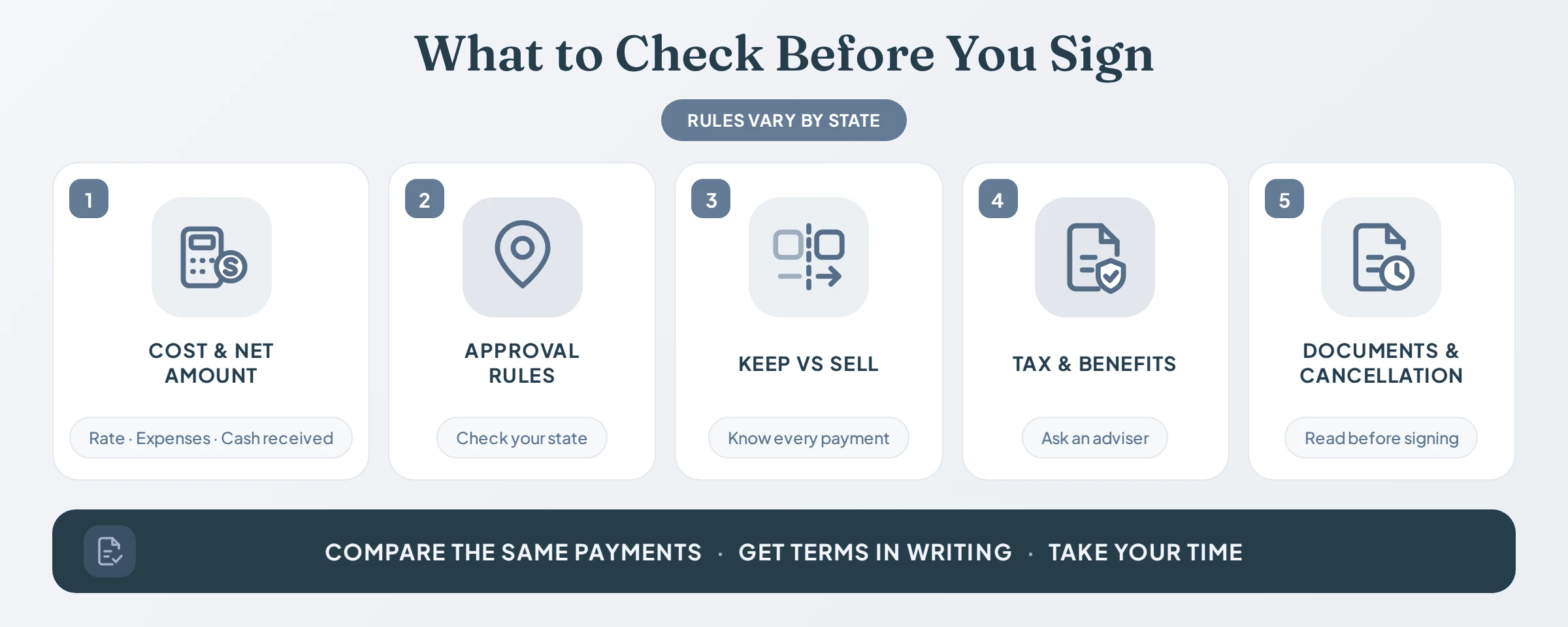
What to Look at Before You Sign
Compare the Discount Rate and Net Amount
There is no universal “good” discount rate. The result depends on which payments you sell, when they are due, and how the offer is calculated. Ask for the discount rate, an itemized list of transfer expenses, the gross advance amount, and the net amount you will receive. Compare offers for the exact same payment schedule.
Approval Rules Depend on the State and Settlement Type
Do not assume a judge must approve every transaction in every state. The rules vary. In Kansas, a covered transfer needs advance approval from a court or responsible administrative authority, with findings that include the payee’s best interests and dependents’ welfare.
Kansas law also requires a disclosure statement at least three days before signing and provides a cancellation period through the third business day after signing. Kansas’s Structured Settlement Protection Act excludes workers’ compensation settlements and awards. Check which law applies to your settlement.
Selling Part May Be Possible, But It is not Automatic
Some buyers offer partial transfers. What you can sell depends on your settlement documents, state law, and the payer’s obligations. In Kansas, an annuity issuer or obligor cannot be required to split one periodic payment between you and a transferee. Confirm exactly which payments you would keep and give up.
Check Tax and Benefits Consequences
Under Internal Revenue Code §104(a)(2), qualifying damages received because of personal physical injury or physical sickness are generally excluded from federal income, with exceptions such as punitive damages.
Other claims can be taxed differently. IRC §5891 also sets a 40% excise tax on the factoring discount for certain transactions; it generally applies to the acquirer, and a qualified court order matters to the exception. Ask a tax professional to review your settlement and proposed transfer.
If you receive SSI or other means-tested benefits, talk with a benefits adviser before receiving a lump sum. The effect depends on your circumstances and program rules.
Read the Paperwork and Take Your Time
Ask for the disclosure statement, transfer agreement, itemized costs, cancellation terms, and a written timeline. Get independent legal, tax, or financial advice if a term is unclear. Be wary of pressure to sign before you understand which future payments you are giving up.
The Bottom Line
MySettlement is our top pick for its experience, attorney connections, broad settlement support, and guidance through the transfer process. District Settlement Finance, Payment Stream Group, JG Wentworth, and LJC Solutions are also options worth comparing, depending on service model and company scale.
Get written quotes for the same payments. Then compare the net amount, costs, approval steps, and future income you’ll lose. The best-looking headline offer is only useful if you understand what it costs and what you’re giving up.
This article is general information, not legal, tax, or financial advice. State laws and individual settlement documents matter.
Sources and Company Information
- Kansas Structured Settlement Protection Act: K.S.A. 40-461–40-467
- Kansas K.S.A. 40-462: disclosures
- Kansas K.S.A. 40-463: transfer approval
- Kansas K.S.A. 40-464: annuity issuer and obligor rules
- Kansas K.S.A. 40-465: application procedure
- Kansas K.S.A. 40-467: workers’ compensation exclusion
- IRS: Tax implications of settlements and judgments
- IRS Instructions for Form 8876
Your settlement has a number. Let's make it work for you.
Get a free, no obligation quote from a specialist who actually knows what your payments are worth.