
- Structured Settlements
- What are Structured Settlements
- Best Structured Settlement Buyers
- How Selling Works
- Eligible Cases
- Eligibility Criteria
- Structured Settlement Regulations
- J&J Settlement
- Maui Wildfire Settlement
- Types of Structured Settlements
- Guaranteed Structured Settlements
- Increasing Structured Settlements
- Deferred Structured Settlements
- Life-Contingent Structured Settlements
- Future Lump Sum Settlements
- Annuities
- What Is An Annuity
- Guide to Selling an Annuity
- Income Annuities
- How Are Annuities Taxed?
- 7 Common Annuity Mistakes & How to Avoid Them
- Annuity Beneficiaries
- Types of Annuities
- Fixed Annuities
- Fixed Index Annuities
- Variable Annuities
- Immediate Annuities
- Deferred Annuities
- Registered Index-Linked Annuity
- Pre-Settlement Funding
- What is Pre-Settlement Funding
- How Pre-Settlement Funding Works
- Eligible Cases for Pre-Settlement Funding
- Pre-Settlement Funding Criteria
- Pre-Settlement Funding Regulations
- Types of Pre-Settlement Funding
- Non-Recourse Cash Advances
- Structured Pre-Settlement Funding
- One-Time Lump Sum Cash Advances
- Compounding Interest Funding
- Flat-Fee Structured Funding
- Structured Settlement Calculator



One specialist stays with you from your first call through funding.

November, 2026
A registered index-linked annuity, or RILA, is an insurance contract whose returns follow an index-based formula. It offers a chosen level of protection against index losses, usually in exchange for limits on potential gains. Your account can still lose money.
The tricky part is the timing. A protection level that applies when a term ends can tell you very little about the cash available halfway through it.
RILA sales reached $79.5 billion in 2025, up 20% from the previous year, according to LIMRA’s annual sales report. Those figures measure purchases, not investment performance. Before committing money, you’ll want three answers: How much can I earn, how much can I lose, and what happens if I need cash early?
How a RILA Actually Works
You pay a premium to an insurance company and select an available strategy. That strategy specifies an index, a measurement period, a crediting formula, and loss protection. The measurement period might last one, three, or six years, depending on the contract.
At the term’s end, the insurer calculates your credit using those rules. A positive credit increases the allocated balance; a negative credit reduces it. Some contracts also offer fixed or variable investment options alongside their indexed strategies.
The SEC identifies RILAs as securities, so they carry securities disclosures as well as insurance contract terms. You may also see the names buffered annuity, structured annuity, or index-linked variable annuity.
That “structured” label can cause confusion. A RILA purchased for retirement is a different arrangement from a structured settlement arising from a legal claim. Our guide to how annuities work covers the broader contract basics.
Buffers and Floors Work Differently
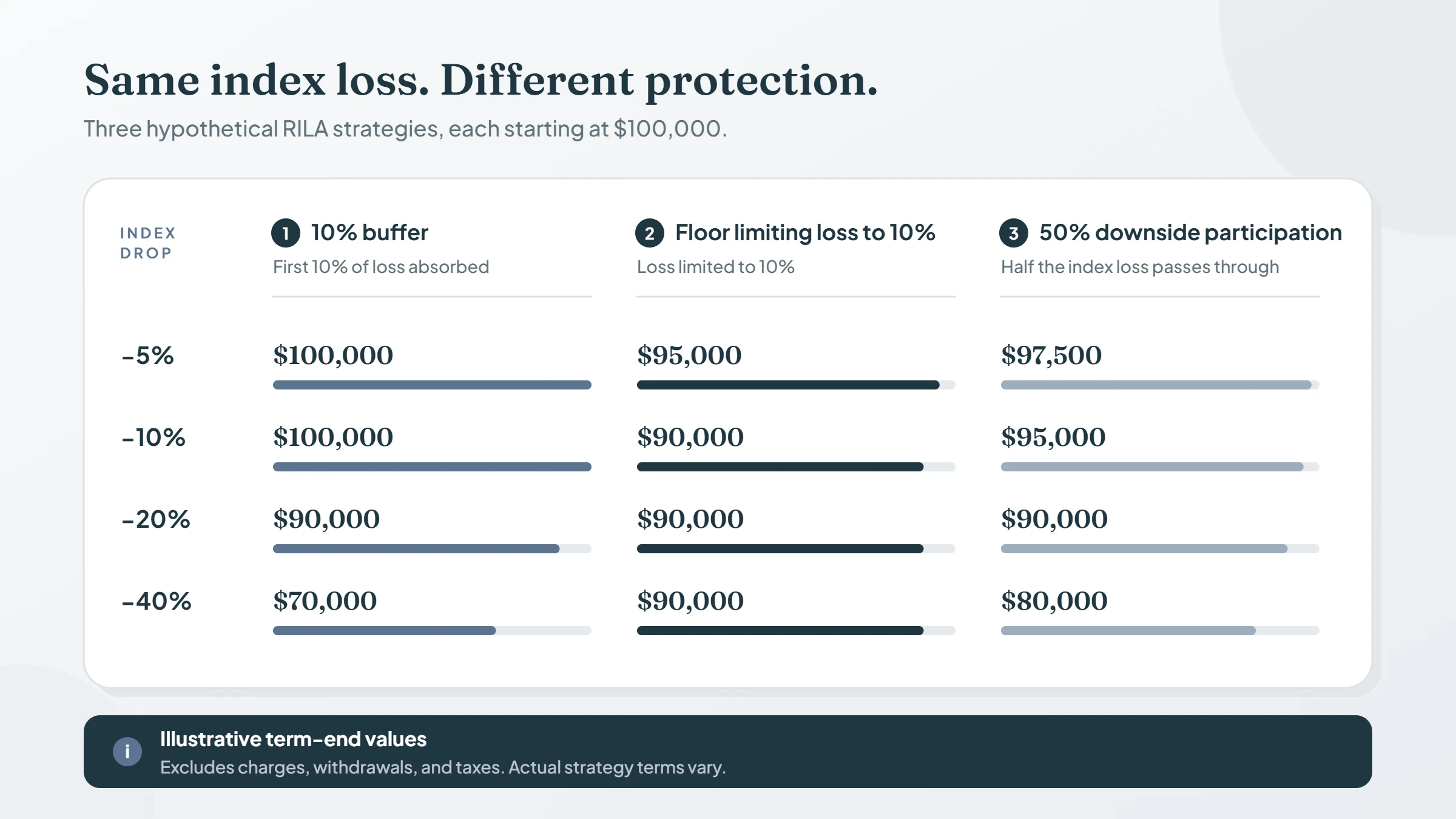
A buffer absorbs an initial band of index loss. A floor limits how much index loss your allocation takes during the specified term. They can produce very different results during a modest decline.
A Buffer Absorbs Initial Losses
A basic 10% buffer absorbs the first 10 percentage points of a decline at term end. An index drop of 5% produces a 0% index credit. A drop of 25% produces a 15% loss.
Think of the buffer as the first layer of protection. Losses beyond that layer reach your allocation.
A Floor Limits Term Losses
A floor limiting index losses to 10%, sometimes displayed as a −10% floor, works differently. An index drop of 5% produces a 5% loss. A drop of 25% produces a 10% loss.
You absorb smaller declines, but the floor limits larger ones under that term’s formula.
Downside Participation Shares the Loss
Some strategies apply a downside participation rate. A 50% rate passes through half the index loss: a 30% decline produces a 15% negative credit. The SEC’s RILA disclosure rules recognize this method alongside buffers and floors.
These hypothetical results start with $100,000, assume the allocation stays through term end, and exclude withdrawals, charges, and taxes. Availability varies by contract.
| Index change | 10% buffer | Floor limiting loss to 10% | 50% downside participation |
|---|---|---|---|
| −5% | $100,000 | $95,000 | $97,500 |
| −10% | $100,000 | $90,000 | $95,000 |
| −20% | $90,000 | $90,000 | $90,000 |
| −40% | $70,000 | $90,000 | $80,000 |
How Your Gains Are Calculated
The index’s return and your credited return are two different numbers. Your strategy connects them through a formula.
Common features include:
- Cap: The maximum positive credit for the specified period. An 8% cap turns a 12% index gain into an 8% credit under a basic capped formula.
- Upside participation rate: The share of a positive index return used in the calculation. A 75% rate applied to an 8% gain gives 6%, before any other applicable limits. Some rates exceed 100%.
- Step rate: A stated credit when specified conditions are met. The trigger matters as much as the advertised rate.
- Spread: An amount subtracted in strategies that use this feature. Read its position in the calculation.
Check the Period Behind the Percentage
A 60% cap over six years is a total-period limit. Reaching that cap would equal approximately 8.15% annualized growth before deductions, assuming an unchanged investment. It does not promise either return.
Measurement dates matter, too. A start-to-end calculation can differ sharply from a headline about the market’s decline from its highest point.
Check Which Index Version Applies
You own an insurance contract, not the stocks in its reference index. Many strategies use price indexes that exclude dividends. Other indexes may incorporate volatility controls, deductions, or different return calculations.
New York’s insurance regulator explains that omitted dividends can reduce the index performance used for crediting. A stock-market return chart therefore needs more scrutiny before you use it to judge an annuity illustration. Back-tested index results are also different from actual contract returns.
Read the Renewal and Lock Rules
Caps and other terms may change at renewal within the contract’s guarantees. Check your election deadline and the default allocation if you take no action.
Some contracts offer a performance lock that captures a strategy’s current calculated value. It can capture a loss, end further index participation, and affect your next allocation date. Locking one term’s value does not permanently protect that money in future terms.
Earlier Gains Can Still Decline
A credited gain becomes part of your balance, which can face losses in a later term.
Take $100,000 that earns 8% in its first year. It grows to $108,000. During the next one-year term, a 25% index decline combined with a 10% buffer produces a 15% negative credit. The balance falls to $91,800, before other deductions.
Recovery can also be slower than the index’s rebound. The example below uses two one-year terms, a 10% buffer, and an 8% cap. It excludes charges, taxes, and withdrawals.
| Point in time | Index level | RILA balance |
|---|---|---|
| Starting point | 100 | $100,000 |
| After a 30% index decline | 70 | $80,000 |
| After a 42.86% index rebound | 100 | $86,400 |
Taking Cash Out Before Term End
This is where a simple buffer example stops being enough. A mid-term withdrawal can involve a different valuation formula, a surrender charge, and taxes.
Two Timelines Can Overlap
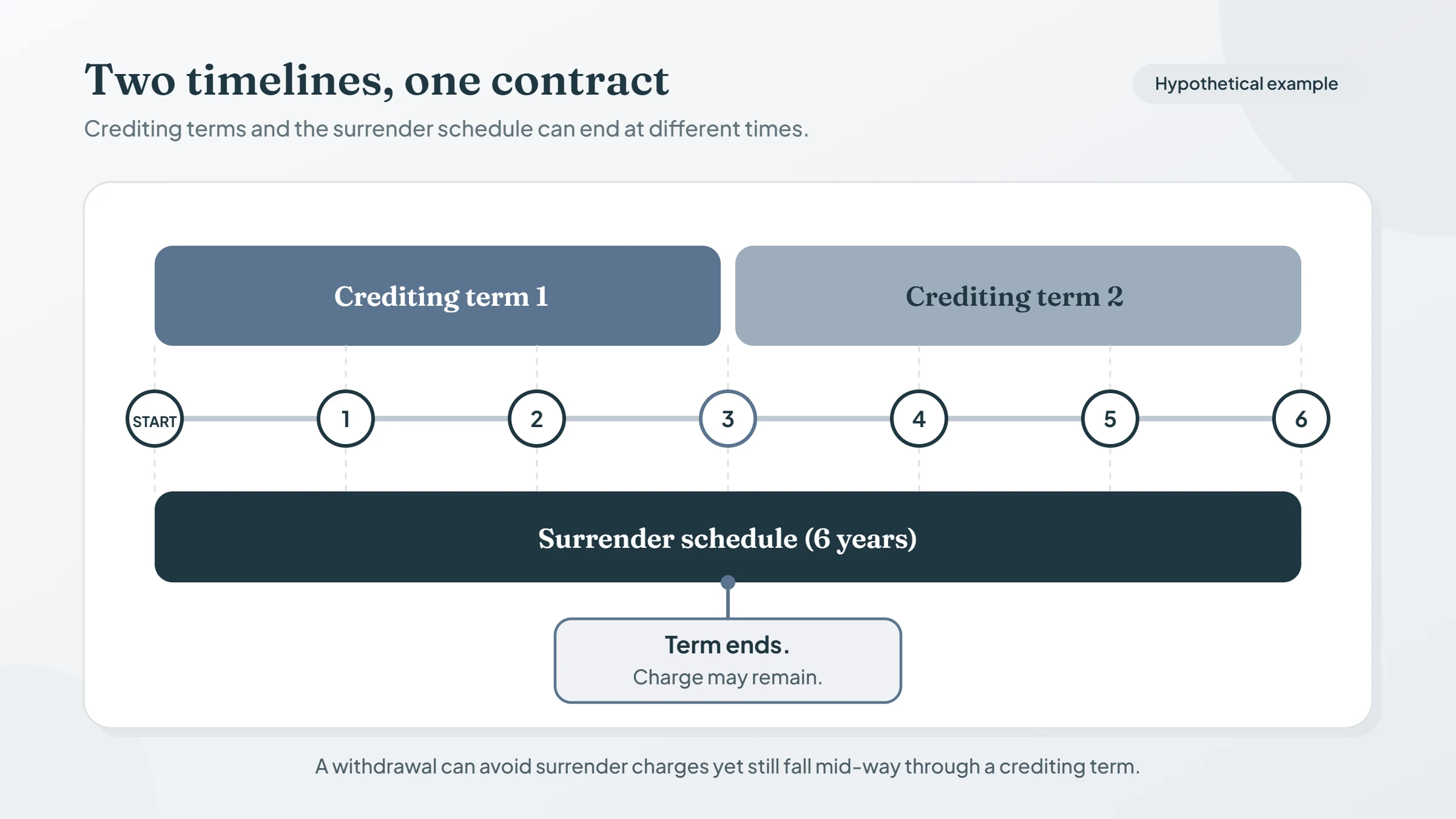
The crediting term determines when your strategy’s final return is calculated. The surrender schedule determines how long specified withdrawals may carry a surrender charge.
A hypothetical contract could have three-year crediting terms inside a six-year surrender schedule. The first strategy ends at year three, while surrender charges may still apply. Later, a withdrawal may escape surrender charges but still occur halfway through another strategy.
Your Cash Value Can Change Daily
An interim value adjustment, or IVA, helps determine the value available during a term. Its calculation can reflect index changes, interest rates, time remaining, and other contract-specific factors. Some contracts also apply a separate market value adjustment, or MVA.
FINRA’s 2026 annuity oversight report highlights the importance of explaining these adjustments. An early withdrawal can lose more than the term-end protection suggests, even when the index has risen.
Ask the insurer for a dated cash-surrender quote showing each deduction. Also ask which adjustments are already included in the quoted value so you avoid counting them twice.
Free Withdrawals Still Have Conditions
A “free withdrawal” provision generally waives a specified surrender charge within its limits. Valuation adjustments, taxes, and reductions to benefits may still apply.
Some contracts reduce the remaining crediting base proportionally. An $8,000 withdrawal from an $80,000 interim value removes 10%. Under a proportional formula, a $100,000 calculation base would also shrink by 10%, to $90,000.
That $10,000 base reduction is a change to a calculation figure, not an extra $10,000 cash charge. Carlton Fields’ analysis of RILA disclosures explains why proportional formulas deserve attention. Ask how your withdrawal changes future credits, income benefits, and death benefits.
What You Pay and Receive
RILA costs vary. Some contracts have no separate annual base charge; others include contract, strategy, rider, or advisory charges. Optional variable investment choices may bring their own expenses.
Growth limits also carry an economic cost. An 8% cap during a 15% index gain leaves part of that gain outside your credit. The SEC’s Form N-4 disclosure framework describes limits on index gains as an implicit ongoing fee, distinct from money deducted through a separate annual charge.
Ask how the seller is paid and request total costs in dollars for your planned premium. A 5% return assumption in a fee illustration is a calculation input, not an expected return.
Income and beneficiary features deserve their own check:
- Annuitization converts value into a payment arrangement, potentially including lifetime income.
- A withdrawal-benefit rider may support lifetime withdrawals under specified conditions, often for a fee. Its payout percentage is different from an investment return.
- An income benefit base can differ from the cash available to withdraw.
- A death benefit depends on the contract’s triggers, valuation date, and withdrawal rules. Ask whose death triggers payment and what beneficiaries receive.
RILAs and Other Annuity Choices
The comparison below describes the core return structures. Withdrawals, fees, optional benefits, and insurer obligations add separate considerations.
| Annuity type | How growth works | Main market-risk distinction |
|---|---|---|
| Fixed-rate | Insurer credits a stated rate for a specified period | Interest follows the insurer’s stated-rate guarantee |
| Fixed indexed | Contract calculates interest using an index-linked formula | Negative index performance generally produces no negative index credit; deductions can still reduce value |
| RILA | Formula can produce positive or negative index credits | Selected protection limits certain losses at specified times |
| Variable | Value reflects selected investment options and expenses | Investment losses generally reach the account; optional guarantees have separate conditions |
Comparing RILAs With Buffer ETFs
Defined-outcome, or buffer, ETFs also offer a specified pattern of gains and losses over an outcome period. They are exchange-traded funds, with different tax, trading, expense, and insurance features.
FINRA explains that purchase and sale timing can change the advertised outcome. Buying midway through an ETF’s outcome period may give you a different remaining buffer and upside potential. Compare the actual holding dates and costs, alongside any income features you need.
Taxes and Rules Worth Knowing
A personally owned, nonqualified RILA generally allows earnings to grow tax-deferred. During accumulation, partial withdrawals generally take taxable earnings out first; those earnings usually face ordinary income tax. Your after-tax investment is treated separately. Annuitized payments follow different allocation rules, covered in IRS Publication 575.
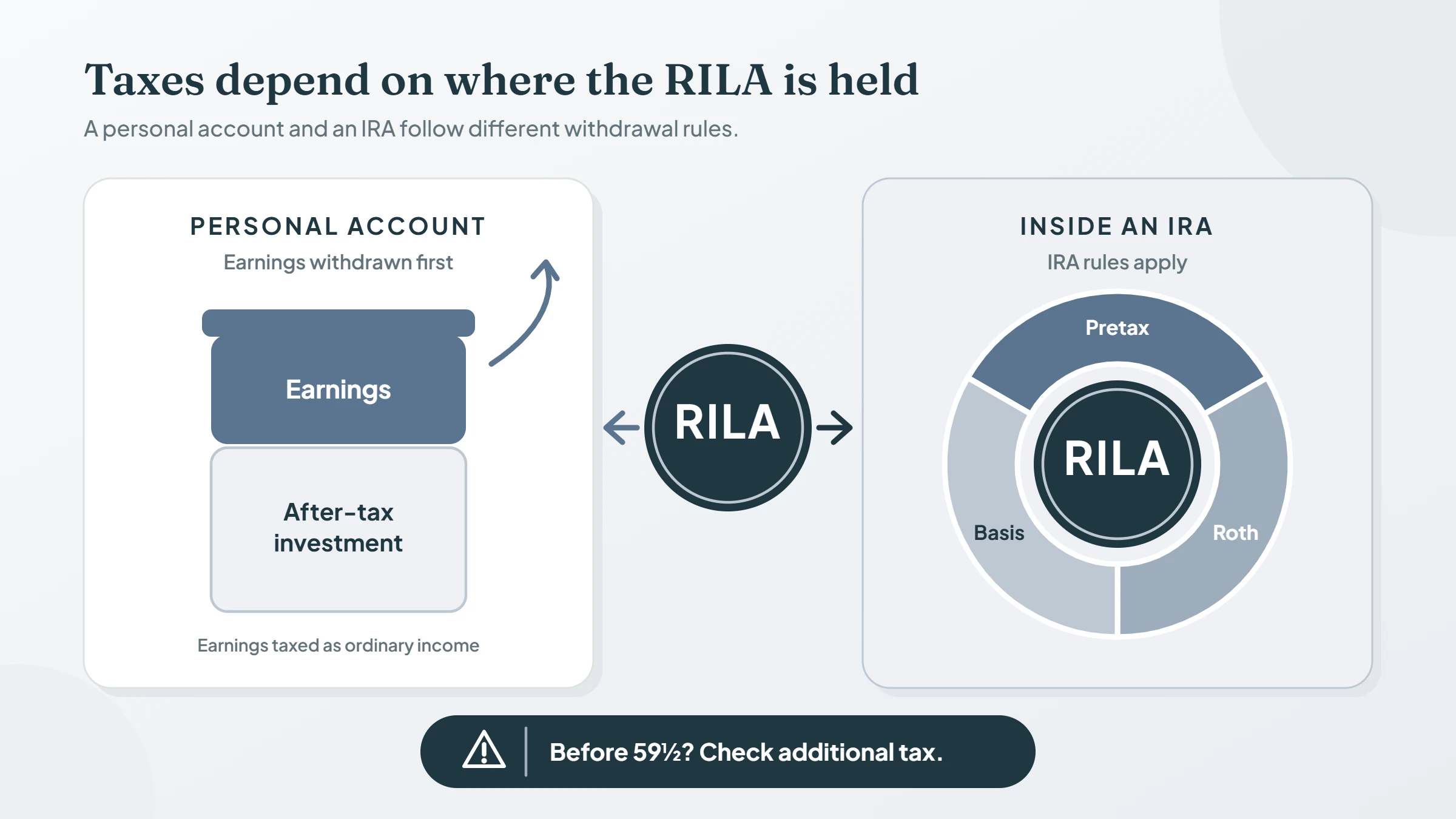
An IRA already provides its own tax treatment. Adding an annuity creates no extra layer of tax deferral. Pretax balances, after-tax basis, and Roth distributions require different treatment.
Other rules can affect the amount you keep:
- Early distributions: A 10% additional federal tax may apply to the taxable portion before age 59½ unless an exception applies. This is separate from insurer charges.
- Required minimum distributions: Applicable retirement accounts can require distributions. Check how that obligation interacts with your strategy dates and withdrawal rules.
- Exchanges: A qualifying Section 1035 exchange may defer recognition of gain, but surrender charges, lost benefits, and a new surrender schedule still need review. The IRS distinguishes qualifying direct exchanges from receiving cash and buying another contract in Revenue Ruling 2007-24.
RILAs are subject to securities and state insurance requirements. Broker-dealer recommendations fall under Regulation Best Interest. Registration is no government endorsement, and a RILA is not FDIC-insured. Insurance guarantees depend on the insurer’s ability to meet its obligations.
Why Someone Might Choose a RILA
The appeal is a specific compromise: accept limits on growth in exchange for a defined way of handling index losses. A smaller decline might leave a buffered allocation unchanged at term end, while a floor strategy can place a clearer boundary on a larger decline.
Tax deferral may also help someone investing after-tax money for a long holding period. Available income options can address another retirement concern: turning savings into payments. Each benefit needs to justify the contract’s charges, restrictions, and remaining risk.
Consider how the purchase fits your other savings. A contract can meet its stated terms and still leave you short of accessible cash. Keeping emergency funds elsewhere helps avoid a forced mid-term withdrawal, but it does not remove investment or insurer risk inside the RILA.
Questions Before You Commit Money
A RILA may suit money you can leave invested through the relevant periods, provided you can absorb its potential losses. Cash needed for near-term bills deserves separate planning.
Request written answers to these questions:
- Which index version and measurement dates apply?
- How do my allocation’s gains and losses work in dollars?
- What can change at renewal, and what happens if I miss the election window?
- What would I receive if I withdrew after one year or halfway through the term?
- Which charges, adjustments, and benefit reductions apply?
- How does a withdrawal change my remaining calculation base?
- What income and death benefits am I paying for?
- What is my cancellation deadline, and how is that refund calculated?
Free-look cancellation rights vary by state and contract. Check the refund formula as carefully as the deadline. Also compare any existing annuity’s benefits before replacing it.
What If You Need a Lump Sum?
Start with the insurer’s withdrawal and surrender options. Selling payment rights to a third party is a separate transaction, and a RILA may restrict transfers or assignments. IRA annuities have additional ownership restrictions.
MySettlement purchases eligible annuity payment rights. You can discuss your payment arrangement through our annuity purchasing service, but a RILA’s eligibility requires confirmation. Keep the contract and a current insurer quote available so you can compare the cash available under each permitted option.
Common Questions About RILA Annuities
Can a RILA Lose Money?
Yes. Negative index credits can reduce your allocation. Early withdrawals and charges can also reduce what you receive. Some strategies offer full protection against index losses at term end, but that protection has specific conditions.
Is a RILA a Structured Settlement?
No. “Structured annuity” is an alternative label used for some RILAs. A structured settlement comes from resolving a legal claim and follows a different legal arrangement.
Are RILA Minimums Always the Same?
Minimum premiums vary by contract and distribution channel. Check the actual application requirements. A minimum advertised by one provider does not apply across the market.
Does Protection Reset After Each Term?
Protection applies under each selected term’s rules. Repeated losses can accumulate: two consecutive 10% losses reduce $100,000 to $81,000 before other deductions. Review the next term’s terms before renewing.