



One specialist stays with you from your first call through funding.

October, 2026
A $50,000 settlement payment due in 2036 can help pay for a major expense that year. But what if you need the money in 2030? What happens if you die before it arrives? And does a payment described as “college money” still arrive if your plans change?
Those answers come from your payment schedule and the conditions attached to it. The dollar amount tells only part of the story.
Future lump sum structured settlement payments are amounts scheduled for specific dates after a settlement. Your agreement might provide one large payment, several payments years apart, or larger sums alongside monthly income. Each payment can carry its own conditions, including a requirement that a named person is alive when it becomes due.
What Does a Future Lump Sum Mean?
A deferred annuity usually has an accumulation phase, when you hold money in the contract before taking income. Its value changes based on the contract’s interest credits, investments, fees, and withdrawals.
Later, you may annuitize: convert the value into a payment arrangement. That choice is generally permanent. Some contracts also allow withdrawals or offer an optional income rider, an added benefit with its own conditions and possible charge.
The people named in the contract also matter:
- Owner: holds the contractual rights.
- Annuitant: the person whose life helps determine benefits.
- Beneficiary: may receive benefits after a death.
The same person can fill more than one role. Someone receiving structured settlement payments may hold payment rights but not own the annuity funding them.
What is your annuity worth?
A structured settlement can spread compensation across dates agreed when the case settles. A future lump sum is one larger payment within that arrangement. The Society of Actuaries’ benefit definitions recognize both single future lump sums and a series of them.
You might also see “deferred lump sum” or “balloon payment.” Here, balloon means a larger payout coming to you; it does not mean a debt you owe.
The phrase “lump sum” also appears in discussions about taking cash upfront or selling future payments. Those transactions create different rights and different decisions.
| Term | What it means | When money arrives |
|---|---|---|
| Upfront settlement cash | Cash paid as part of resolving the original claim | Following settlement and required processing |
| Scheduled future lump sum | A payment already specified in your settlement schedule | On its agreed date, subject to its conditions |
| Payment sale proceeds | Cash received for transferring specified future payment rights | After an eligible transfer is approved and completed |
| Contractual commutation | Conversion of future payments to cash under an existing contract provision | When the provision’s event and requirements are met |
How Can the Payments Be Arranged?
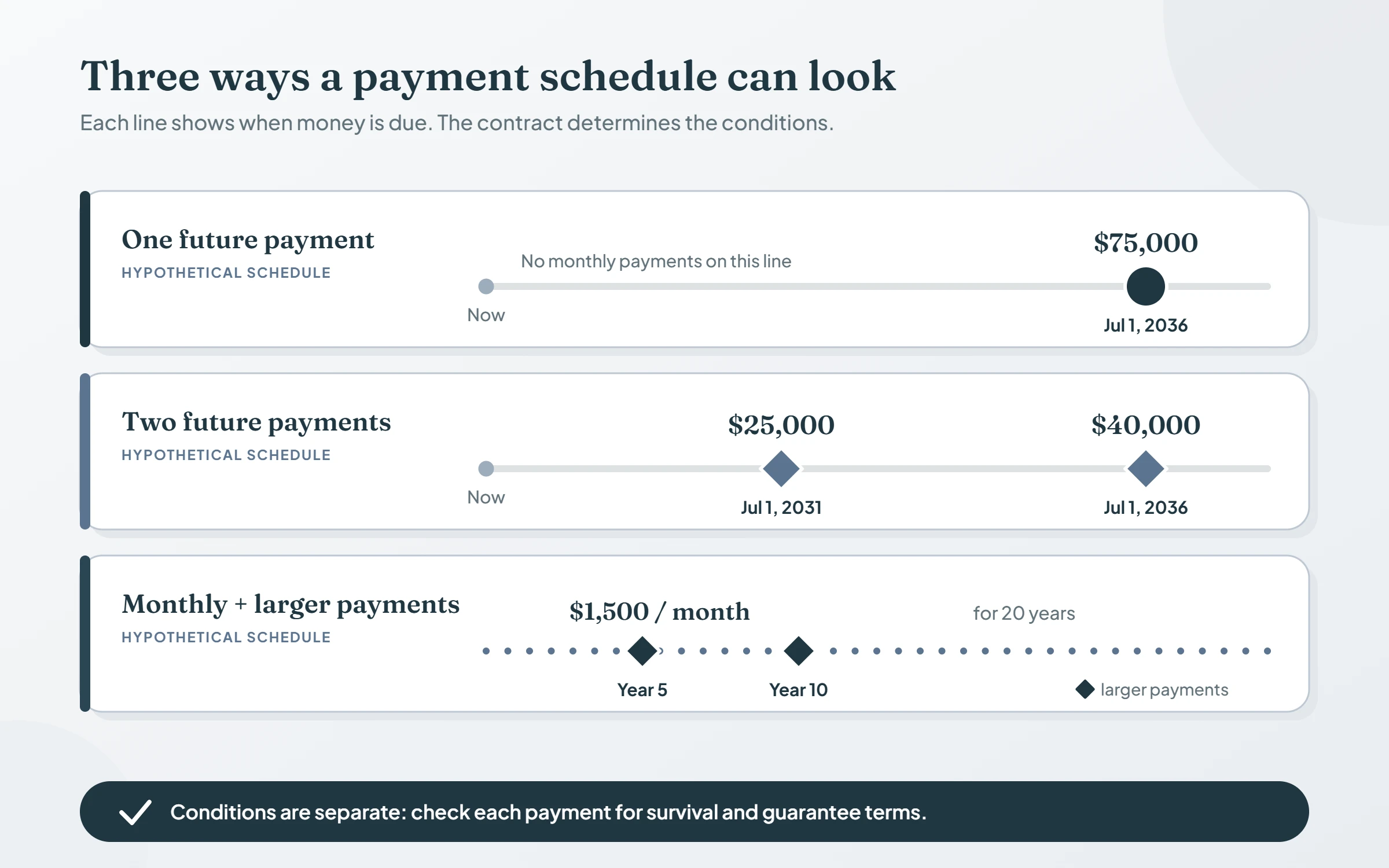
Three schedules help explain the choices. These examples illustrate payment patterns, not insurer quotes or recommendations.
One Payment on a Future Date
Your settlement might include $75,000 payable on July 1, 2036. That amount is due on a single date, subject to the agreement’s terms. It does not provide monthly income during the years leading up to it.
Several Payments Across Different Years
A schedule could provide $25,000 on July 1, 2031, followed by $40,000 on July 1, 2036. Each is a separate scheduled benefit. Check the amount, date and survival condition for each entry.
Monthly Income Plus Larger Payments
Another arrangement could combine $1,500 per month for 20 years with larger payments in years 5 and 10. Monthly payments might cover recurring bills, while the larger sums help with planned expenses.
The conditions do not have to match across the entire arrangement. Monthly income might depend on survival while a particular lump sum is guaranteed. Read each component separately before making decisions about the whole settlement.
Why Schedule Money for Later?
Some expenses arrive every month. Others come years apart. A settlement schedule can account for both when the arrangement is first negotiated.
Possible reasons for choosing future lump sums include:
- Education: Tuition, training or living costs expected at particular ages.
- Housing: A planned move, down payment or accessibility work.
- Medical needs: Anticipated equipment replacement or treatment costs.
- Later financial support: Additional money during a planned transition, such as retirement.
Plans can also combine immediate cash and future payments. In MetLife’s 2025 Personal Injury Settlement Study, 34% of respondents chose a combination of cash and annuity payments. The insurer-sponsored survey covered 503 U.S. adults who received, or were guardians of someone receiving, a qualifying settlement of at least $25,000 and had a payout choice.
That figure describes the survey sample. It does not tell us how many recipients nationwide have scheduled future lump sums.
The practical limitation is timing. An expense can arrive early, cost more than expected or disappear entirely. A fixed payment date does not automatically change along with your plans.
Check What Your Documents Actually Promise
Start with the settlement agreement, benefit schedule and any relevant court orders. Ask the issuing insurer for current payment information if your records are incomplete. New York Life, for example, provides benefit letters describing payment amounts and dates.
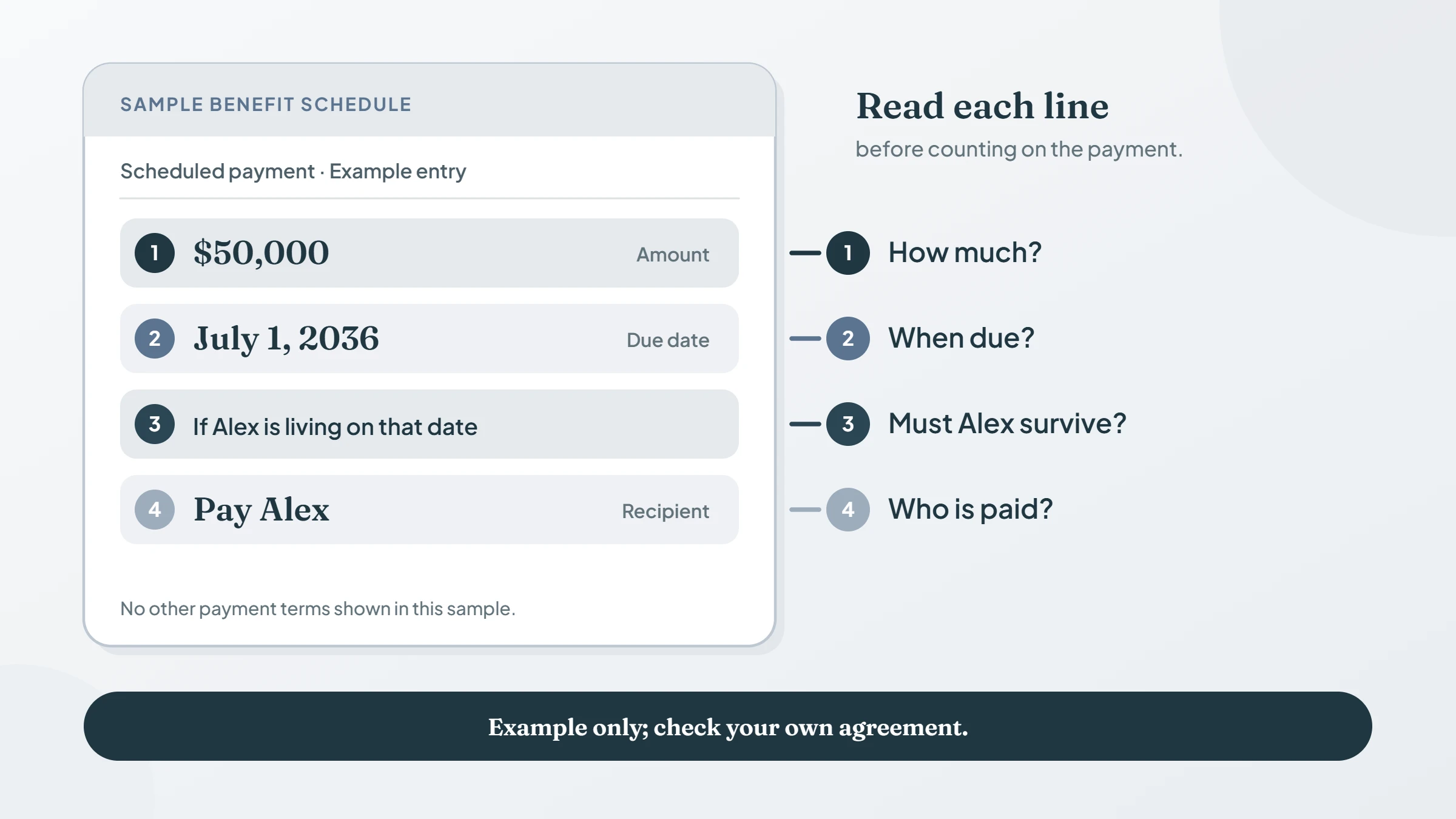
Check these details before treating a future amount as money you can count on:
- Exact due date: “At age 25” needs to match the actual contractual date.
- Payment amount: Confirm the specific sum, including any scheduled increase.
- Survival condition: Does a named person have to be alive on the due date?
- Recipient: Is payment directed to you, a trust or someone else?
- Beneficiary terms: Who receives an eligible payment after death?
- Previous transfers: Have any rights to that payment already been sold?
Also distinguish the payment’s purpose from its contractual conditions. A payment planned for college does not automatically require college enrollment. Equally, changing your education plans does not automatically move the due date.
Your actual documents determine whether spending restrictions or other conditions apply. A label such as “education payment” in an informal summary cannot answer those questions on its own.
If you inherited payment rights or previously sold part of the settlement, an old schedule may not show your current entitlement. Request confirmation of the remaining payments before budgeting around them. Keep that confirmation with any transfer order or beneficiary paperwork so the amounts and recipients can be checked together.
Now you know the number. Ready to act on it?
Most buyers won’t tell you what your settlement is actually worth. Now you know. Let’s get you a real offer.
What Happens If You Die First?
The key distinction is guaranteed versus life contingent. A date on the schedule does not establish which one applies.
A guaranteed, or certain, payment remains due under its terms even if the person whose life is relevant dies before that date. Eligible remaining benefits go to the beneficiary or other recipient specified under the documents and applicable rules. Claims paperwork may be required.
A life-contingent payment requires the specified person to be alive when it is due. If that person dies first, that benefit may end. Naming a beneficiary does not remove the survival condition.
Also check for a commutation provision. Some contracts allow specified remaining benefits to be converted into a lump sum after death. Such a provision has its own terms; beneficiaries should not assume it exists or that the cash amount equals the sum of all remaining scheduled dollars.
Can You Get the Money Earlier?
You generally cannot call the insurer and ask it to move a scheduled payment forward simply because your circumstances changed. IRC § 130(c)(2) requires payments under a qualified assignment to be fixed and determinable and prevents the recipient from unilaterally accelerating, delaying, increasing or decreasing them.
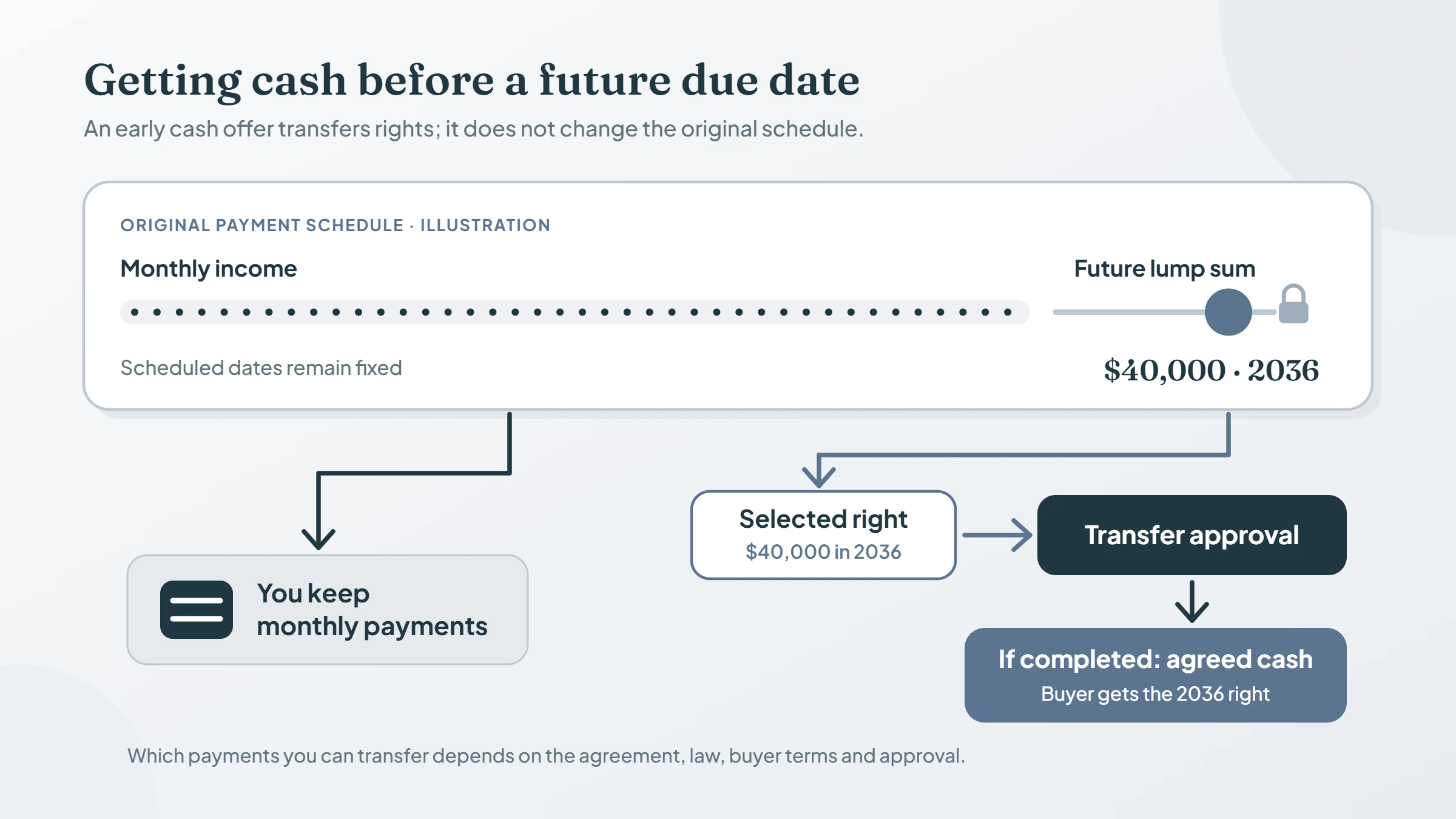
A later sale of payment rights is a separate transaction. A purchaser pays you an agreed-upon amount now and receives the specified future payment rights upon completion of the transfer.
Any existing contractual option also needs its own review. A death-related commutation clause, for example, is not a general cash-withdrawal feature available whenever the recipient needs money.
Can You Sell Just One Payment?
An eligible partial sale may involve one future lump sum while leaving monthly payments and other future sums in place. The contract, applicable law, purchaser’s terms and required approval determine what can be transferred.
Say your schedule includes monthly payments and a separate $40,000 payment in 2036. A proposed sale might cover only that $40,000 payment. Read the transfer documents carefully: the rights being sold must match the transaction you intended.
Ask for a written list of payments you will retain. Also revisit the expense that the future lump sum was meant to cover. Keeping monthly income does not replace money earmarked for a later medical bill or home modification.
What Approval Does a Sale Need?
State Structured Settlement Protection Acts establish applicable transfer requirements, commonly including court approval. IRC § 5891 also imposes a 40% excise tax on an acquirer’s factoring discount, subject to an exception for advance approval in a qualified order.
That federal framework includes a finding that the transfer serves the payee’s best interests, taking into account the welfare and support of dependents. It recognizes certain responsible administrative authorities as well as courts. The 40% tax is not a routine charge deducted from the seller’s payment.
Your state and settlement determine the applicable process. An offer is not approval, and approval is not a promise that funds will arrive on a particular day.
What Is a Future Payment Worth Today?
A $100,000 payment ten years away is a right to future money. It is not a $100,000 bank balance you can withdraw today.
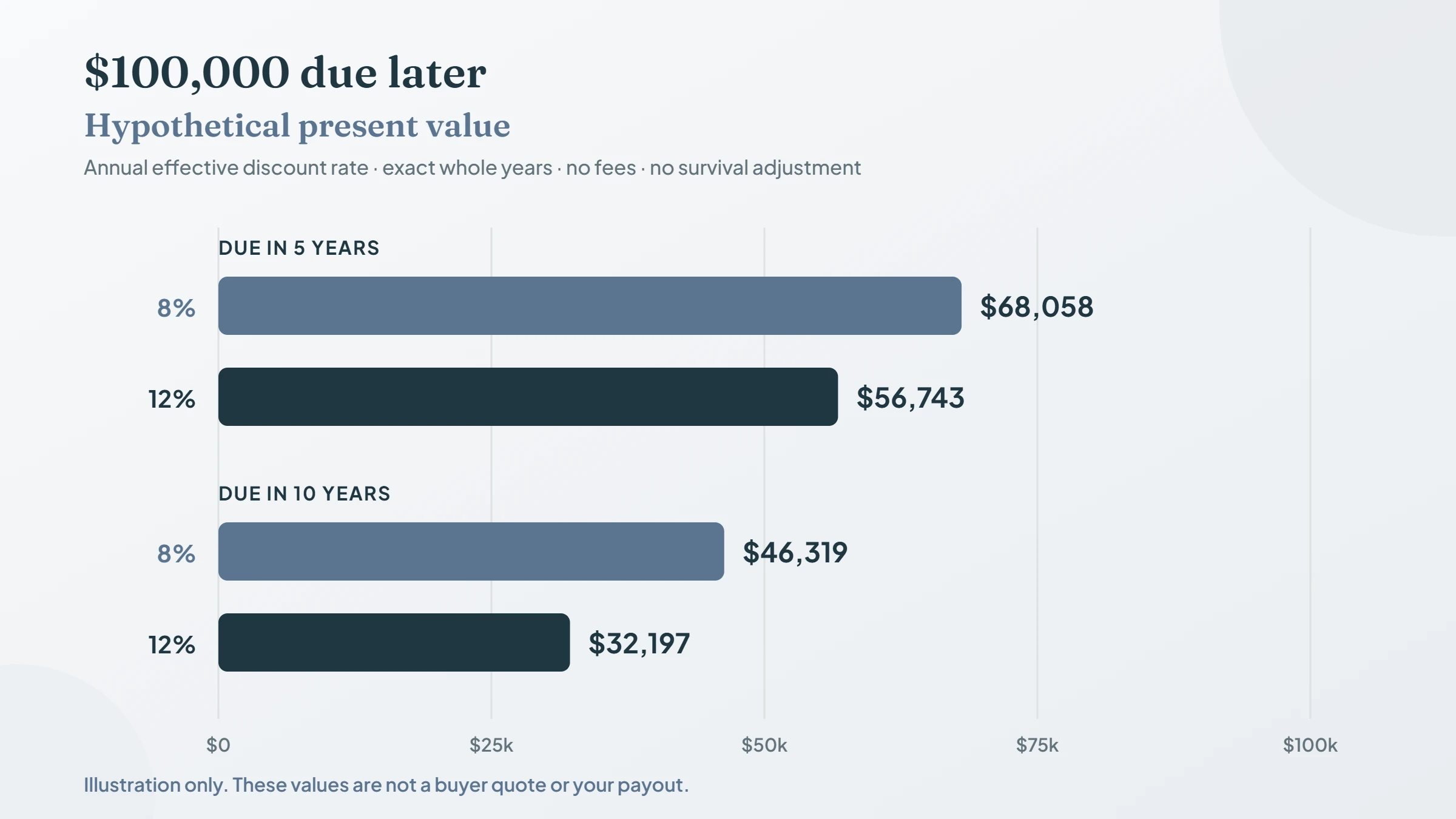
Present value converts a future amount into a current figure using stated assumptions. A purchaser’s quote also reflects its pricing, payment conditions, and any transaction costs. Your net offer is the cash you would actually receive after applicable deductions.
A simple annual-effective calculation for one certain payment is:
Present value = Future payment ÷ (1 + annual discount rate) ^ years remaining
The examples below use hypothetical 8% and 12% annual effective rates, exact whole years, no fees and no survival adjustment. Neither rate is presented as an industry standard or a predicted offer. Life-contingent payments need additional analysis.
| When $100,000 is due | Present value at 8% | Present value at 12% |
|---|---|---|
| In five years | $68,058 | $56,743 |
| In ten years | $46,319 | $32,197 |
Which Numbers Should You Compare?
A transaction disclosure can contain several values that serve different purposes. The total future dollars, a statutory present value and the cash offer are not interchangeable.
The original amount paid to fund the annuity is another separate figure. You cannot calculate that historical cost just by adding the future payments. A schedule promising $200,000 over time also does not mean the recipient has a $200,000 account available for withdrawal. The agreement creates rights to payments on specified terms.
New York’s disclosure law, for example, separates the present value calculated using a federal standard, the gross advance, the expenses, and the net advance. It also requires an annual discount rate compounded monthly. That disclosure convention differs from the annual-effective assumption used in our example.
Check the actual dollars alongside the rate:
- Which payment rights are being transferred?
- How much cash reaches you after fees?
- Which payments remain yours?
- What future expense will need another funding source?
The Consumer Financial Protection Bureau recommends reviewing costs, future income needs and independent advice before exchanging settlement payments for cash.
Does Waiting Protect You Against Inflation?
A fixed future payment does not automatically keep pace with prices. Receiving more dollars later also does not prove you will have more purchasing power.
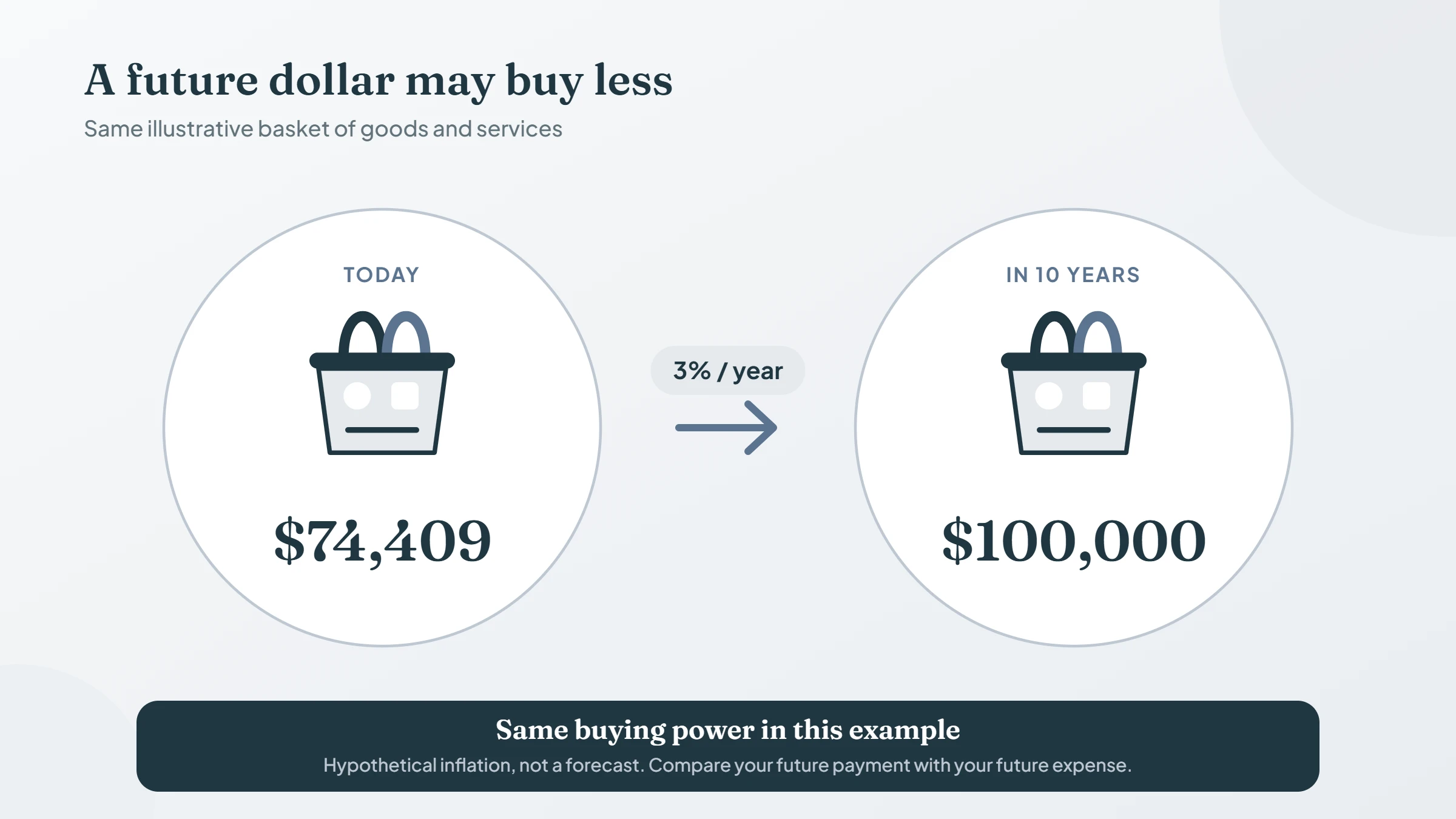
At a hypothetical average annual inflation rate of 3%, $100,000 received ten years later would buy roughly what $74,409 buys today. That 3% is an illustration, not a current inflation figure or forecast.
Check how the amount was chosen and whether increases are built into the arrangement. Even a fixed annual increase can differ from actual inflation. The Bureau of Labor Statistics explains purchasing power separately from the number of dollars you hold.
A useful planning check is to compare the future payment with the expense it is meant to meet. A $40,000 housing payment and a future housing bill are two different numbers. If the expected bill rises, identify how you would cover the gap; the settlement amount will follow its contractual terms.
Taxes and Benefits Need Separate Checks
Are Future Lump Sums Taxable?
IRC § 104(a)(2) generally excludes qualifying damages received on account of personal physical injuries or physical sickness from federal gross income. The rule covers lump sums and periodic payments.
The underlying damages matter. Punitive damages are generally taxable, and employment-related compensation may be treated differently. Previous deductions for medical expenses may also affect the result. Receiving money later does not turn an otherwise taxable award into tax-free compensation.
Could a Payment Affect SSI?
Federal income-tax treatment does not establish eligibility for Supplemental Security Income. Under SSA guidance on awards, countable amounts can be counted as income in the month received and as resources in the following month. Permitted deductions, exclusions and trust arrangements can change the analysis.
If you receive SSI or another means-tested benefit, arrange a benefits review before a scheduled payment arrives or you sell payment rights. Give the adviser the amount, date, recipient and relevant trust documents.
What About Payments Scheduled for Children?
A minor’s settlement can provide payments at different ages. Turning 18 does not automatically release every future annuity payment. A payment scheduled for age 25 generally follows that schedule, subject to its terms and applicable orders.
State procedures differ. North Carolina law, for example, permits qualifying protective transactions involving annuity contracts. That does not create a nationwide payout schedule for children.
Also distinguish an annuity payment from cash held by a court, guardian or custodial account. They can have different access rules. A parent should review the actual arrangement before assuming they can withdraw money or sell the child’s future rights.
Your settlement has a number. Let's make it work for you.
Get a free, no obligation quote from a specialist who actually knows what your payments are worth.
Questions About Future Lump Sum Payments
Is the Payment Automatically Guaranteed?
No. A scheduled future lump sum may be certain or life contingent. Check its specific survival condition, even if other payments in the same settlement are guaranteed.
Can I Change the Payment’s Purpose?
The reason a payment was originally planned does not, by itself, establish a spending restriction. Your agreement, court orders or trust terms may impose restrictions. Read those documents before using money for a different purpose.
Does a Calculator Show My Cash Offer?
A calculator supplies an estimate based on its inputs and assumptions. It cannot confirm ownership, transfer eligibility, survival conditions or transaction costs from an amount and date alone. Use the structured settlement calculator as a starting point for understanding present value.
Start With Your Next Payment
Find its amount, due date and conditions. Then check the payments you would keep and the future expenses you would still need to cover if you sold it.
Considering early access? Have your payment schedule ready when you contact MySettlement. Ask which rights a proposed transaction would cover and how much cash you would receive after applicable fees.