
- Structured Settlements
- What are Structured Settlements
- Best Structured Settlement Buyers
- How Selling Works
- Eligible Cases
- Eligibility Criteria
- Structured Settlement Regulations
- J&J Settlement
- Maui Wildfire Settlement
- Types of Structured Settlements
- Guaranteed Structured Settlements
- Increasing Structured Settlements
- Deferred Structured Settlements
- Life-Contingent Structured Settlements
- Future Lump Sum Settlements
- Annuities
- What Is An Annuity
- Guide to Selling an Annuity
- Income Annuities
- How Are Annuities Taxed?
- 7 Common Annuity Mistakes & How to Avoid Them
- Annuity Beneficiaries
- Types of Annuities
- Fixed Annuities
- Fixed Index Annuities
- Variable Annuities
- Immediate Annuities
- Deferred Annuities
- Registered Index-Linked Annuity
- Pre-Settlement Funding
- What is Pre-Settlement Funding
- How Pre-Settlement Funding Works
- Eligible Cases for Pre-Settlement Funding
- Pre-Settlement Funding Criteria
- Pre-Settlement Funding Regulations
- Types of Pre-Settlement Funding
- Non-Recourse Cash Advances
- Structured Pre-Settlement Funding
- One-Time Lump Sum Cash Advances
- Compounding Interest Funding
- Flat-Fee Structured Funding
- Structured Settlement Calculator



One specialist stays with you from your first call through funding.
November, 2026
An income annuity turns money you pay to an insurance company into a stream of scheduled payments. Those payments can begin soon or years later, and they may last for a set period or for life.
The idea sounds straightforward, but the choices you make can change how much you receive, what happens after your death, and how easily you can access money outside your payment schedule.
Here’s how income annuities work and what to look for before buying one—or considering a sale of payments you already receive.
What Is an Income Annuity?
An income annuity is a contract designed to provide regular income in exchange for one or more premium payments.
You might buy one as you approach retirement and want to cover part of your monthly expenses. You could also arrange for payments to begin later, when you expect to need additional income.
Some income annuities pay for a fixed number of years. Others continue for your lifetime or the lifetimes of two people. The schedule and amount depend on the contract and payout option you select.
According to LIMRA, Americans purchased $4.1 billion in single premium immediate annuities and $1.3 billion in deferred income annuities during the third quarter of 2026.
How Do Income Annuities Work?
The process begins when you pay a premium to an insurance company. In return, the insurer agrees to make payments according to the contract.
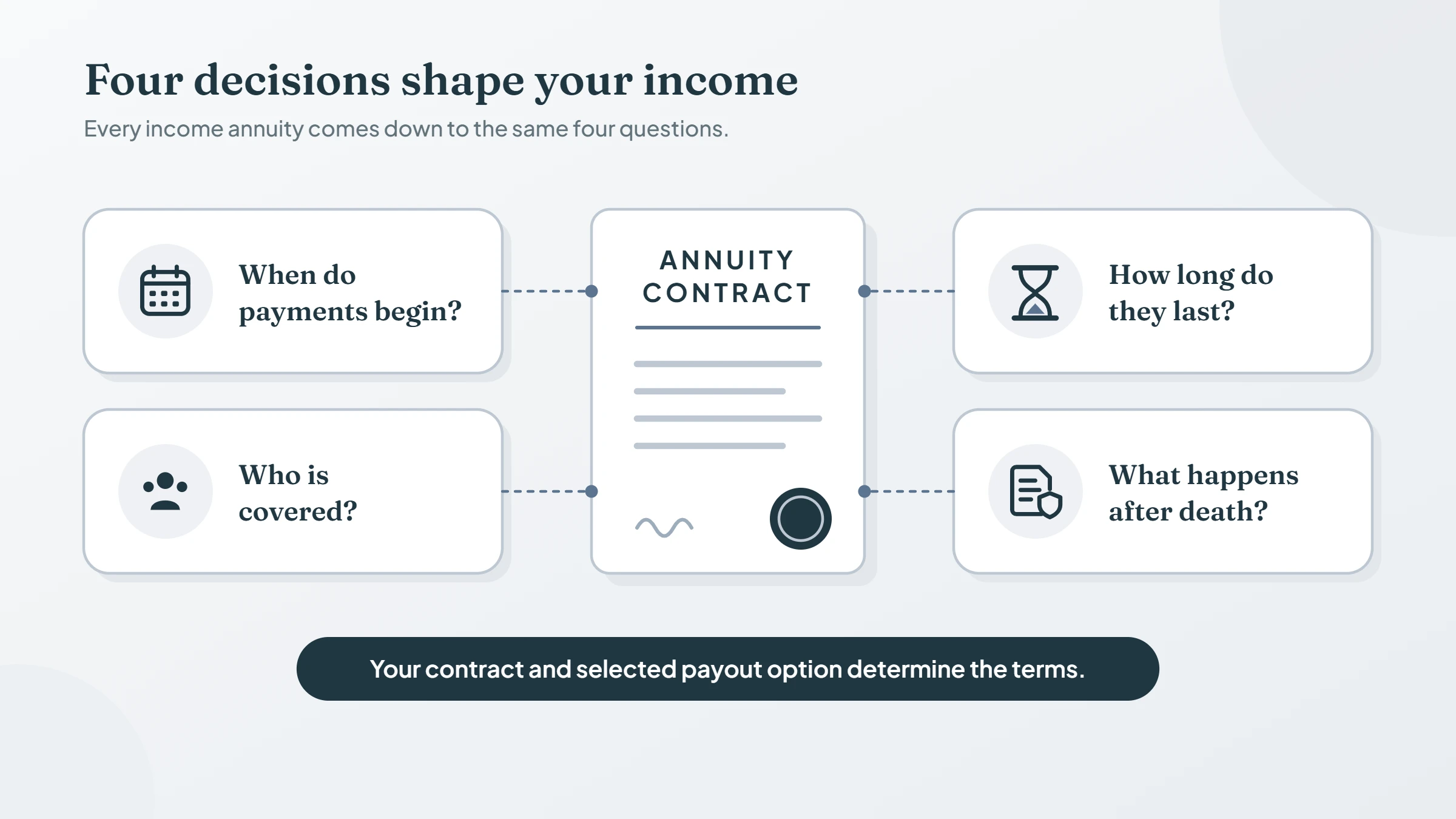
The main decisions generally include:
- When payments begin: Soon after purchase or at a future date.
- How long they last: A set number of years, your lifetime, or another available period.
- Who is covered: You alone or you and another person.
- What happens after death: The selected option determines if payments or another benefit can continue.
Payments may arrive monthly, quarterly, or on another schedule offered by the insurer.
A fixed income annuity generally provides payments established under the contract. Its guarantees depend on the issuing insurance company’s financial strength and ability to pay claims.
Is an Income Rider the Same Thing?
An income rider is an optional feature available on certain annuities. One example is a guaranteed lifetime withdrawal benefit, which can allow withdrawals up to a specified amount for life under the rider’s terms.
That arrangement differs from converting money into scheduled annuity payments. The rider can have its own fees, withdrawal limits and rules, so check your contract to understand which type of income you have.
Immediate vs. Deferred Income Annuities
The main difference is when your income starts.
| Feature | Immediate income annuity | Deferred income annuity |
|---|---|---|
| Payment start date | Generally within 12 months of purchase | More than a year after purchase |
| Premium | Usually one lump sum | One premium or, if permitted, multiple premiums |
| Purpose | Create income soon | Arrange income for a future date |
| Common name | Single premium immediate annuity, or SPIA | Deferred income annuity, or DIA |
Immediate Income Annuities
A single premium immediate annuity may appeal to someone who has a lump sum and wants income to begin soon.
Suppose you retire this year and want an additional monthly payment alongside Social Security. An immediate income annuity can be structured to start payments within the first year, subject to the insurer’s available options.
Deferred Income Annuities
A deferred income annuity establishes payments that begin at a later date. Someone who expects to retire in several years might choose one to arrange part of their future income.
Some DIAs allow additional premium payments before income begins. Each contribution and available start-date change is subject to the contract’s rules.
A DIA is also different from a deferred annuity primarily used to accumulate savings. The latter generally builds a contract value that may later be withdrawn or converted into income, depending on its terms.
A qualified longevity annuity contract (QLAC) is a specialized deferred income annuity purchased with eligible retirement-account funds. It must meet specific federal requirements.
Income Annuity Payout Options
The payout option determines how long income lasts and what, if anything, continues after death.
| Payout option | How it works |
|---|---|
| Life only | Pays for the covered person’s lifetime. Payments generally stop at death. |
| Joint and survivor | Covers two people. Payments continue to the survivor under the selected terms, sometimes at a reduced amount. |
| Period certain | Pays for a specified number of years. Remaining payments may go to a beneficiary if the recipient dies during that period. |
| Life with a guaranteed period | Pays for life and guarantees payments for at least the selected period. |
| Cash or installment refund | May provide a beneficiary with a payment if the covered person dies before receiving the premium amount back, subject to the contract. |
Consider a life annuity with a 10-year guaranteed period. If the covered person dies six years after payments begin, the remaining four years of guaranteed payments may go to the beneficiary.
If that person lives beyond the 10-year period, lifetime payments continue. Once the guaranteed period has ended, that guarantee provides no additional payments after death.
Adding beneficiary protection generally affects the amount of each payment. Compare the actual quotes and contract terms before choosing an option.
How Much Does an Income Annuity Pay?
There is no single payment amount for an income annuity. Insurers consider several factors, including:
- The premium paid.
- The covered person’s age.
- When payments begin.
- Current interest rates and the insurer’s pricing.
- How long payments may continue.
- Survivor, refund or inflation-adjustment features.
A life-only option generally pays more initially than an otherwise comparable option that also protects a beneficiary. A deferred start date may produce a higher payment than an immediate start, though payments begin later and may be received for fewer years.
Understanding the Payout Rate
Suppose a hypothetical $100,000 annuity pays $600 per month. That is $7,200 per year, equal to a 7.2% annual payout rate.
That figure describes the annual payment compared with the premium. It does not mean the annuity earns 7.2% interest each year. The payments include a return of premium.
This example is only an illustration. An actual quote depends on the person, product and options selected.
Advantages and Limitations of Income Annuities
Income annuities can provide a useful source of income, but they also involve commitments that deserve a close look.
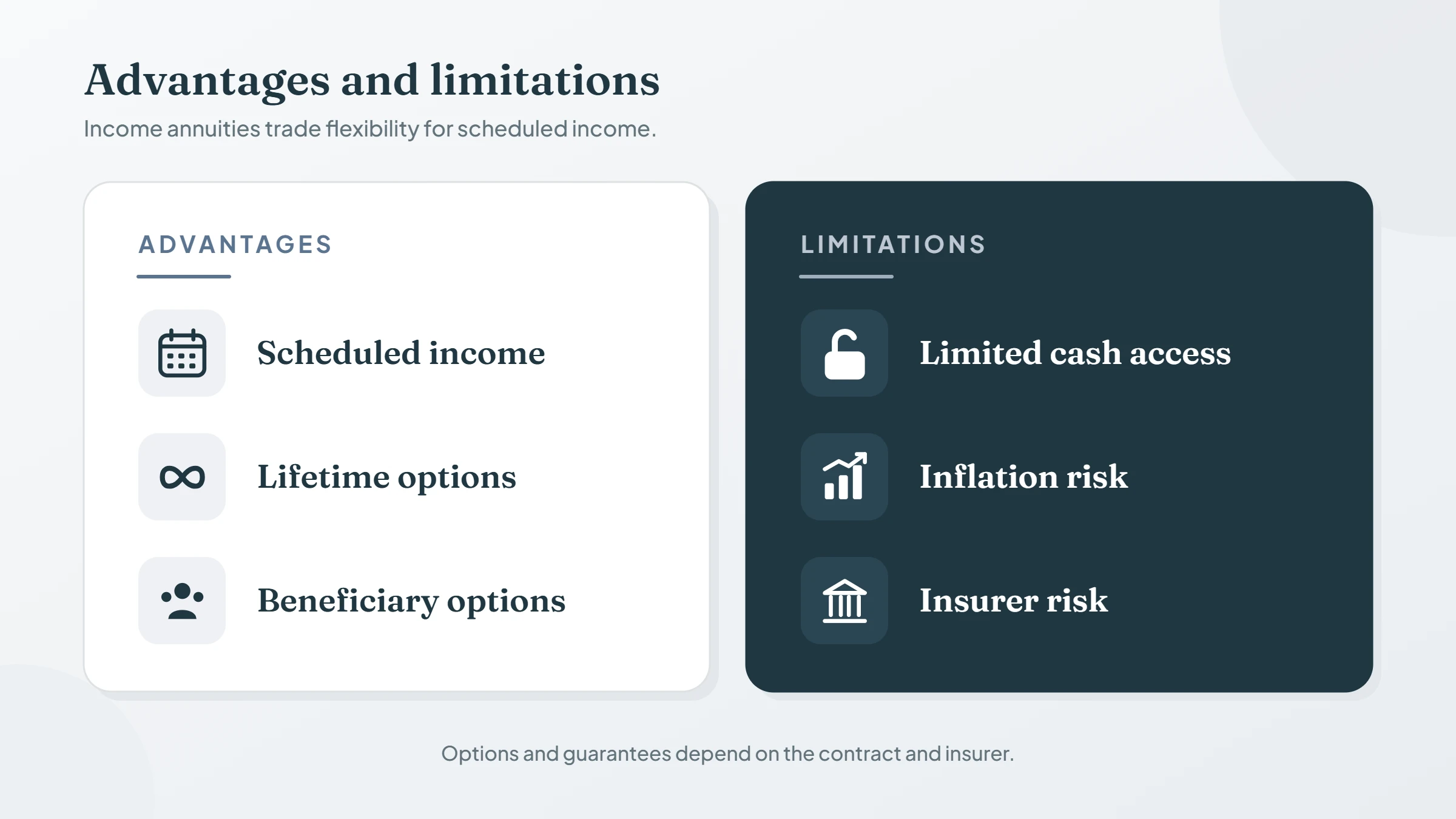
Potential Advantages
- Scheduled income: You know when payments are due under the contract.
- Lifetime income options: An eligible lifetime arrangement can continue for as long as the covered person lives.
- Choice of payment period: Some contracts offer lifetime, joint-life and fixed-period options.
- Beneficiary protection: Certain options can provide payments or a refund after death.
Potential Limitations
- Limited cash access: Many contracts provide little or no access to the premium outside scheduled payments.
- Inflation: Level payments may buy less over time as prices rise.
- Limited death benefits: A life-only option may stop at death, even if the recipient received less than the premium paid.
- Insurer risk: Guarantees depend on the issuing company’s ability to meet its obligations.
Some contracts offer payment increases to help address inflation. A fixed annual increase may be higher or lower than actual inflation.
Annuities are insurance products and are not FDIC-insured bank deposits.
How Are Income Annuity Payments Taxed?
Tax treatment depends on how the annuity was funded and how payments are received.
A non-qualified annuity is generally purchased with after-tax money. When it is annuitized, each payment generally includes a taxable portion and a portion treated as a return of the investment in the contract. The calculation may use an exclusion ratio to determine the tax-free portion.
An annuity purchased through a traditional IRA or retirement plan follows the account’s tax rules. Payments may be fully or partly taxable, depending on the funding and any after-tax basis. Qualified Roth distributions can be tax-free.
The IRS explains the calculation of taxable and tax-free portions in Publication 939. A tax professional can help you understand your contract before you select or change a payout option.
Can You Get a Lump Sum From an Income Annuity?
Possibly. The available options depend on your contract and the type of payment rights you hold.
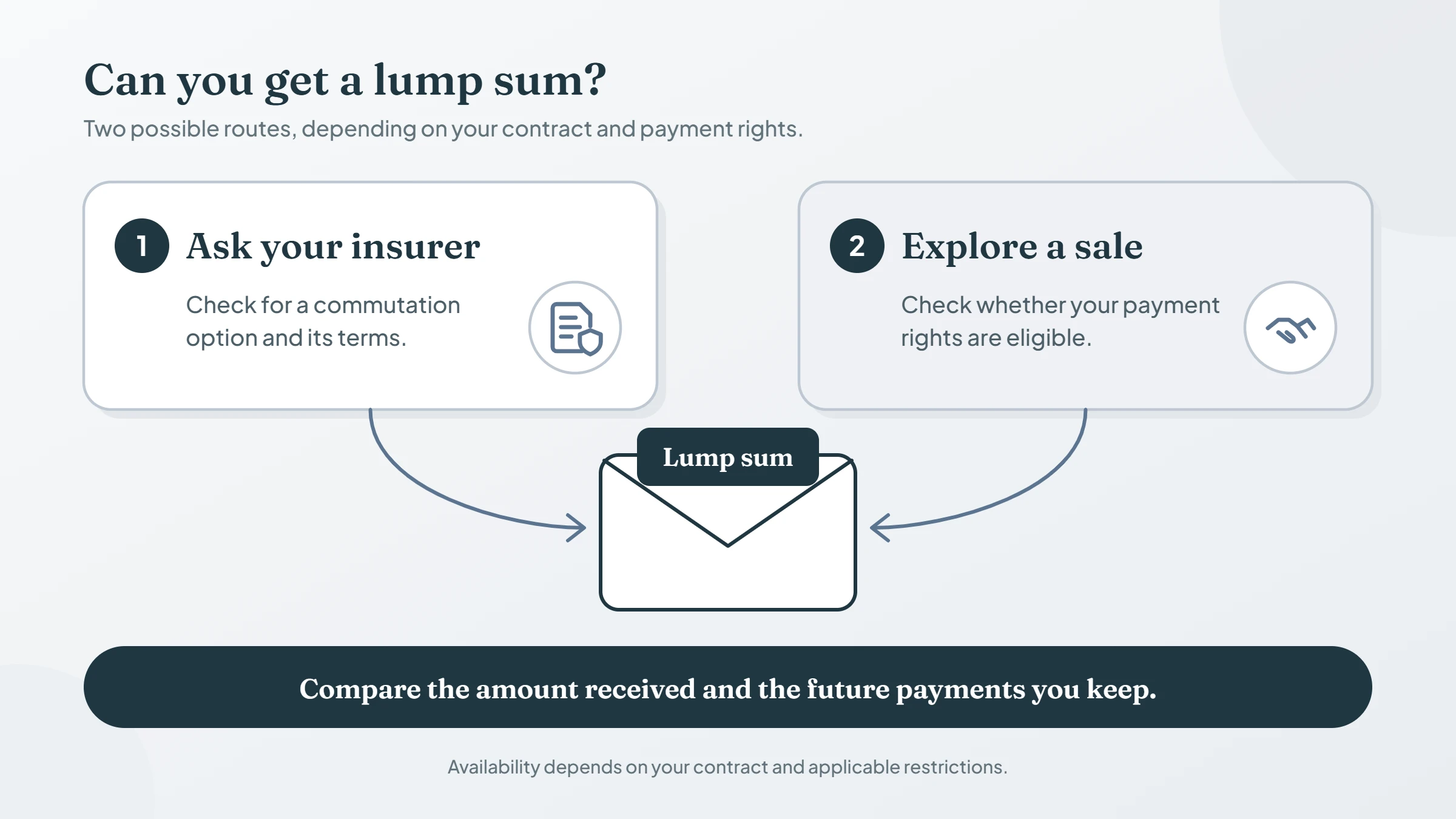
Ask the Insurer About Cash Access
Some income annuities include a commutation provision. It may allow you to exchange certain future payments for a present payment from the insurer. The transaction reduces or eliminates the payments included in the commutation.
Other contracts offer limited access or no commutation option. Ask the insurer for the terms and amount available before making a decision.
Selling Eligible Income Annuity Payments
A sale to a third-party buyer is another potential option when your payment rights are eligible for transfer.
At My Settlement, we purchase eligible annuity payment rights in exchange for a discounted lump sum. The amount you receive is less than the combined scheduled value of the payments you sell.
Eligibility depends on the contract, payment conditions, ownership and applicable restrictions. Individual retirement annuities have statutory transfer restrictions, so an IRA annuity should not be assumed eligible for an ordinary sale of payment rights.
Before accepting an offer, ask which payments are included, what income you would retain, and the net amount you would receive.
Explore our annuity purchasing service to learn more.
Frequently Asked Questions
Do all income annuities pay for life?
No. Some pay for a specified number of years. A lifetime option continues according to the contract for as long as the covered person lives.
Can income annuity payments increase over time?
Some contracts offer scheduled increases or inflation-adjustment features. The availability, cost and method of increase depend on the insurer and contract.
Can a beneficiary receive income annuity payments?
A beneficiary may receive remaining payments or another benefit if the selected payout option provides one. A life-only option generally stops when the covered person dies.
Can I change when a deferred income annuity starts paying?
Some contracts permit a change to the income start date during the deferral period. The change may be limited and can affect the payment amount. Check with your insurer before assuming the date can be changed.