
- Structured Settlements
- What are Structured Settlements
- Best Structured Settlement Buyers
- How Selling Works
- Eligible Cases
- Eligibility Criteria
- Structured Settlement Regulations
- J&J Settlement
- Maui Wildfire Settlement
- Types of Structured Settlements
- Guaranteed Structured Settlements
- Increasing Structured Settlements
- Deferred Structured Settlements
- Life-Contingent Structured Settlements
- Future Lump Sum Settlements
- Annuities
- What Is An Annuity
- Guide to Selling an Annuity
- Income Annuities
- How Are Annuities Taxed?
- 7 Common Annuity Mistakes & How to Avoid Them
- Annuity Beneficiaries
- Types of Annuities
- Fixed Annuities
- Fixed Index Annuities
- Variable Annuities
- Immediate Annuities
- Deferred Annuities
- Registered Index-Linked Annuity
- Pre-Settlement Funding
- What is Pre-Settlement Funding
- How Pre-Settlement Funding Works
- Eligible Cases for Pre-Settlement Funding
- Pre-Settlement Funding Criteria
- Pre-Settlement Funding Regulations
- Types of Pre-Settlement Funding
- Non-Recourse Cash Advances
- Structured Pre-Settlement Funding
- One-Time Lump Sum Cash Advances
- Compounding Interest Funding
- Flat-Fee Structured Funding
- Structured Settlement Calculator



One specialist stays with you from your first call through funding.

November, 2026
A fixed annuity lets you earn interest under an insurance contract’s guarantees. The appeal is straightforward: you can know the rate you’ll earn during a specified period, even when stock prices bounce around.
The part that deserves a closer look is access to your money. A guaranteed interest rate doesn’t mean every withdrawal is free, every payment lasts for life, or your rate stays the same forever.
Here’s how fixed annuities work, what the paperwork means, and which options may be available if your plans change.
What Is a Fixed Annuity?
A fixed-rate deferred annuity is an insurance contract that earns interest under stated rate guarantees while you save for later. You pay a premium (the money you put into the contract) and the insurer credits interest according to its terms.
“Deferred” means income starts later. It doesn’t mean monthly payments automatically begin when the first rate guarantee ends.
The phrase fixed income annuity describes another arrangement: scheduled income payments, which may begin soon or years ahead. New York’s Department of Financial Services explains these different uses of annuities.
This guide focuses on fixed-rate deferred annuities, including multi-year guaranteed annuities. Their main job during the savings stage is accumulating value. Choosing an income arrangement is a separate decision.
How Fixed Annuity Rates Work
A rate needs a time frame. “Four percent” tells you less than “four percent guaranteed for five years.” Even that second statement leaves questions about withdrawals, renewal and charges.
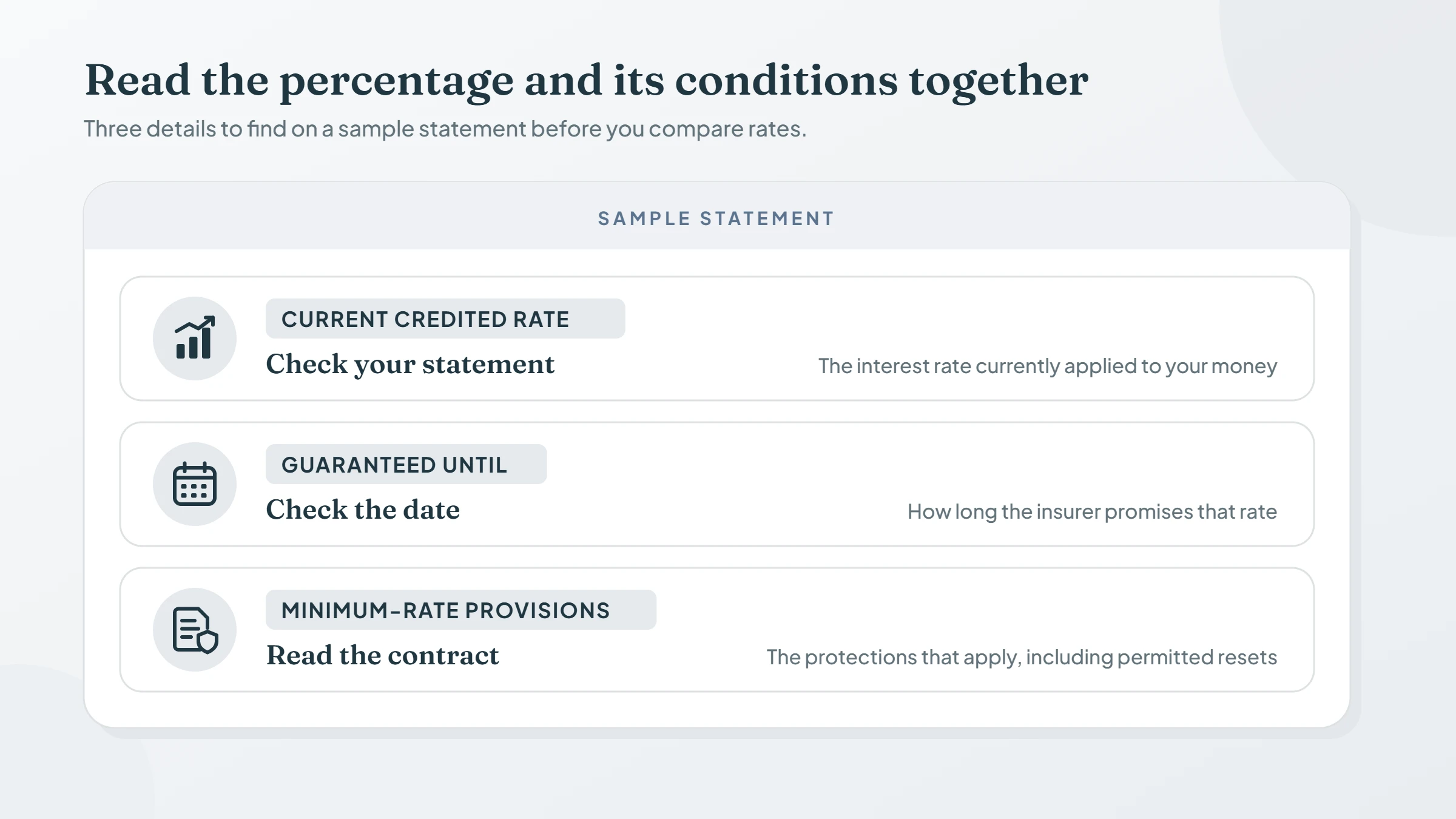
Look for these four details:
- Current credited rate: The interest rate currently applied to your money.
- Guarantee period: How long the insurer promises that rate.
- Minimum-rate provisions: The contractual protections that apply, including any permitted resets.
- Renewal terms: How the next rate is set and when you’ll hear about it.
An introductory rate and a minimum rate aren’t interchangeable. Minimum provisions can also differ between contract periods. New York Life’s glossary illustrates why reading the actual definitions matters.
Ask whether a quote shows a nominal interest rate or an effective annual yield, which accounts for compounding. Comparing different measures can make one offer look better than it is. Identify any temporary bonus separately.
Where MYGAs Fit
A multi-year guaranteed annuity, or MYGA, guarantees an interest rate for a stated period of multiple years. It’s a type of fixed deferred annuity, not a separate category competing with all fixed annuities.
Other fixed-rate contracts may reset their credited rate more frequently. Neither arrangement tells you everything about cash access.
Also check additional-premium rules. Some contracts accept one initial payment; others allow further contributions under specific conditions. A MYGA isn’t automatically an account you can top up whenever you wish.
A Fixed Annuity Growth Example
Let’s put numbers to the savings stage. You deposit $100,000 into a hypothetical fixed annuity earning 4% effective annual interest, guaranteed for five years.
All interest stays in the contract. This example assumes no withdrawals or charges and shows values before any taxes on later distributions.
The first year adds $4,000. The second adds $4,160 because the earlier interest now earns interest too. That’s compounding at work.
After five years, the account reaches $121,665.29.
| End of year | Illustrative account value |
|---|---|
| 1 | $104,000.00 |
| 2 | $108,160.00 |
| 3 | $112,486.40 |
| 4 | $116,985.86 |
| 5 | $121,665.29 |
When Your Rate Guarantee Ends
A five-year rate guarantee ending doesn’t necessarily mean the whole contract ends. Your annuity may continue at a renewal rate under its existing terms.
Your next step depends on the contract. Available choices may include continuing, selecting an offered guarantee period, withdrawing money or arranging income. Some decisions have deadlines, so read the renewal notice before filing it away.
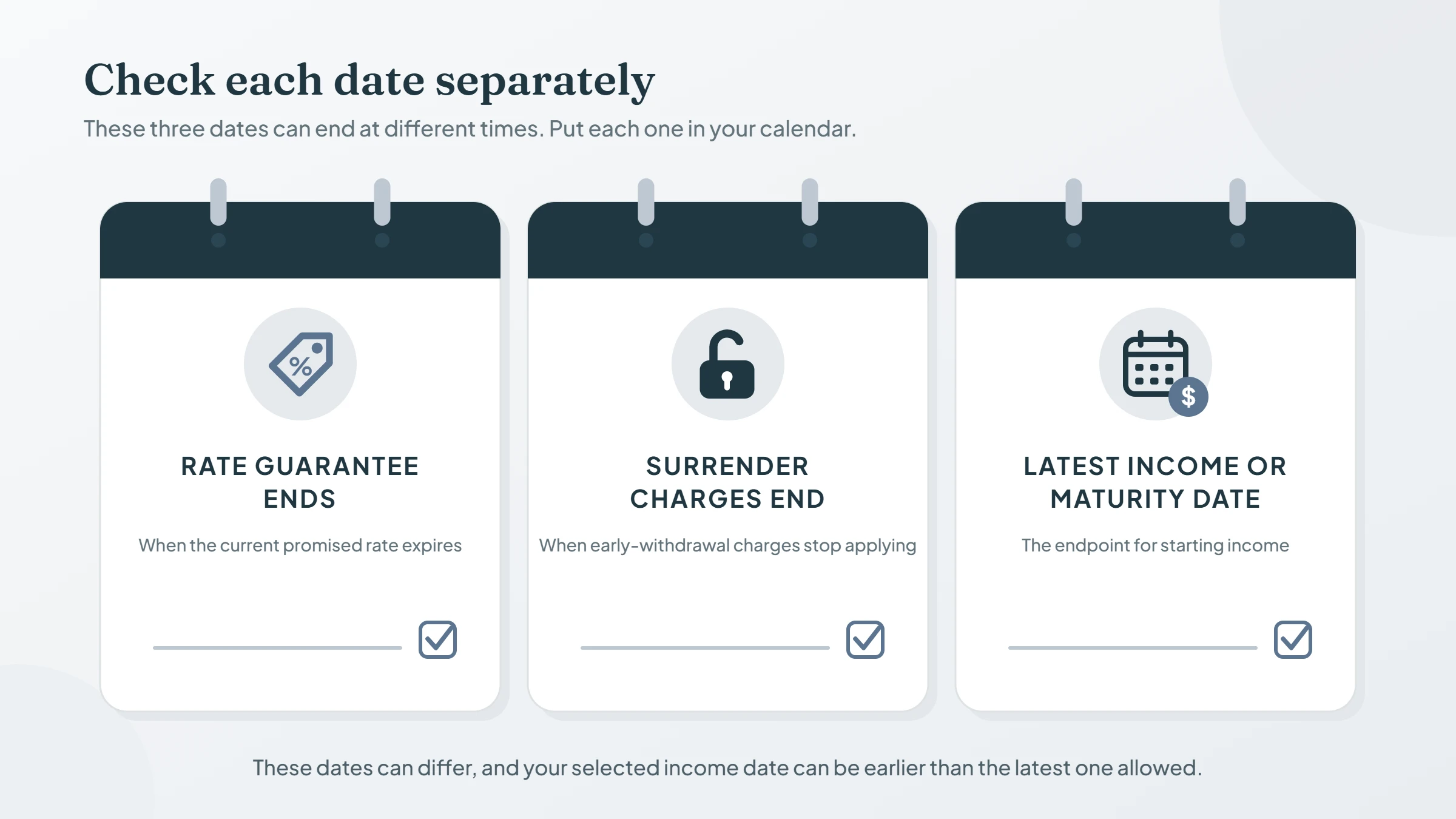
Three dates deserve separate entries on your calendar:
- The rate guarantee’s end: When the current promised rate expires.
- The surrender schedule’s end: When the relevant early-withdrawal charges stop applying.
- The latest income or maturity date: The contractual endpoint for starting income or making another required election.
These dates can differ. Your selected income date can also be earlier than the latest date allowed.
Renewal doesn’t universally restart surrender charges. New York Life’s FAQs explain that its completed surrender periods don’t restart like a CD term. Other products have their own provisions.
Ask the insurer what happens if you take no action. An automatic renewal, an income election and a cash payment are very different outcomes.
Accessing Money and Paying Charges
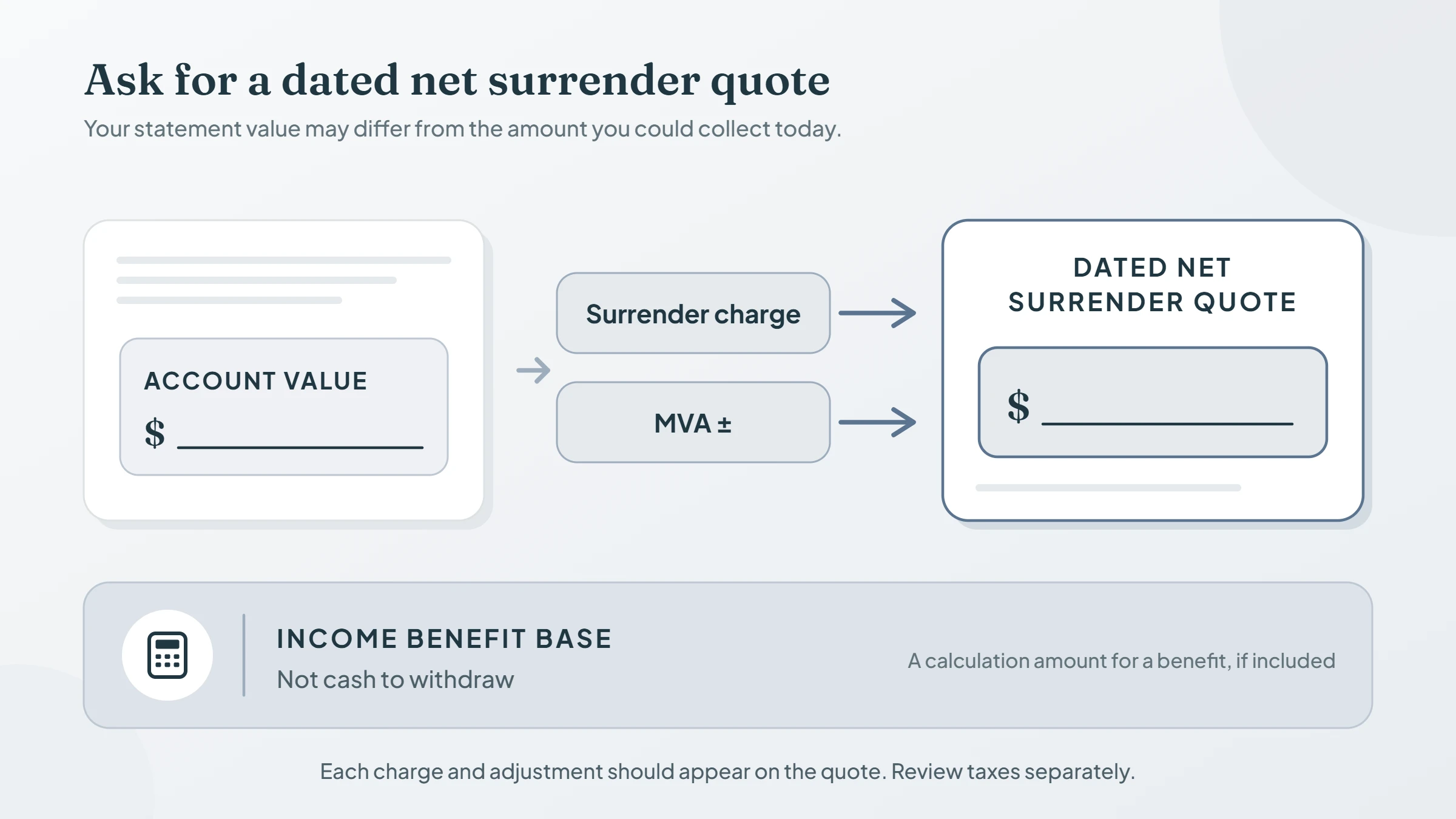
Your statement’s account value may differ from the amount you could collect today. Before requesting money, ask for a dated net surrender quote showing each adjustment and charge.
Surrender Charges and Withdrawal Allowances
A surrender charge is a contractual cost that can apply when you withdraw money early or end the contract. The schedule tells you when it applies and how it changes.
Some contracts allow limited withdrawals that avoid a specified surrender charge. The allowance might depend on account value, premium, interest earned or other terms. Fidelity’s product comparison shows how these provisions differ.
“Charge-free” doesn’t automatically mean tax-free. It also doesn’t promise that every adjustment or benefit reduction disappears.
Market Value Adjustments
A market value adjustment, or MVA, changes the applicable withdrawal value using a contractual formula. It can increase or decrease that value. Interest-rate movements and the time remaining may affect the calculation.
An MVA is separate from a surrender charge. Some products can also apply an MVA to an early annuitization, as MassMutual’s fixed-annuity information illustrates. Request an income quote before assuming that starting payments bypasses adjustments.
Different Values on Your Statement
An optional income rider may show a benefit base used to calculate benefits. That figure may not be cash you can withdraw. Its growth percentage isn’t automatically your investment return.
Minimum surrender-value protections also use their own rules. They aren’t necessarily a promise to return every dollar of your original premium whenever you leave.
| Term | What it tells you |
|---|---|
| Account value | The accumulating value under the contract’s accounting rules |
| Cash surrender value | The value available upon surrender after applicable contractual deductions or adjustments; taxes need separate review |
| Income benefit base | A calculation amount for a particular benefit, if included; it may not be accessible cash |
Benefits and Risks to Consider
The strongest benefit is predictability during the rate guarantee. You don’t have to track stock-market performance to know the promised crediting rate.
A fixed annuity can also provide tax-deferred growth in an eligible nonqualified contract and options for future income. Those features come with limits:
- Cash access: Charges and restrictions can make early withdrawals expensive.
- Inflation: A fixed return or payment may buy less as prices rise.
- Future rates: A locked rate can look less attractive if new rates increase.
- Insurer strength: Guarantees depend on the issuing insurance company.
Annuities aren’t FDIC-insured deposits, even when purchased through a bank. FINRA’s annuity guide explains that insurance guarantees differ from FDIC and SIPC protection. State guaranty associations provide certain protections, but eligibility and limits vary; NOLHGA explains that system.
A contract advertising no annual administrative fee can still have surrender charges or paid optional benefits. Ask which costs apply and how the salesperson is compensated.
Fixed Annuities Compared
A fixed-rate annuity and a bank certificate of deposit, or CD, can both offer a known interest rate for a period. Their insurance, taxes and access rules differ.
Fixed indexed annuities also deserve a distinction. They belong to the broader fixed family, but calculate some interest using an index-linked formula. They don’t simply pay a declared fixed rate on every crediting option.
Variable annuities use investment options whose performance can change account value. Registered index-linked annuities, or RILAs, link returns to an index with specified limits on gains and losses; losses remain possible. The SEC’s annuity overview explains these categories.
The CD comparison below covers an ordinary bank CD held outside an IRA and an individually owned nonqualified fixed annuity. An IRA-held CD has a different tax context, so the tax row shouldn’t be applied to it.
| Feature | Fixed-rate deferred annuity | Ordinary bank CD |
|---|---|---|
| Provider | Insurance company | Bank |
| Rate | Guaranteed under specified contract terms | Stated under the deposit terms |
| Protection | Insurer guarantees; applicable state guaranty-association protections | FDIC coverage at an insured bank, subject to coverage rules and limits |
| Federal tax timing | Earnings generally deferred until distribution | Interest generally taxable as earned or credited under applicable rules |
| Early access | Contractual charges, possible MVA and tax consequences | Bank withdrawal terms and possible early-withdrawal penalty |
| Income feature | May offer annuitization into scheduled income | No insurance-based lifetime-income promise |
How Fixed Annuities Are Taxed
The tax treatment depends on how the annuity is owned and funded.
Nonqualified Annuities
A nonqualified annuity is generally purchased outside a tax-qualified retirement arrangement using after-tax money. In the usual individually owned contract, earnings grow tax-deferred. Taxable earnings distributed later are generally ordinary income.
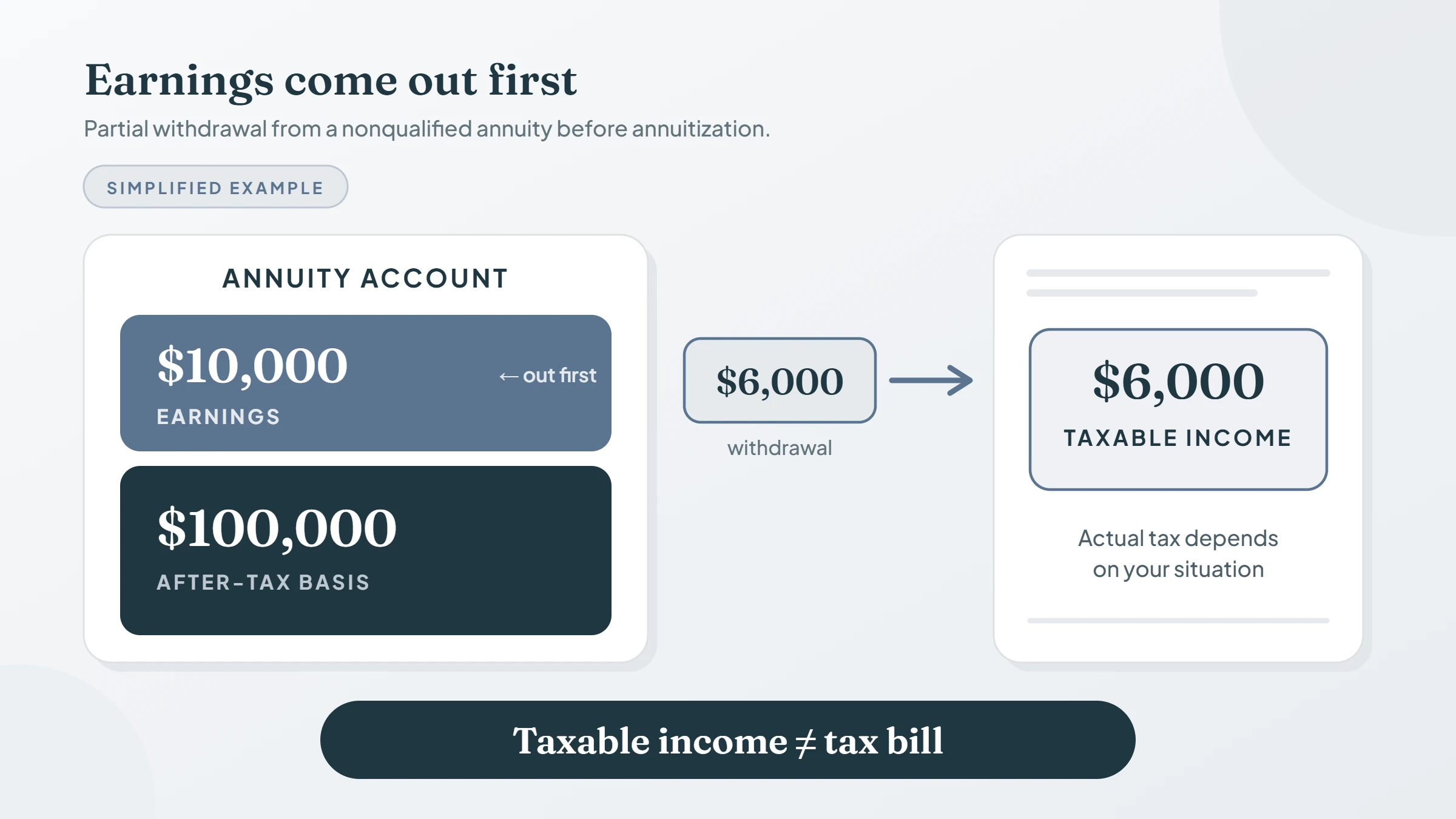
Partial withdrawals before annuitization generally take earnings out first under Internal Revenue Code Section 72. Certain older contracts have different rules.
Here’s a simplified example: your remaining tax basis is $100,000 and your account value before surrender charges is $110,000. A $6,000 partial withdrawal would generally be entirely taxable earnings, assuming no other adjustments affect the calculation. That means $6,000 of taxable income.
Annuitized payments use different cost-recovery rules. Part of each payment may represent a return of after-tax investment, as explained in IRS Publication 575.
Retirement Accounts and Early Distributions
An annuity inside an IRA adds no extra tax deferral to the IRA itself. Distributions from a fully pretax traditional retirement arrangement are generally fully taxable; after-tax basis can change that result. Qualified Roth distributions receive different treatment under IRS retirement-account rules.
An additional 10% federal tax can apply to taxable early distributions before age 59½, subject to exceptions. Nonqualified annuities and retirement accounts don’t share every exception.
Reaching 59½ doesn’t erase insurer charges. State taxes and other individual tax consequences may also matter. Have the tax treatment checked before requesting a withdrawal or changing ownership.
Payments and Beneficiaries
Receiving monthly money doesn’t identify how your annuity works. Systematic withdrawals draw down an account and can exhaust it. Annuitization converts value into an income arrangement and is generally irreversible under its terms. A guaranteed withdrawal rider, if offered, is another arrangement with its own conditions.
Income choices affect what happens after death:
- Life-only payments generally end when the covered person dies.
- Joint-and-survivor payments can continue for a surviving covered person under the selected terms.
- Period-certain or refund provisions can provide additional payments or a remaining benefit under their rules.
Before income begins, a contract may provide a death benefit. Check whose death triggers it (the owner and annuitant can be different people) and confirm beneficiary details.
A death benefit isn’t automatically tax-free. Taxable gain may pass to beneficiaries under the applicable rules. Don’t assume an annuity death benefit receives the same tax treatment as life insurance proceeds.
Check Your Existing Annuity
A recent statement is useful. The contract and endorsements explain what that statement leaves out.
Collect these before discussing a change:
- Your current rate, guarantee period and renewal notice.
- The surrender schedule, withdrawal allowance and MVA terms.
- A current account value and net surrender quote.
- Any rider’s benefit base, charges and withdrawal conditions.
- Ownership, tax status and remaining tax basis.
- Beneficiary details and income or maturity dates.
Ask the insurer about processing requirements and timing too. A withdrawal that avoids a surrender charge isn’t a promise of same-day cash.
If the contract is newly delivered, check its cancellation or “free look” provision promptly. The period and refund rules depend on applicable law and contract terms; there’s no single deadline to assume nationwide.
Need a Lump Sum Now?
Start by identifying what you own: an accumulating contract, a contract providing withdrawals, or rights to scheduled income payments. That distinction determines which options are worth exploring.

Withdraw or Surrender
An accumulating contract may allow a partial withdrawal or full surrender. Ask the insurer what you would receive after contractual charges and adjustments, then review taxes separately. Compare the cash available with the income and benefits you would give up.
Exchange Into Another Contract
A qualifying Section 1035 exchange can defer recognition of gain when moving between eligible contracts. It doesn’t provide unrestricted spending cash or remove old surrender charges, lost benefits or new restrictions.
The transaction must meet the tax rules. Receiving a check and endorsing it to another insurer isn’t equivalent to a qualifying direct exchange, as IRS Revenue Ruling 2007-24 explains. Retirement-account transfers follow their applicable rules.
Sell Eligible Payment Rights
Some payment rights may qualify for a sale to a purchaser. Eligibility depends on ownership, transfer restrictions, required consents and the actual payments. A “fixed” or “nonqualified” label alone doesn’t settle the question.
Individual retirement annuities have an owner-nontransferability requirement under Section 408(b). Assignments can also have tax consequences. Structured settlement transfers involve separate legal requirements; their court-approval process isn’t a universal process for retail annuities.
MySettlement purchases eligible annuity payment rights. If you receive payments and want a lump sum, you can contact MySettlement to ask whether your rights qualify for review. A purchase offer is payment for the rights transferred, not a refund of your original premium or a promise to pay the total of all future checks.
Common Fixed Annuity Questions
Can a Fixed Annuity Lose Money?
Contractual interest guarantees don’t eliminate every loss. Early-access charges or adjustments can reduce cash received, inflation can reduce purchasing power, and guarantees depend on the insurer’s ability to pay.
Is a MYGA a Fixed Annuity?
Yes. A MYGA is a fixed deferred annuity with an interest rate guaranteed for multiple years. The guarantee period doesn’t, by itself, establish the withdrawal rules or income start date.
How Much Would $100,000 Pay Monthly?
There’s no single payment amount. An income quote depends on factors including the start date, covered lives, payment duration and beneficiary options. A 4% credited rate isn’t a promise of a particular lifetime payout.
Does Age 59½ Remove All Charges?
No. Age 59½ generally matters for the additional federal tax on early distributions. Surrender charges and MVAs follow the contract’s separate rules, and ordinary income tax may still apply.
Can I Sell My Fixed Annuity?
Possibly, if the payment rights are eligible and transferable. Some arrangements restrict transfers, while others provide access directly through the insurer. Have the contract reviewed before treating a payment sale as an available option.