



One specialist stays with you from your first call through funding.
September, 2026
An annuity is a contract with an insurance company. You pay money into it, called a premium, and the contract gives you options for receiving income now or later. Payments can last for a set period or your lifetime, depending on the option you choose.
That sounds straightforward. The confusing part is that two annuities can work very differently: one credits a fixed interest rate, while the other can rise or fall with market performance.
Here are the essentials:
- Lifetime income is an option, not a feature of every payout.
- Fees, withdrawal rules and guarantees depend on the contract.
- Taxes depend on the money used to buy it and how you receive it.
How does an annuity work?
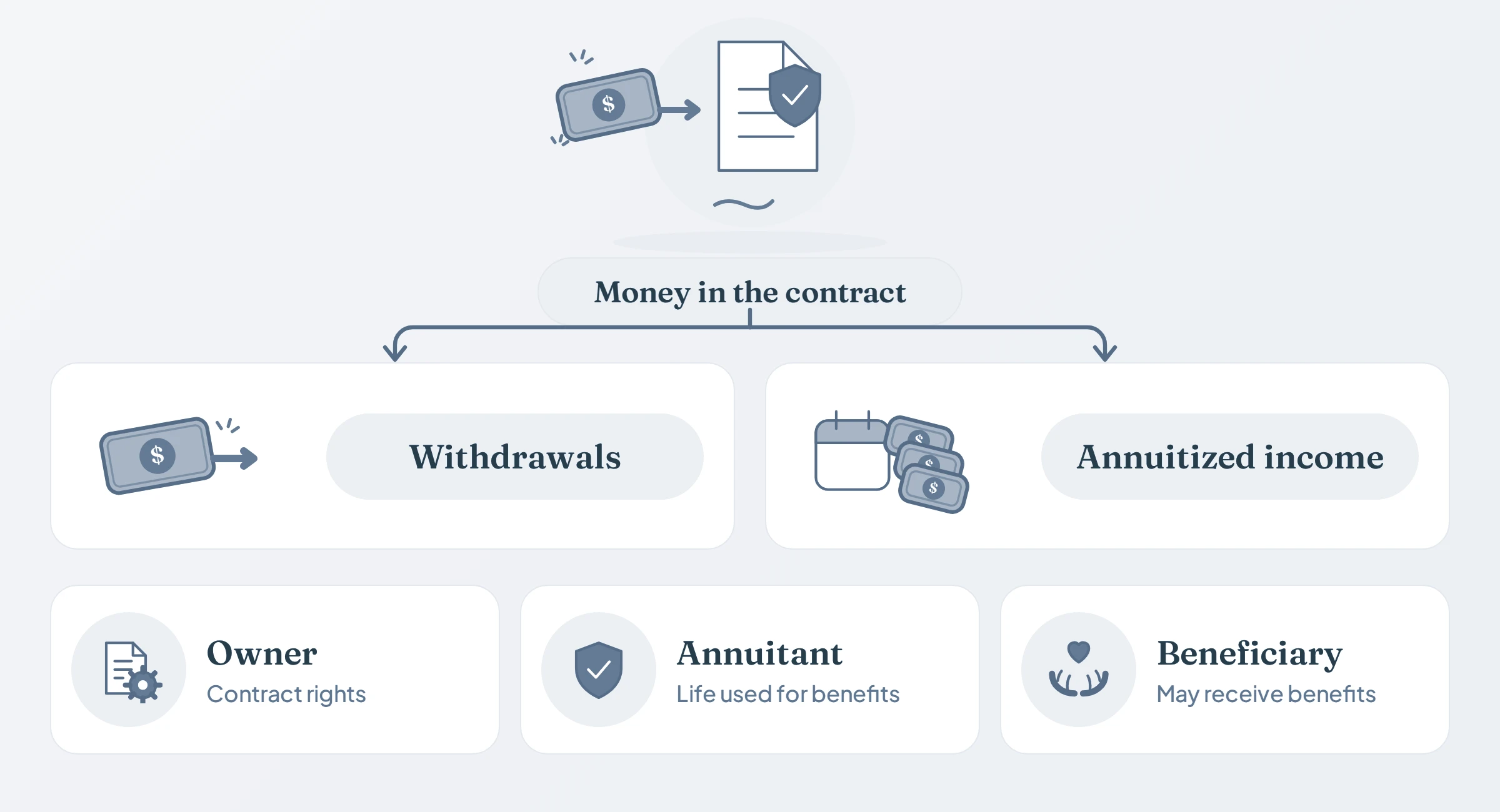
A deferred annuity usually has an accumulation phase, when you hold money in the contract before taking income. Its value changes based on the contract’s interest credits, investments, fees, and withdrawals.
Later, you may annuitize: convert the value into a payment arrangement. That choice is generally permanent. Some contracts also allow withdrawals or offer an optional income rider, an added benefit with its own conditions and possible charge.
The people named in the contract also matter:
- Owner: holds the contractual rights.
- Annuitant: the person whose life helps determine benefits.
- Beneficiary: may receive benefits after a death.
The same person can fill more than one role. Someone receiving structured settlement payments may hold payment rights but not own the annuity funding them.
What is your annuity worth?
Check which number you are looking at. These figures can describe different things:
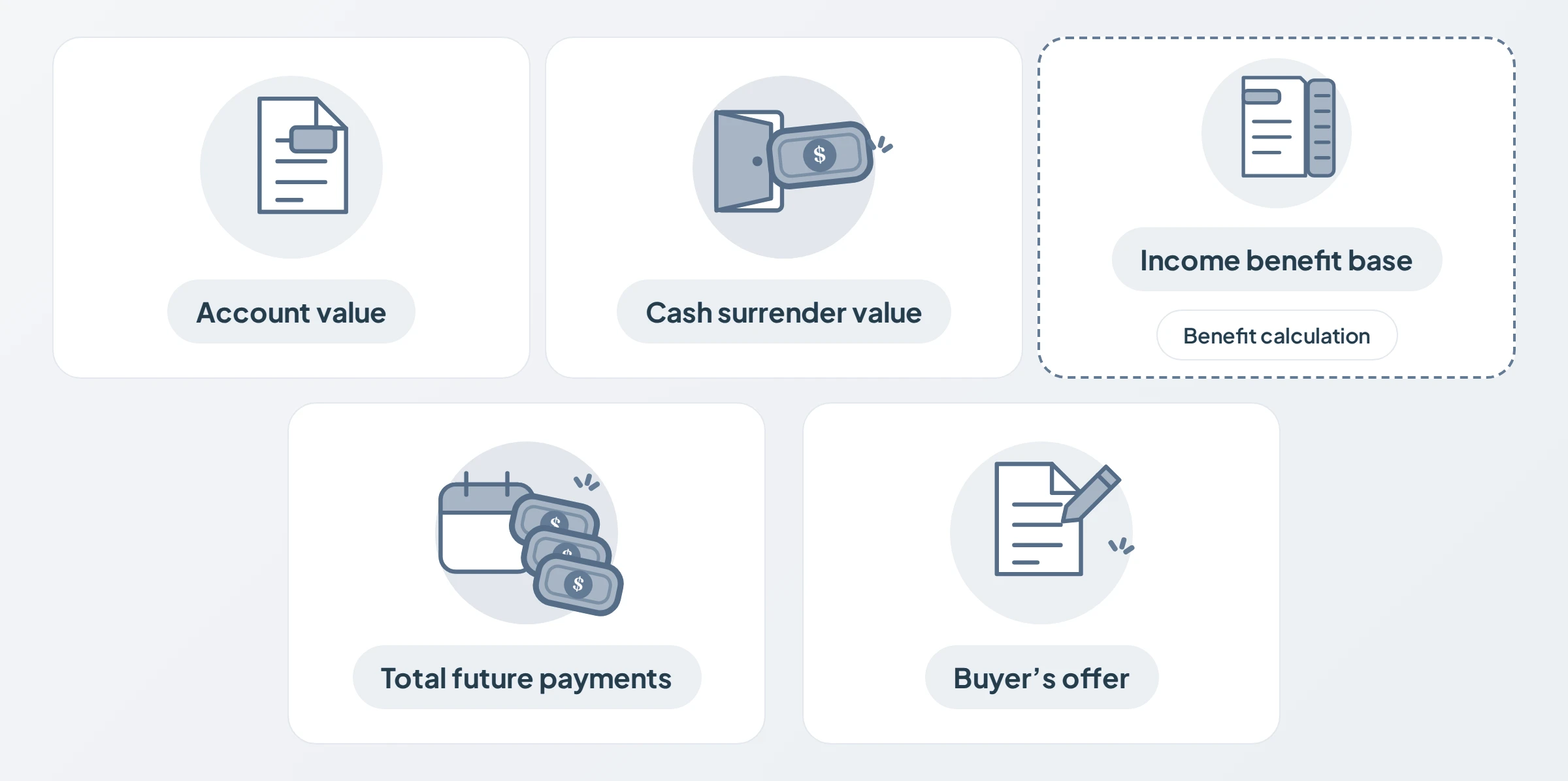
- Account value: the stated accumulation value, where the contract has one.
- Cash surrender value: what a full exit provides after applicable charges and adjustments, before your personal taxes.
- Income benefit base: a calculation amount for a specified rider benefit, not automatically cash you can withdraw.
- Total future payments: the sum of scheduled checks; a lifetime total depends on how long payments continue.
- Buyer’s offer: the purchase price quoted for eligible payment rights.
Ask the insurer to explain your statement’s values. The Insurance Compact’s living-benefit standards distinguish benefit calculations from contract values and charge bases.
What are the main annuity types?
Start with how the contract’s value changes. The SEC’s annuity guide outlines four common deferred annuity categories.
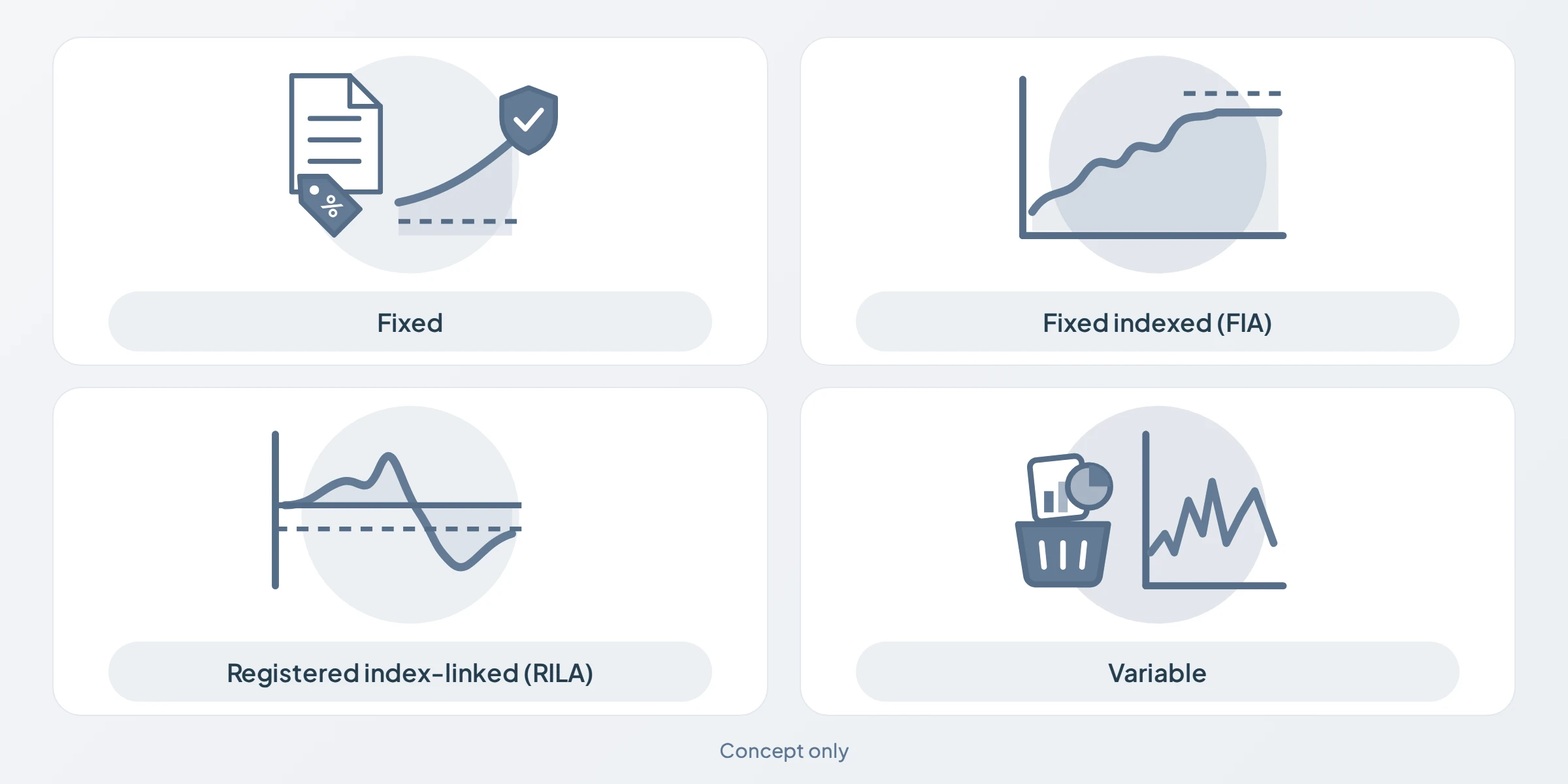
A multi-year guaranteed annuity (MYGA) belongs to the fixed category. It guarantees an interest rate for a specified term. Other labels, such as immediate and deferred, describe timing, so one contract can carry several labels.
RILA example: a hypothetical 10% buffer absorbs the first 10% of the specified term’s index loss. If that index falls 12%, the resulting loss is 2% before contract adjustments. A floor works differently: it caps a specified loss. Early withdrawals can change the outcome.
| Type | How value changes | What to check |
|---|---|---|
| Fixed | Interest credited under the insurer’s guaranteed terms. | Guarantee period, renewal rate and early-exit costs. |
| Fixed indexed (FIA) | Credits linked to an index, subject to contract limits. | Caps, participation rates and charges; you do not directly own the index. |
| Registered index-linked (RILA) | Index-linked results can be positive or negative. | A buffer or floor limits specified losses; it does not eliminate market risk. |
| Variable | Value follows selected investment options, usually through subaccounts. | Investment performance, contract expenses and optional guarantees. |
When do annuity payments start?
An immediate annuity generally starts income within a year of purchase. A single-premium immediate annuity, or SPIA, uses a single lump-sum premium.
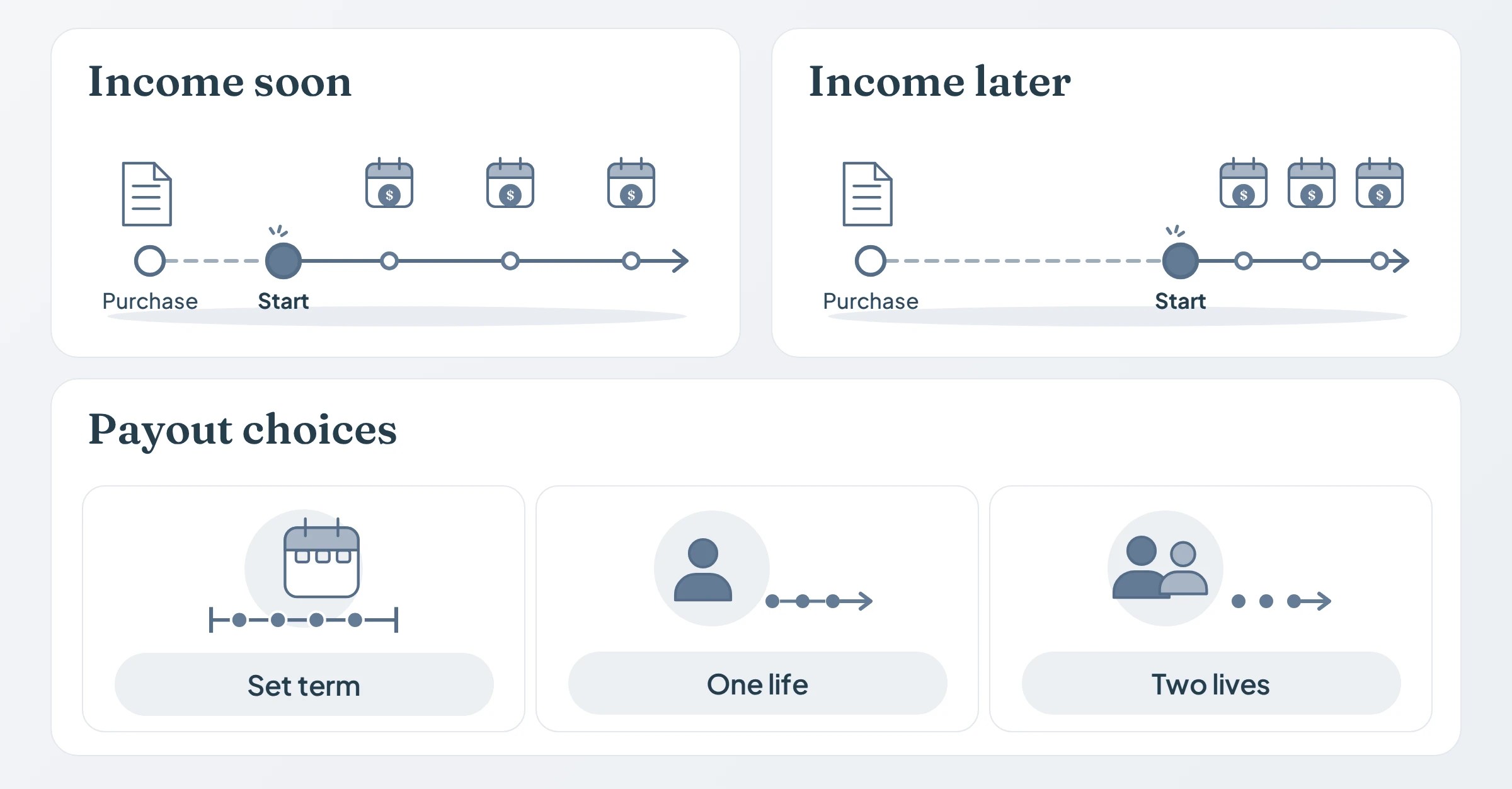
A deferred income annuity (DIA) starts payments at a later date. Other deferred annuities focus on accumulating value before income begins. Income can last for a chosen term, one lifetime or two lives.
Your payout percentage is not the same as an investment yield. Payments may include a return of the money you paid in. Compare equivalent payout options, including any increases or survivor benefits.
What fees can an annuity charge?
Ask for the charges in dollars, their calculation base and when they apply. SEC guidance on variable annuities explains several costs to check:
- Contract charges: administration and mortality and expense risk charges, where applicable.
- Investment expenses: costs of the underlying funds.
- Rider charges: costs for added benefits.
- Surrender charges: charges for certain early withdrawals or a full exit.
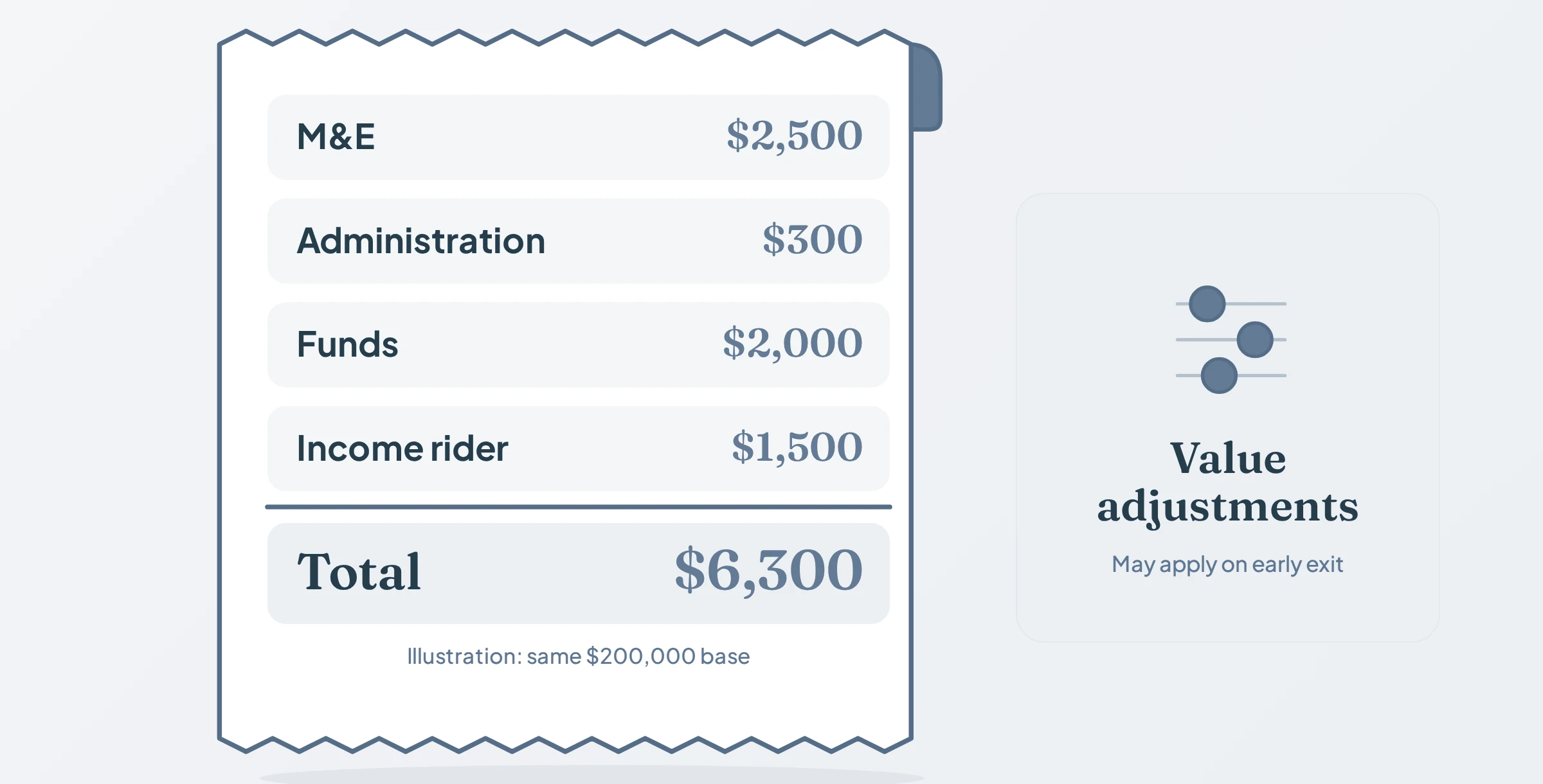
- Value adjustments: some contracts apply a market or interim value adjustment on early exits.
Costs can also be reflected in interest credits or payout terms. Ask how the seller is paid.
Hypothetical example: M&E at 1.25%, administration at 0.15%, fund expenses at 1% and an income rider at 0.75%, total 3.15%. Applied to the same constant $200,000 base, that is $6,300 annually. Actual charges can use different bases, including a rider benefit base.
Already Receiving Annuity Payments? Find Out What They Are Worth as a Lump Sum Today.
MySettlement purchases annuity payment streams directly. Free consultation, transparent offer, court-approved process.
How are annuities taxed?
The funding source comes first. Annuity earnings are generally taxed as ordinary income when taxable distributions are made, not at capital gains rates.
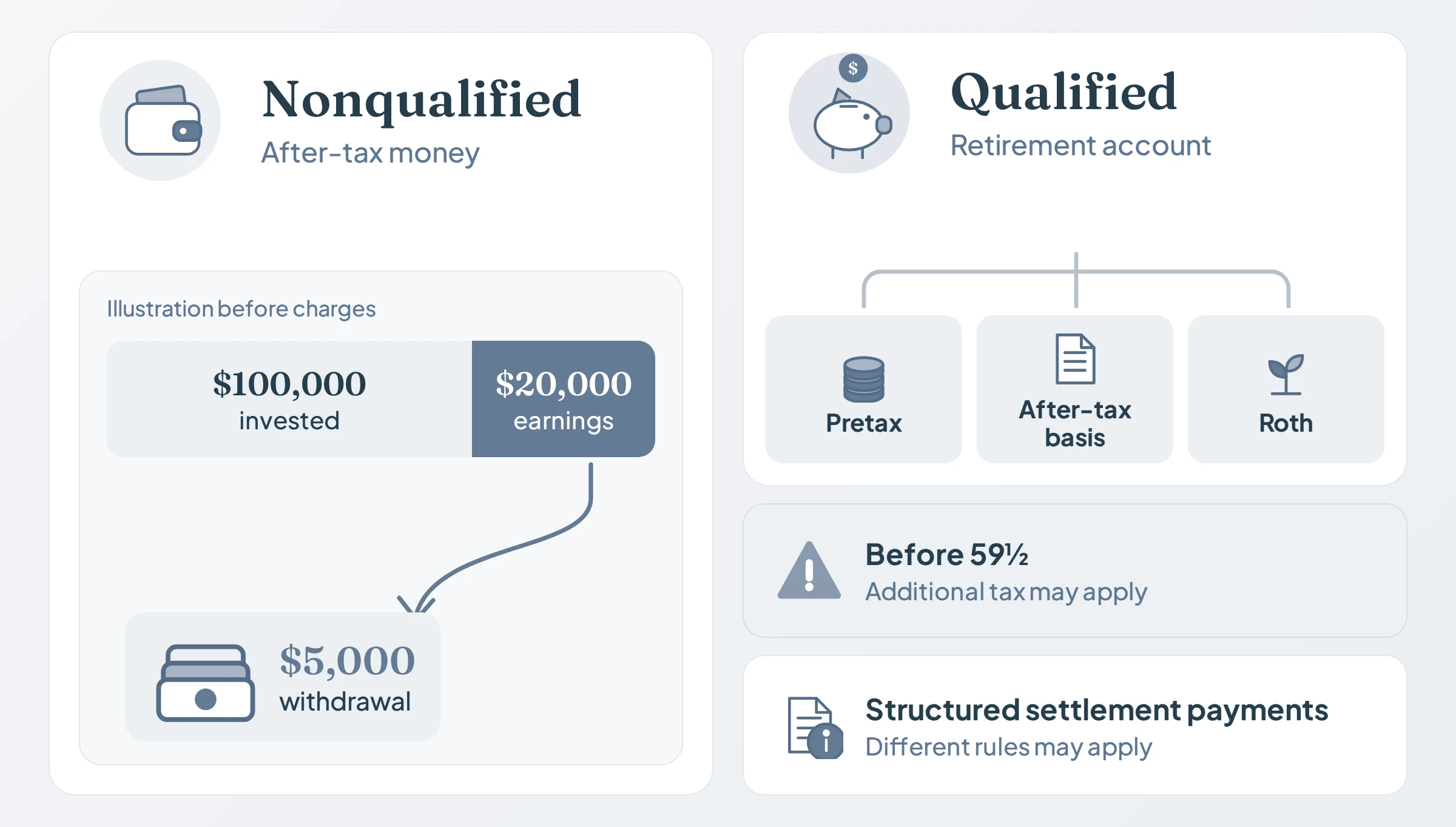
Nonqualified annuity: bought using after-tax money outside a retirement account. Under the usual IRS withdrawal rules, a withdrawal before annuitization first takes out taxable earnings. Annuitized payments may combine taxable income and returned principal under an exclusion-ratio calculation.
Withdrawal example: a nonqualified contract has $100,000 of after-tax investment and is worth $120,000. Under the usual earnings-first rule, a $5,000 withdrawal before annuitization is taxable earnings. This illustration assumes no charges or earlier withdrawals.
Qualified annuity: held through a tax-advantaged retirement arrangement. Fully pretax funding generally produces fully taxable distributions. After-tax basis changes that calculation, and qualified Roth distributions can be tax-free. An annuity inside an IRA does not add another layer of tax deferral.
Before age 59½, a federal 10% additional tax may apply to taxable distributions. Exceptions and account-specific rules matter. State taxes may also apply. Retirement accounts have their own RMD rules; Roth IRA owners have no lifetime RMDs.
Structured settlement payments: qualifying personal physical-injury or physical-sickness damages can be excluded from federal income under 26 U.S.C. § 104(a)(2). Other settlement components can be taxable. Ask your tax adviser which rules apply to your payments.
What is a QLAC?
A qualified longevity annuity contract (QLAC) is a qualifying deferred income annuity purchased through an eligible retirement arrangement. Its value is excluded from the calculation of the required minimum distribution (RMD) before payments begin.
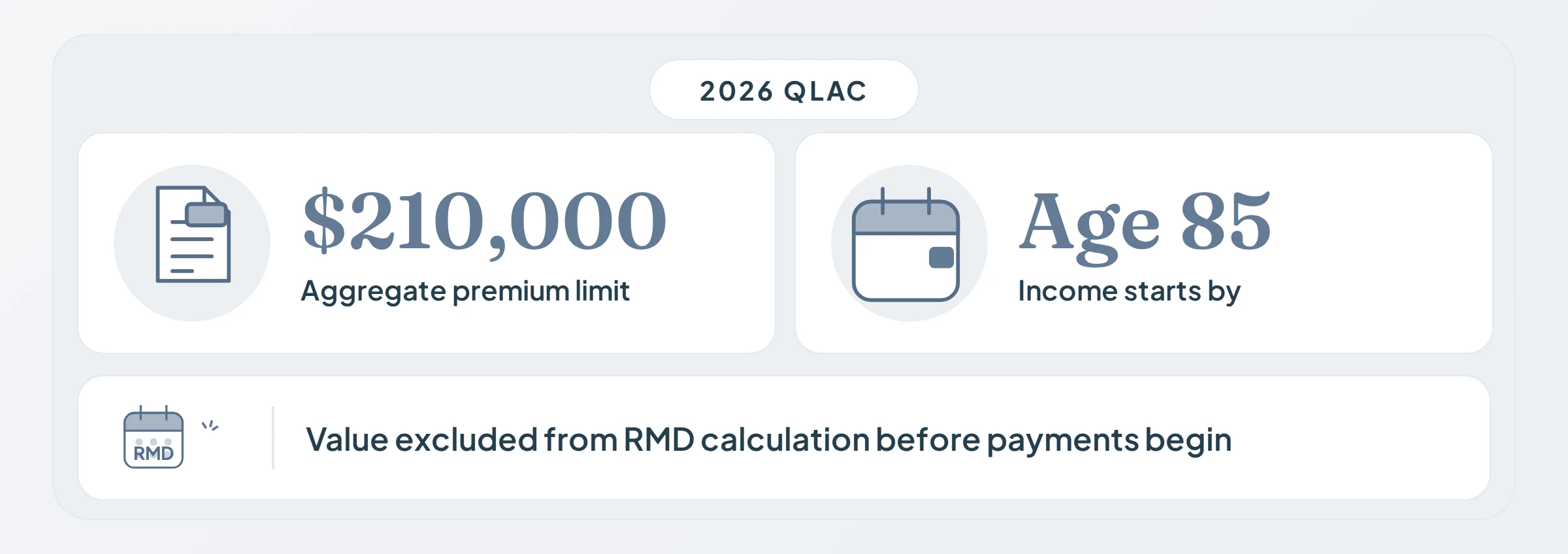
The 2026 aggregate premium limit is $210,000. SECURE 2.0 removed the old 25% account-balance restriction. This is not a fresh annual allowance.
Payments must begin no later than age 85. A QLAC postpones the relevant distributions; it does not permanently erase income tax.
Can you lose money in an annuity?
Yes. Variable annuities and RILAs can lose value through market performance. A fixed or FIA guarantee also does not eliminate insurer risk, early-exit costs or inflation.
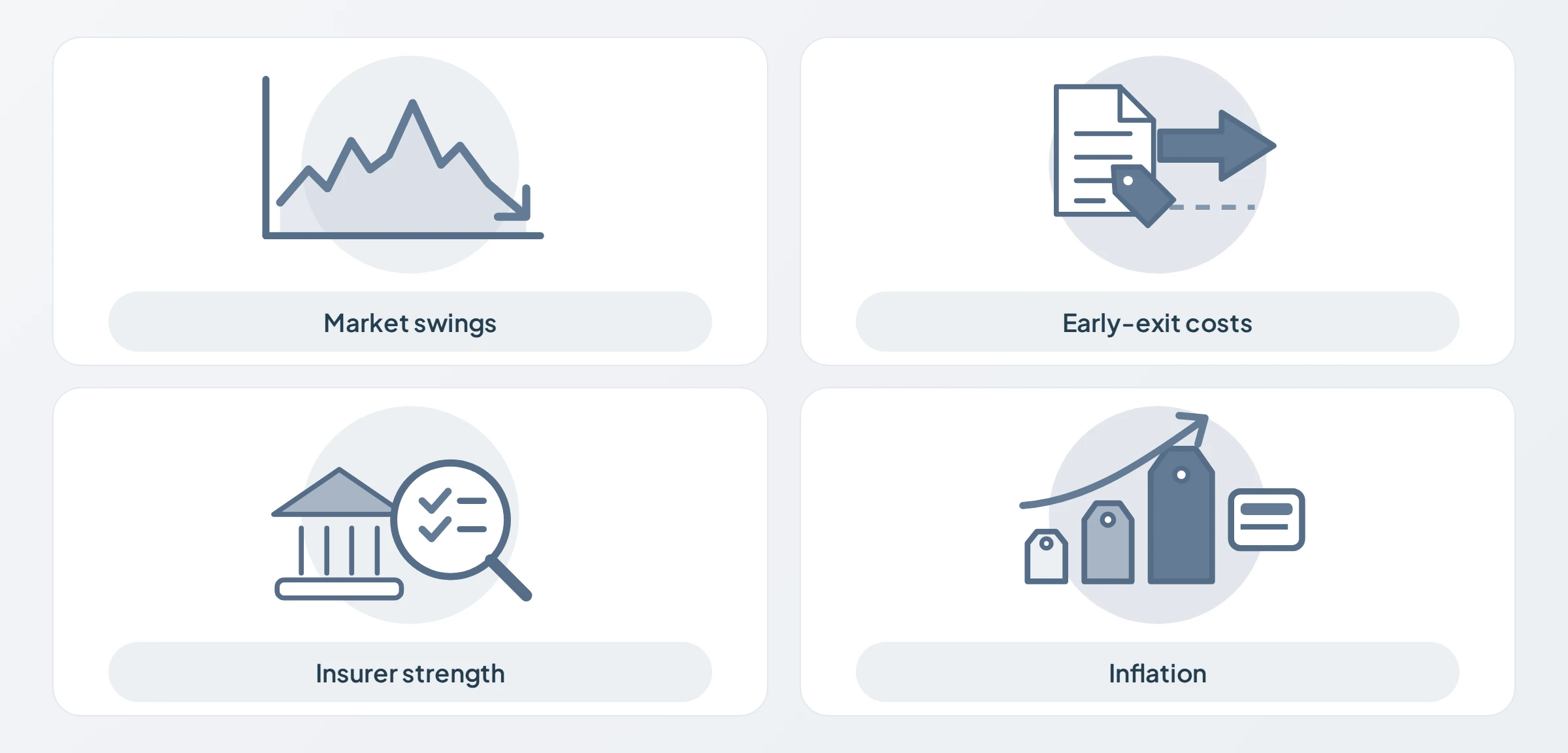
A zero index-crediting floor concerns the applicable credit, not every possible reduction in contract value. A lifetime income promise is also different from a promise to return your premium.
Annuities are not FDIC-insured, even when sold through a bank. State guaranty associations provide limited protection for eligible benefits after an insurer fails. Coverage varies; these examples do not establish protection for every contract or owner.
| State | Selected coverage distinction |
|---|---|
| Washington | Up to $500,000 in present value of eligible annuity benefits. |
| New Jersey | $250,000 for eligible cash surrender/withdrawal values; $500,000 in present value for eligible payout benefits. |
| California | 80% of the present value of covered annuity benefits, capped at $250,000, subject to other limits. |
What happens when you die?
The answer depends on whose death triggers the benefit, the contract’s phase and its payout option. A death benefit before annuitization can differ from protection after income starts.
Adding survivor protection generally changes the quoted income. Compare the options using the same premium and other assumptions.
| Payout choice | What happens after the covered death |
|---|---|
| Life only | Payments stop; no remaining income passes to heirs. |
| Life with period certain | Payments continue for any remaining guaranteed period. |
| Joint and survivor | Payments continue for the surviving covered person under the selected terms. |
| Life with cash refund | A beneficiary receives any premium balance not already paid out. |
Annuities compared with CDs and IRAs
A CD is a deposit with a bank or credit union. Eligible deposits have federal deposit-insurance protection, subject to its rules and limits. A fixed annuity’s guarantee comes from the insurer.
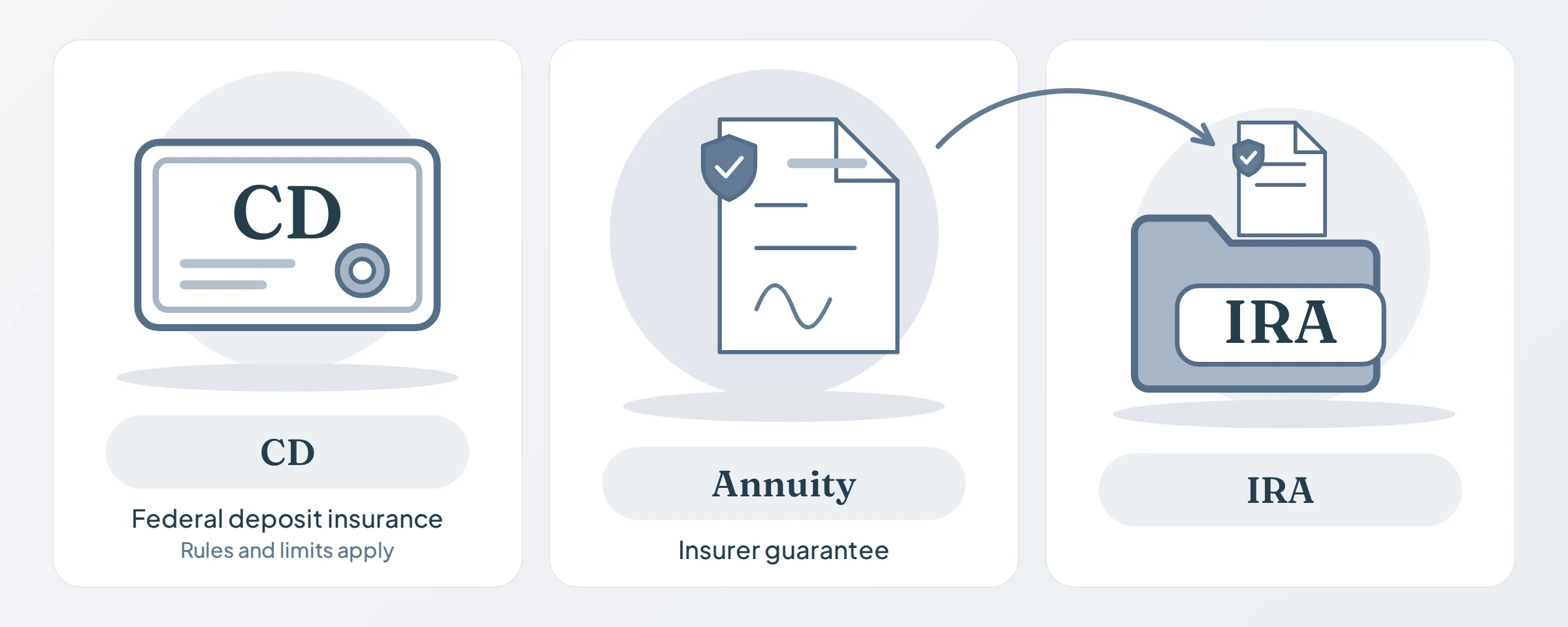
An IRA is a retirement arrangement, not one investment product. It can hold different permitted investments, including an annuity. Compare the annuity’s insurance benefits, costs and access rules separately from the IRA’s tax treatment.
Is an annuity right for you?
Start with the income you already expect, including Social Security or a pension. Then look at essential expenses, emergency savings and whether someone else needs income after your death.
An annuity may help cover an income gap. It can be a poor fit for money needed soon, especially when withdrawal restrictions apply. Compare quotes with matching payout choices, and keep accessible savings for unexpected bills.
Can you access or sell payments?
Access depends on your contract and the rights you hold. A withdrawal, a surrender, an exchange, and a payment sale are different transactions.
Certain direct 1035 exchanges can continue tax deferral, including qualifying partial exchanges. Charges and replacement guarantees still need review. An individual retirement annuity under 26 U.S.C. § 408(b) is not transferable by its owner.
Structured settlement payment sales follow a separate transfer process, including qualified-order provisions under 26 U.S.C. § 5891 and applicable state law. A buyer’s offer discounts future payments. Check net proceeds, tax effects and the income you give up before agreeing.
Do annuities affect Medicaid eligibility?
They can. Federal rules in 42 U.S.C. § 1396p address annuity transfers and beneficiary requirements, alongside state eligibility rules. A contract described as Medicaid-compliant does not automatically establish eligibility. Consult an elder-law attorney before using an annuity for long-term-care planning.
Questions to ask before you sign
Get the contract, any prospectus and a written explanation of these points:
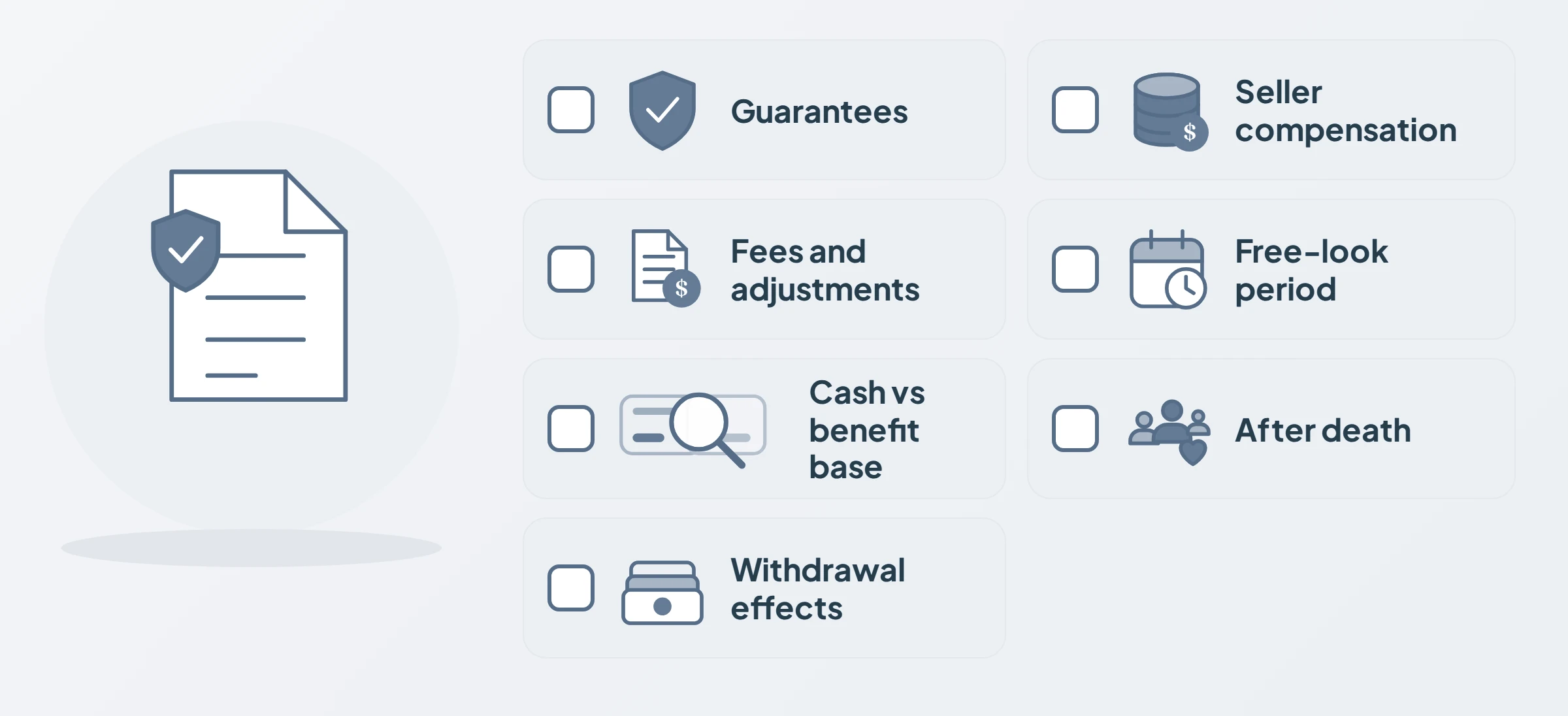
- What is guaranteed, for how long, and by which insurer?
- What are the fees, charge bases and early-exit adjustments?
- Is the income benefit base different from available cash?
- How do withdrawals affect income and death benefits?
- How is the selling professional compensated?
- What is your state’s free-look cancellation period?
- What happens to the money or payments if a covered person dies?
Check insurer licensing and financial strength. Variable annuities and RILAs also involve securities regulation; the SEC’s professional-checking tool provides a starting point for checking registration and disciplinary history.
Your Annuity Has Value Right Now. You Don't Have to Wait for Every Payment.
MySettlement purchases annuity payment streams from holders across all 50 states. Free consultation. No obligation. Transparent, court-approved process.
Common annuity questions
Is there a best buying age?
Age affects some payout quotes, but income needs, liquidity, health and survivor goals also matter. There is no single best age for every buyer.
Do annuities always pay for life?
No. A lifetime option can keep paying for the covered life, while a period-only arrangement ends after its agreed term.
Can you cancel a new annuity?
A state-specific free-look period generally allows cancellation of a newly received contract. Check its deadline and refund method. Later cancellation can involve surrender charges, adjustments and taxes.
Talk through your existing payments
Already receiving annuity or structured settlement payments? MySettlement can review your payment details and discuss whether a lump-sum transaction is available. Ask about eligibility, the net offer and the future income involved.