



One specialist stays with you from your first call through funding.
November, 2026
Your lawsuit may move slowly. Rent, groceries and medical bills don’t. Pre-settlement funding can provide cash while you wait, but it comes with a trade-off: repayment can leave you with less money when your case resolves.
Pre-settlement funding is an advance against the potential proceeds of a pending legal claim. A company reviews the claim and offers money in exchange for the right to receive a portion of a future settlement or award. Consumer funding is commonly offered on a non-recourse basis, meaning repayment is generally due only if the case is successful.
You’ll also hear terms such as lawsuit funding, settlement advance and lawsuit loan. All of these are different terms for the same service.
Pre-settlement funding at a glance
| Question | What to know |
|---|---|
| What are you getting? | Cash before your claim resolves, in exchange for repayment rights tied to potential case proceeds. |
| How is the case reviewed? | The funder evaluates factors such as liability, damages, available coverage and likely recovery. |
| What happens if there is no recovery? | Non-recourse terms generally limit repayment to case proceeds. Check fraud, misrepresentation and breach exceptions. |
| What does it cost? | The pricing method, fees, time outstanding and any cap determine the payoff. |
| What rules apply? | Requirements vary by jurisdiction and transaction. There is no single nationwide cancellation period or pricing rule. |
How does pre-settlement funding work?
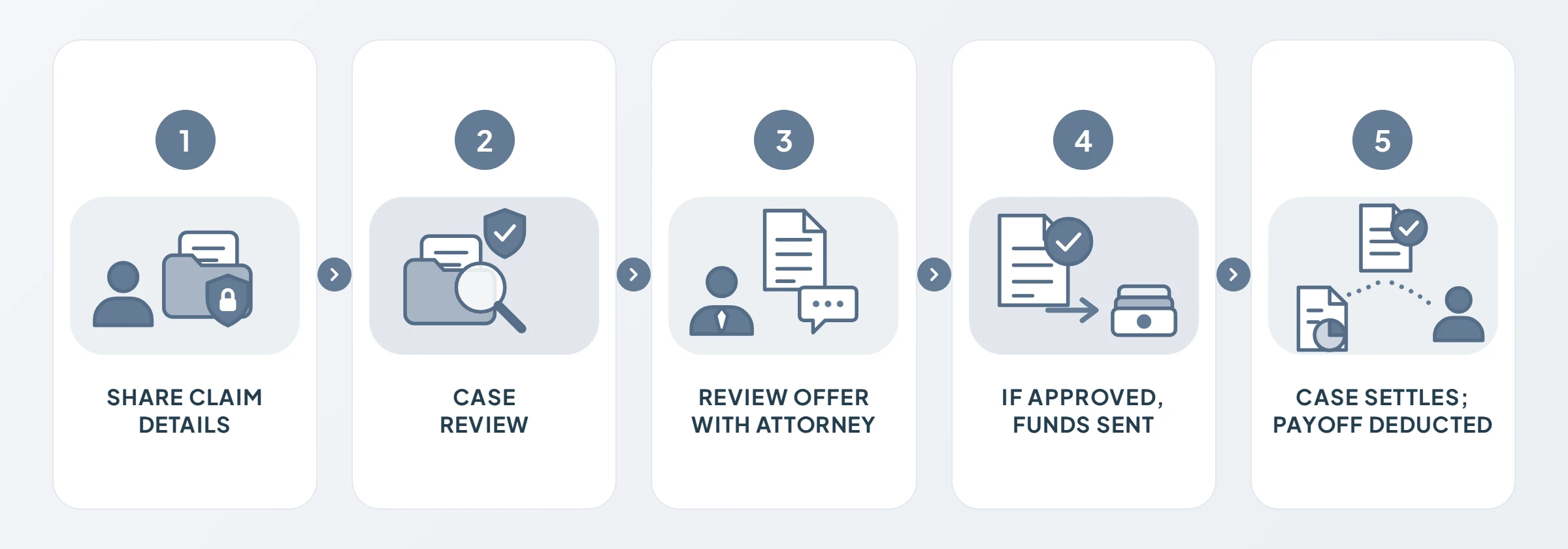
The details vary by provider, but the process generally follows these steps.
1. You provide information about your claim
The application may ask for your state, case type, attorney’s contact details and immediate funding need. Before sending medical records or other sensitive documents, ask your attorney what should be shared and how.
2. The funder evaluates the potential recovery
The review can include evidence of fault, injuries, insurance limits, the defendant’s ability to pay, case progress, existing funding and liens. An estimated settlement value is not a promised outcome.
3. You review the offer with your attorney
Look for the amount you will actually receive, all fees, how charges accumulate, payoff amounts at different dates, cancellation rights and repayment exceptions. Your attorney’s involvement can include providing advice, reviewing contracts, and providing case information. State law or provider policy may require an attorney acknowledgment.
4. Funds are disbursed after approval and required paperwork
Ask when the timing estimate starts. A promise to send funds after a signed agreement is different from a promise to complete the entire application. Document collection, underwriting, weekends and bank processing can affect the schedule.
5. The case resolves, and the proceeds are distributed
If the case produces money, the funding payoff is addressed along with attorney fees, case costs and applicable liens. Those obligations reduce your remaining distribution. The payment order depends on the relevant law and agreements; there isn’t one universal sequence for every case.
What does pre-settlement funding cost?
Start with four questions: How much cash will I receive? How are charges calculated? What fees apply? What will I owe at different payoff dates?
A percentage alone won’t answer them. You need its time basis, calculation method and any limits on the amount owed.
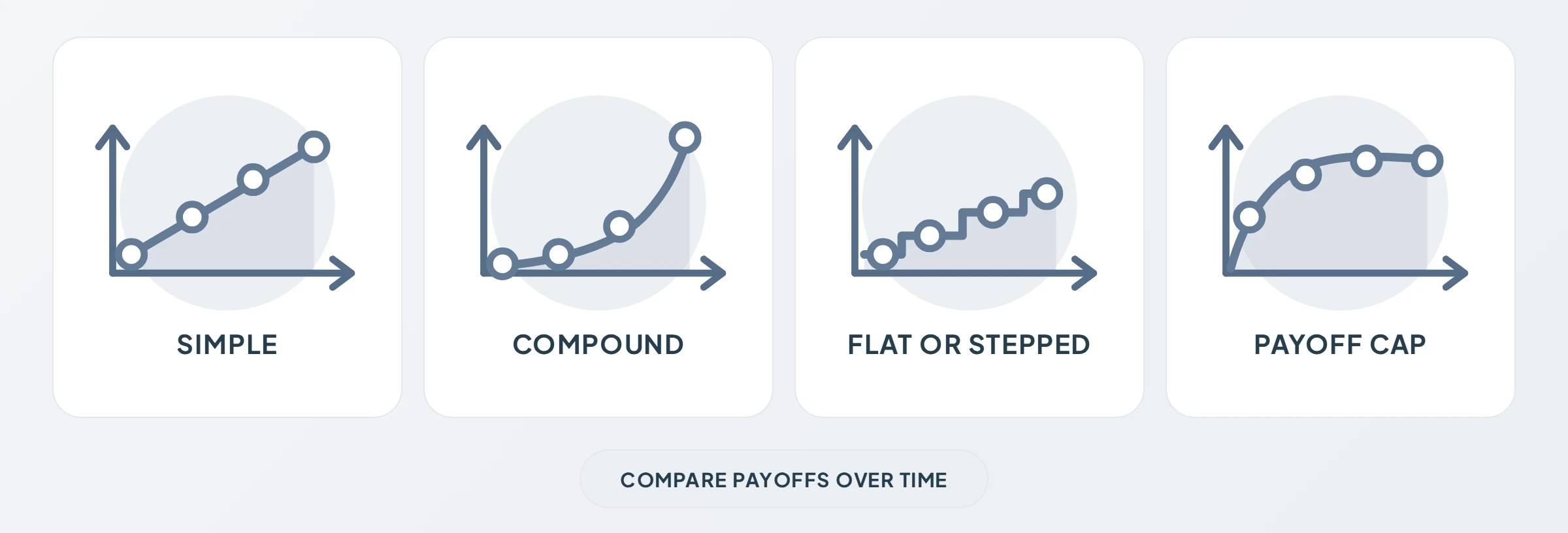
Simple charges, compound charges and flat fees
- Simple interest or charges: Calculated on the original advance, without adding earlier charges to the base for further interest.
- Compound interest or charges: Accrued charges are added to the balance used for later calculations.
- Flat or stepped fees: A fixed charge or an amount that increases at specified intervals. A six-month pricing band may work differently from daily accrual.
- Payoff caps: A contract or applicable law may limit charges or the total repayment. Ask when accrual stops and what the cap includes.
Separate fees matter too. Maine’s legal funding statute, for example, requires itemized disclosures for charges including application, processing, attorney-review and broker fees. That doesn’t make every fee permissible everywhere, but it shows why “no fee to apply” and “no fees at all” are different promises.
What monthly compounding looks like
Here are hypothetical payoffs on a $10,000 advance, with no additional fees or repayment cap:
| Time until repayment | 2% monthly, compounded | 3% monthly, compounded | 4% monthly, compounded |
|---|---|---|---|
| 6 months | $11,262 | $11,941 | $12,653 |
| 12 months | $12,682 | $14,258 | $16,010 |
| 18 months | $14,282 | $17,024 | $20,258 |
These are illustrations, not typical-rate claims. MySettlement quotes or rates are permitted in every state. Figures are rounded to the nearest dollar and assume repayment at the end of the stated period.
At 3% compounded monthly, $10,000 grows to about $20,328 after 24 months. A case taking longer than expected can therefore substantially increase costs when charges continue to accrue.
The same percentage can mean very different costs
Compare these hypothetical terms on $10,000 outstanding for exactly 12 months:
| Pricing terms | Total payoff | Charges above the $10,000 advance |
|---|---|---|
| 15% per year, simple | $11,500 | $1,500 |
| 3% per month, simple | $13,600 | $3,600 |
| 3% per month, compounded monthly | $14,258 | $4,258 |
All three examples exclude extra fees. They show why a monthly percentage should not be compared directly with an annual percentage. At 3% monthly compounding, the effective annual growth is approximately 42.6%, before fees. That calculation is not automatically the statutory annual percentage rate, or APR, required for a particular agreement.
Ask for a written payoff schedule at 6, 12, 18 and 24 months, plus the maximum amount owed. Check partial-period calculations too: settling one week into a new pricing band could affect the payoff differently from a daily-accrual contract.
How much of your settlement could remain?
A $50,000 settlement does not necessarily mean $50,000 is available to you. Fees, expenses, liens and the funding payoff can make the final distribution much smaller.
Consider this hypothetical example:
| Item | Amount |
|---|---|
| Gross settlement | $50,000 |
| Attorney fees | −$15,000 |
| Case costs | −$2,000 |
| Medical or statutory liens | −$5,000 |
| Funding payoff | −$14,258 |
| Remaining distribution | $13,742 |
The funding payoff assumes $10,000 advanced at 3% compounded monthly for 12 months. It includes the original $10,000 and about $4,258 in charges. You already received the advance earlier; it isn’t paid to you again at distribution.
The attorney fee, expenses and liens are assumptions for this example, not standard amounts or a universal payment order. Actual liens and their priority matter. New York Financial Services Law § 1007, for instance, specifically addresses attorney and statutory liens in relation to funding liens.
Ask your attorney to estimate your potential net proceeds and test a longer case timeline. A small advance compared with the gross settlement can still take a sizeable share of what remains.
Who may qualify for pre-settlement funding?
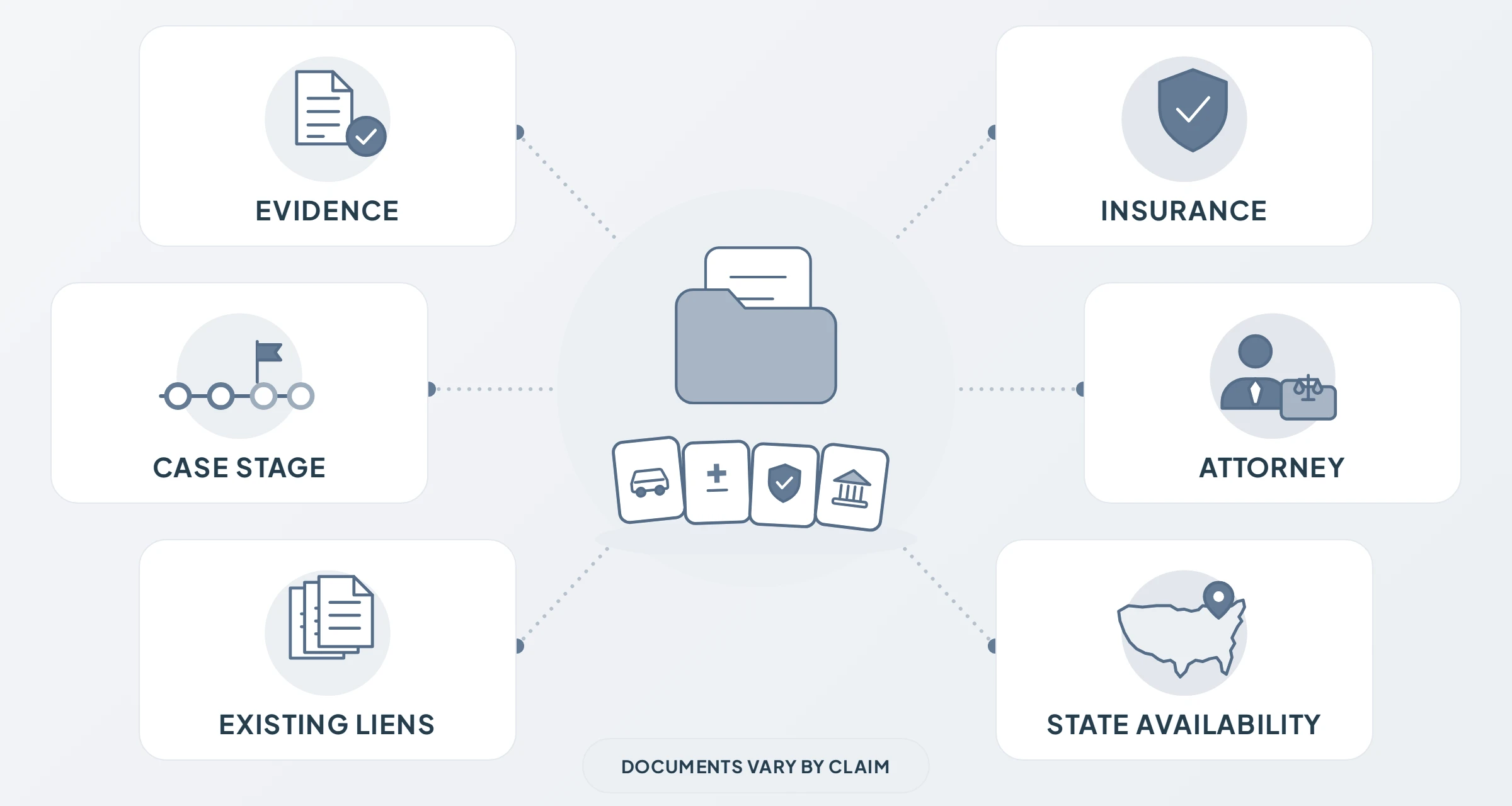
Eligibility depends on the provider, applicable law and facts of the claim. Cases considered by consumer funders can include vehicle accidents, premises liability, medical negligence, wrongful death and other civil claims. Workers’ compensation and employment claims require particular attention to state rules and provider availability.
The review may consider:
- Evidence supporting liability and damages.
- Insurance coverage or another realistic source of payment.
- The stage of the claim and likely time to resolution.
- Attorney representation and cooperation requirements.
- Prior advances, attorney fees, case expenses and liens.
- Whether the provider operates in the relevant jurisdiction.
What documents might be requested?
Depending on the claim, the funder may request incident reports, medical records, insurance information, court filings or settlement communications through your attorney. The requirements for a vehicle collision won’t necessarily match those for an employment claim.
Ask for the provider’s actual checklist. Let your attorney guide the release of case information, and check who will receive it. The New York City Bar’s funding ethics guidance explains why confidentiality, conflicts and advice about the agreement deserve attention.
What happens if you lose your case?
Under non-recourse terms, the funder’s repayment is generally limited to case proceeds. If there are no proceeds, ordinary case-loss protection usually means no repayment.
Read the exceptions carefully. New York’s current contract requirements expressly address potential liability for material breach, fraud or material misrepresentation. That is different from the case simply failing.
Also ask what happens if the case recovers money but less than expected. Check whether the payoff is limited to available proceeds, what deductions have priority and how any shortfall is handled. Non-recourse protection does not make a successful-case payoff inexpensive or guarantee that money will remain for you.
Is pre-settlement funding regulated?
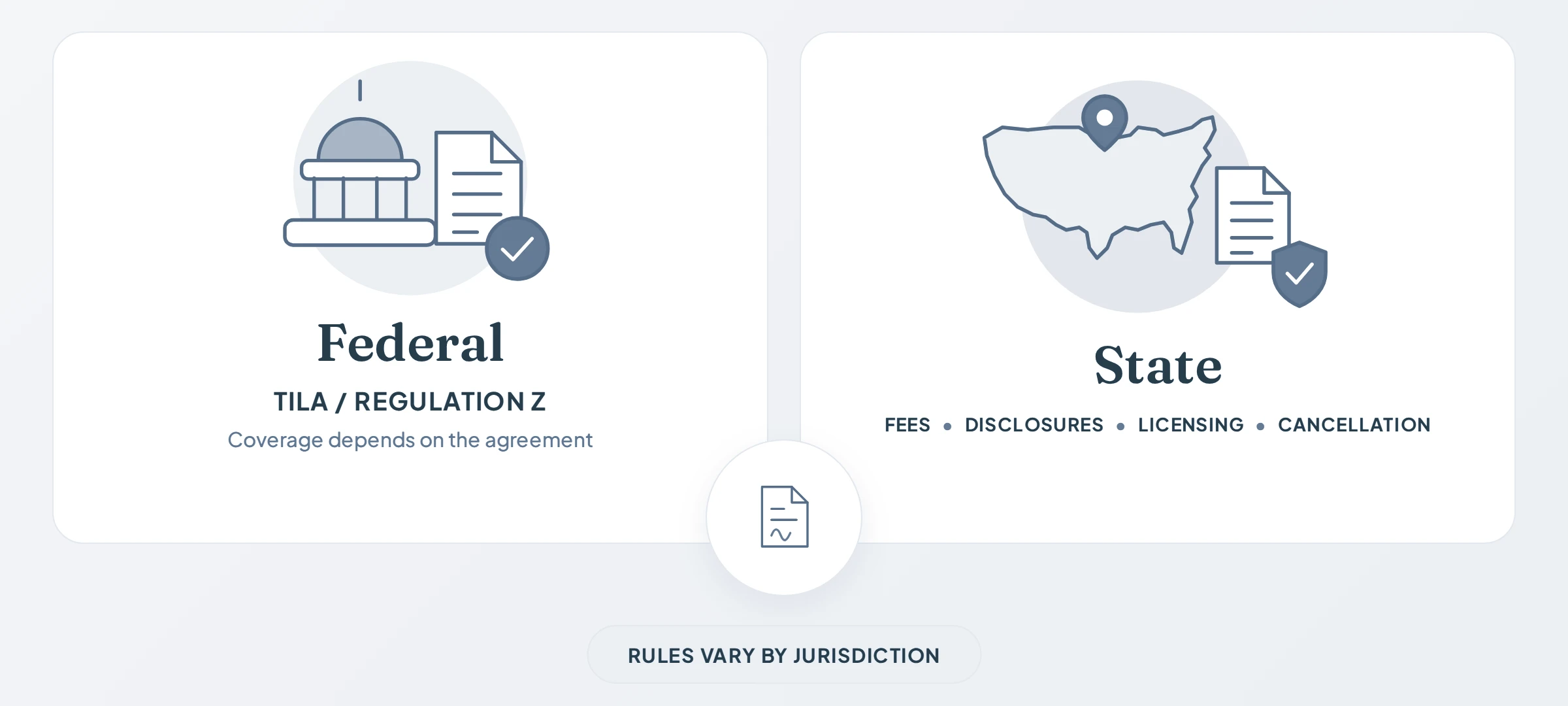
Yes, but the rules vary. Legal classification, contract disclosures, permitted charges, registration and cancellation rights can differ between jurisdictions and products.
Is a “lawsuit loan” legally a loan?
The answer depends on the law and the agreement. In Oasis Legal Finance Group v. Coffman, 2015 CO 63, the Colorado Supreme Court held that the transactions before it were loans under Colorado’s Uniform Consumer Credit Code, despite their contingent repayment terms.
Colorado also addresses legal-proceeds loans in its 2023 legislation, HB23-1162.
Federal disclosure requirements also need a separate analysis. The Truth in Lending Act, or TILA, is federal legislation; a provider calling its product an “advance” doesn’t itself decide coverage. Regulation Z’s credit definitions and other applicable coverage rules matter.
Examples of state protections
The examples below show why you should check the rules governing your agreement. They are not a complete state-by-state availability list.
| State | Example requirement or protection |
|---|---|
| Arkansas | Covered consumer lawsuit lending is regulated under Ark. Code Ann. § 4-57-109, enacted by Act 915, including applicable interest restrictions. |
| Maine | Title 9-A, § 12-104 requires itemized disclosures and a five-business-day cancellation period following receipt of funds, with specified return procedures. |
| Nebraska | Providers must register under the Nonrecourse Civil Litigation Act rather than rely solely on membership in a private trade association. |
| Illinois | The Consumer Legal Funding Act, 815 ILCS 121, establishes a specialized framework that includes licensing requirements. |
| New York | Financial Services Law § 1002 requires a cancellation right that allows covered consumers to return the full funded amount within 10 business days after funding. |
| Ohio | § 1349.55 applies through October 5, 2026 and provides five business days after receipt of funds. From October 6, 2026, Chapter 1357 provides ten business days after funding for covered consumer agreements. Required return procedures apply. |
| Tennessee | The state's consumer financing framework includes specific rules on charges and cancellations. Its 2026 amendments distinguish consumer funding from commercial litigation financing. |
A company’s decision not to operate in a state does not, by itself, mean all funding is illegal there. Trade association membership also does not replace a required government registration or license.
For cancellation, check the starting event, deadline, notice method and return instructions. Sending an email saying you changed your mind may not complete the required process.
What should you ask before signing?
Compare written offers using the same advance amount and payoff dates. These questions help you uncover differences a headline rate can hide:
- How much reaches me? Ask whether charges are deducted before disbursement and whether the stated advance includes money sent elsewhere.
- How does the payoff grow? Identify the time basis, simple or compound calculation, pricing bands and any minimum charge.
- What will I owe at 6, 12, 18 and 24 months? Include every fee, and check the maximum payoff and when accrual stops.
- What if the recovery is small or there is none? Review available-proceeds limits, repayment priority and breach or fraud exceptions.
- How do I cancel? Confirm the exact deadline and how funds must be returned.
- What happens to existing funding? If a new company pays off an old advance, separate that repayment from the additional cash you receive.
- Who receives my information? Ask about sharing with brokers, other funders and service providers, and let counsel address privilege or disclosure issues.
- Who controls settlement decisions? Understand the funder’s information rights and the protections for your and your attorney’s decision-making.
Benefits and drawbacks of pre-settlement funding
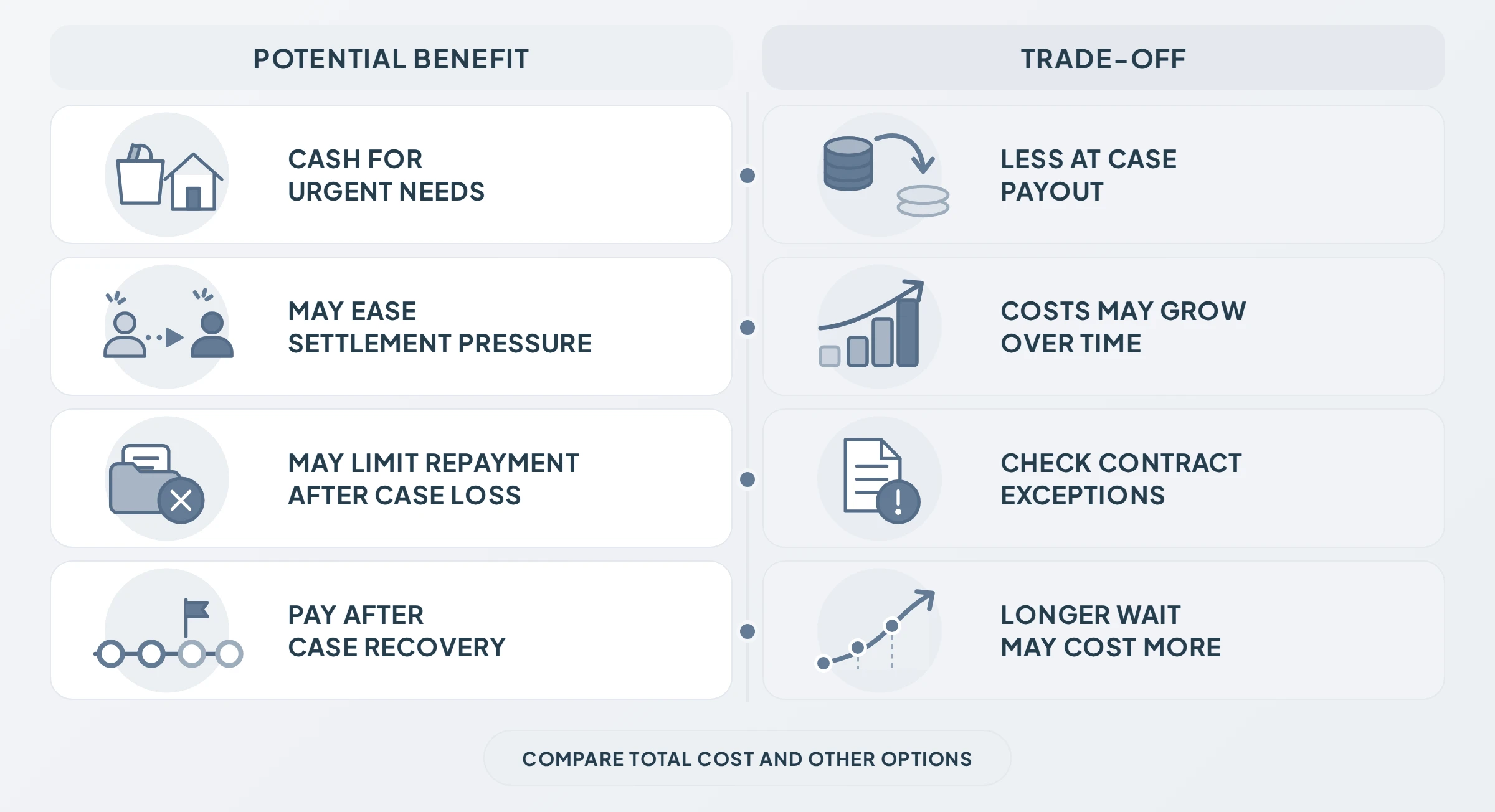
| Potential benefit | Trade-off to consider |
|---|---|
| Cash can help cover urgent living expenses. | Repayment reduces the proceeds available when the case pays out. |
| Funding may ease immediate pressure to settle. | It does not guarantee a better outcome, and accruing charges can create pressure later. |
| Non-recourse terms can protect against repayment after an ordinary case loss. | Exceptions and the treatment of an insufficient recovery still need review. |
| Repayment can be deferred until case proceeds are available. | A longer wait may increase the payoff, depending on the pricing terms. |
Before deciding, consider payment plans, hardship arrangements with creditors, family support or other financing you can realistically manage. Compare the complete cost and repayment obligations. A conventional loan, for example, may require repayment even if the case generates no revenue.
Borrowing less can reduce charges when pricing is tied to the funded amount. If additional draws are available, check whether charges start only when each draw is paid and whether commitment fees or minimum charges apply.
How does it differ from other settlement-related funding?
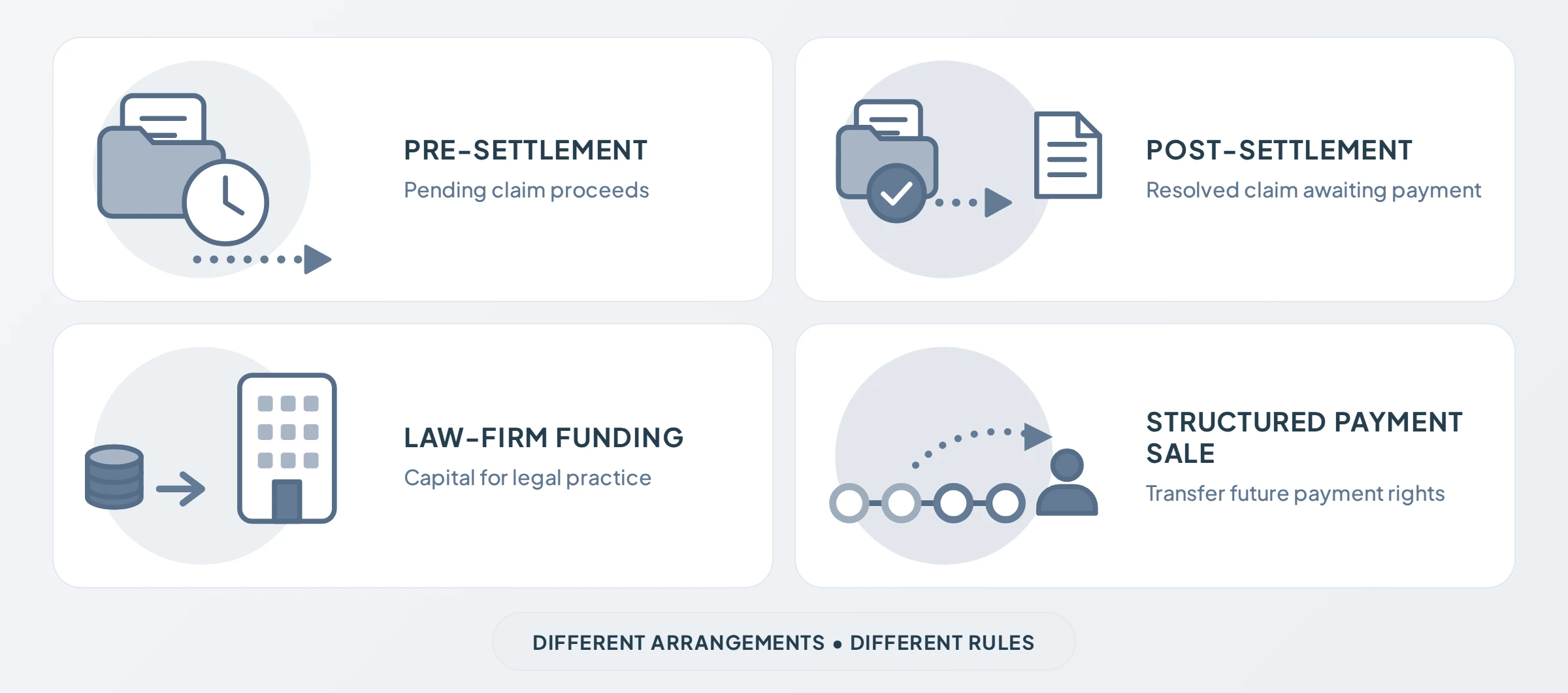
Similar names can describe very different arrangements.
| Arrangement | What you're accessing | Important distinction |
|---|---|---|
| Pre-settlement consumer funding | Potential proceeds of a pending claim. | The claim is unresolved; repayment terms and outcome risk matter. |
| Post-settlement funding | Money from a resolved claim awaiting payment or distribution. | Collection, approvals and liens may still affect access. Lower pricing is not automatic. |
| Law-firm funding | Capital supplied to an attorney or firm. | Funding case expenses does not automatically remove those expenses from the client's obligations. |
| Structured settlement payment sale | Existing rights to receive future periodic payments. | This is a separate transfer transaction, with its own approval requirements. |
For structured settlement factoring, 26 U.S.C. § 5891 provides an excise-tax exception when payment rights are transferred with advance approval in a qualified order. Applicable state transfer laws also matter. That process should not be confused with getting a consumer advance on a pending claim.
Waiting on a Settlement? Find Out If Your Case Qualifies.
Mysettlement reviews cases quickly and gives you a clear answer, fast. No credit check, monthly payments, or obligation to proceed.
Frequently Asked Questions
Do I need good credit to qualify?
Some consumer funders use case-based underwriting without a credit-score requirement. Confirm whether the provider checks credit, income or employment. Approval can still depend on recovery prospects, documentation, prior funding and state availability.
Does my attorney have to participate?
Many providers require attorney cooperation, and some state laws require a specific acknowledgment. Ask about both the provider’s policy and the law governing your agreement. Your attorney should help you understand the terms before you commit.
How quickly can I receive the money?
Timing depends on the review, required documents, completed agreement and disbursement method. Ask for an estimate tied to your actual application, including what still needs to happen before funds can be sent.
Can I get another advance or switch funders?
Possibly, depending on the provider, existing agreement and remaining case value. A buyout can pay off earlier funding, but part of the new advance may go to that payoff. Compare the cash you receive now and the full new obligation.
Can the funder decide when I settle?
Check the governing law and agreement. Some statutes expressly protect the consumer’s and attorney’s control over settlement decisions while permitting case-status updates. Review any clause that gives the funder approval rights or influence over legal strategy.
Will funding affect taxes or benefits?
Don’t assume the answer from a “not a loan” label. If you receive means-tested benefits or have tax questions, get advice specific to your situation before accepting funds. Ohio’s replacement contract rules, effective October 6, 2026, expressly flag the possible need for tax, benefits or financial advice.
Talk through your funding questions
Before accepting an advance, get a written offer, review it with your attorney and work through what could remain after the payoff. You should understand the cash available today and its possible effect on your eventual recovery.
Contact MySettlement to discuss the next steps for your case.
Information checked October 5, 2026. State-law examples apply to covered transactions and are not a complete legal or provider-availability map.
Your Case Has Value Right Now. You Don't Have to Wait Years to Access It.
Mysettlement works with plaintiffs and their attorneys to structure advances around what your case is actually worth. Free consultation, clear terms, fast decisions.