



One specialist stays with you from your first call through funding.
October, 2026
Structured settlement types describe how your payments are arranged: how long they last, when they arrive and whether their amounts change. You might receive payments for a fixed term, for life or on specific future dates.
Those features can overlap. One settlement might combine an increase in monthly income, a guaranteed period, and a future lump sum. Your payment documents show which conditions apply to each part.
Personal injury and medical malpractice describe the underlying claim. The payment arrangements below describe how you receive the compensation.
Types Based on Payment Duration
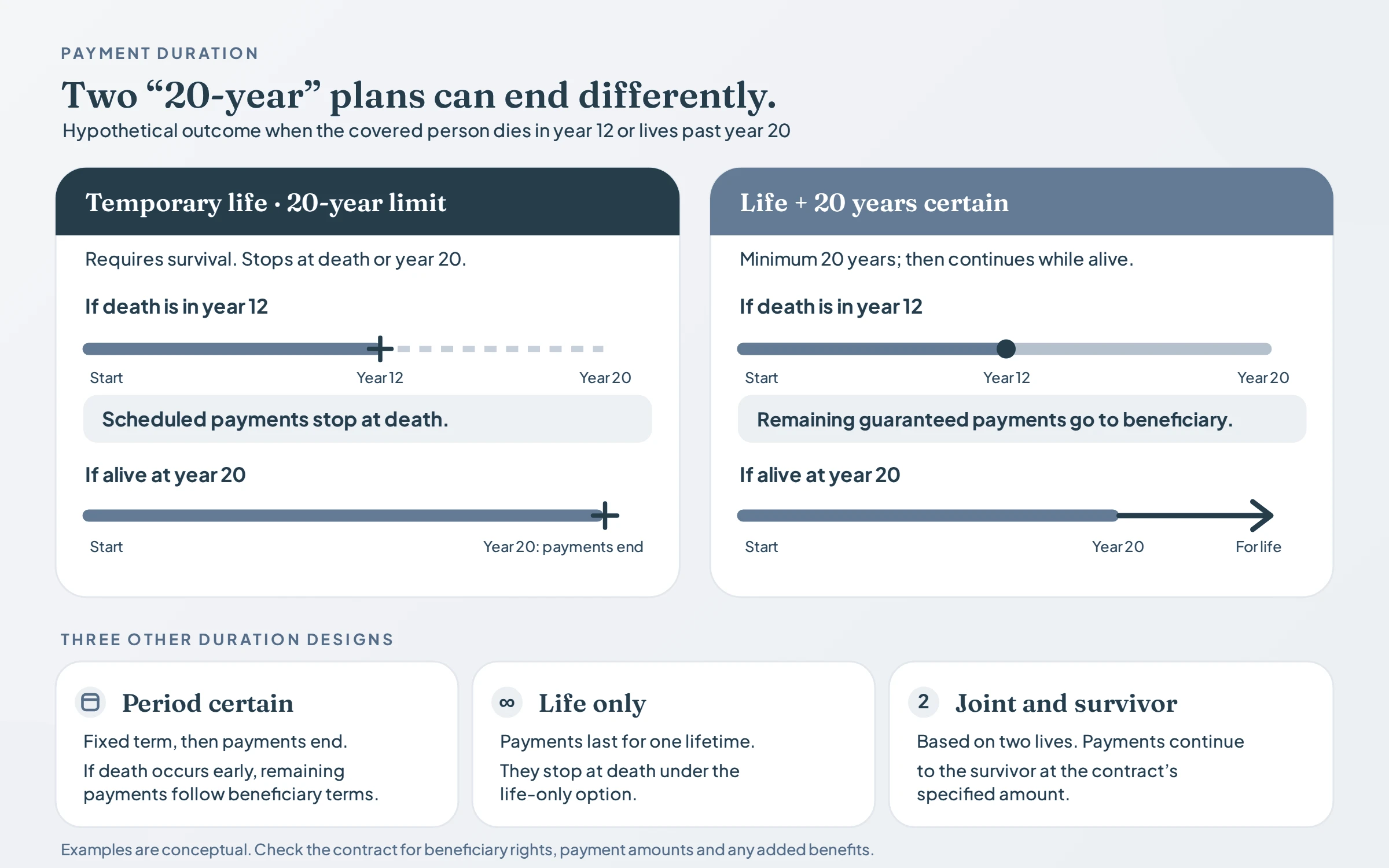
The annuitant is the person whose life determines life-based annuity payments. A guaranteed period provides scheduled payments for a specified term, even if the person dies during that term.
Temporary life and life with a guaranteed period are different arrangements. Temporary life has an end date and requires survival. Life with a guaranteed period can continue beyond that period for the covered lifetime.
Compare two hypothetical schedules: temporary life payments with a 20-year limit stop if the covered person dies earlier. Life payments with 20 years certain keep their remaining guaranteed payments payable after an early death and can continue beyond year 20 if the covered person survives.
The Society of Actuaries’ structured settlement guide and New York’s annuity definitions explain these distinctions. Additional contract benefits can change death benefits. Insurer-backed guarantees depend on the insurer’s ability to meet its obligations.
| Arrangement | How long payments continue | What happens after death |
|---|---|---|
| Period certain | For the agreed fixed term. | Remaining guaranteed payments follow the beneficiary provisions. |
| Life only | For the covered person’s lifetime. | Payments stop under the life-only option. |
| Temporary life | Until death or the agreed end date, whichever comes first. | Remaining life-contingent payments stop. |
| Life with a guaranteed period | For life, with a minimum guaranteed term. | Remaining guaranteed payments continue if death occurs during that term. |
| Joint and survivor | Based on two covered lives. | The surviving annuitant receives payments at the amount specified in the contract. |
Types Based on Payment Amounts
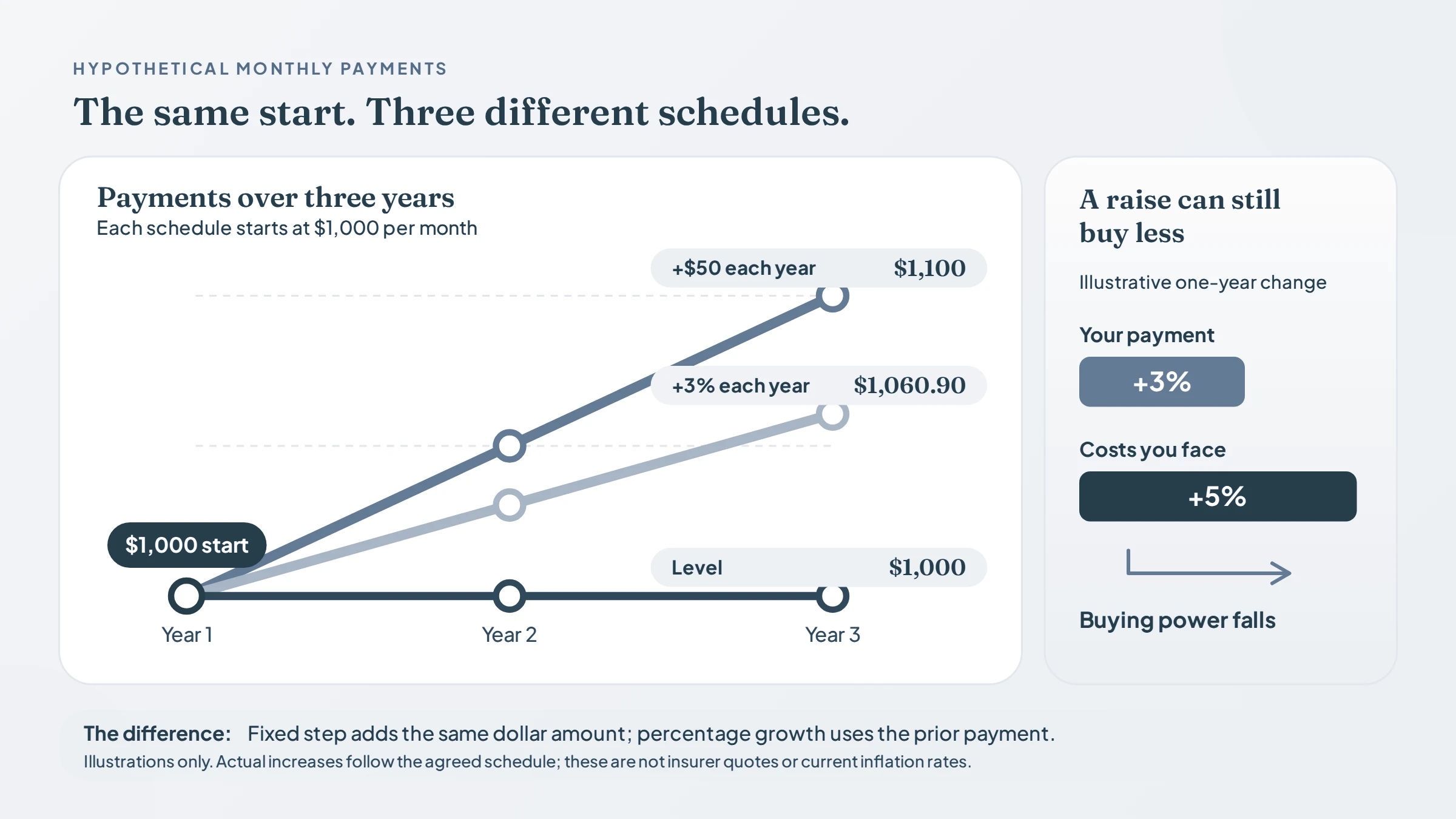
Level payments stay the same amount. A schedule might provide $1,000 each month for ten years. The amount is predictable, but rising prices can reduce what it buys.
Step-up payments increase by agreed dollar amounts at specified dates. Percentage increases raise payments by a stated percentage. These increases must follow the schedule’s terms; they are not automatic adjustments you can request whenever expenses rise.
A fixed increase can help address rising costs. It does not guarantee that payments will match actual inflation. An index-linked adjustment also works differently from a fixed percentage increase.
Payment increases and inflation are separate numbers. If payments rise 3% while the costs you face rise 5%, the higher payment still buys less. These percentages illustrate the difference; they are not current inflation figures.
Here is a hypothetical comparison of monthly payment amounts. Every schedule starts at $1,000. The examples explain the arithmetic; they are not insurer quotes or sale offers.
| Year | Level payment | Annual $50 increase | Annual 3% increase |
|---|---|---|---|
| 1 | $1,000.00 | $1,000.00 | $1,000.00 |
| 2 | $1,000.00 | $1,050.00 | $1,030.00 |
| 3 | $1,000.00 | $1,100.00 | $1,060.90 |
Types Based on Payment Timing
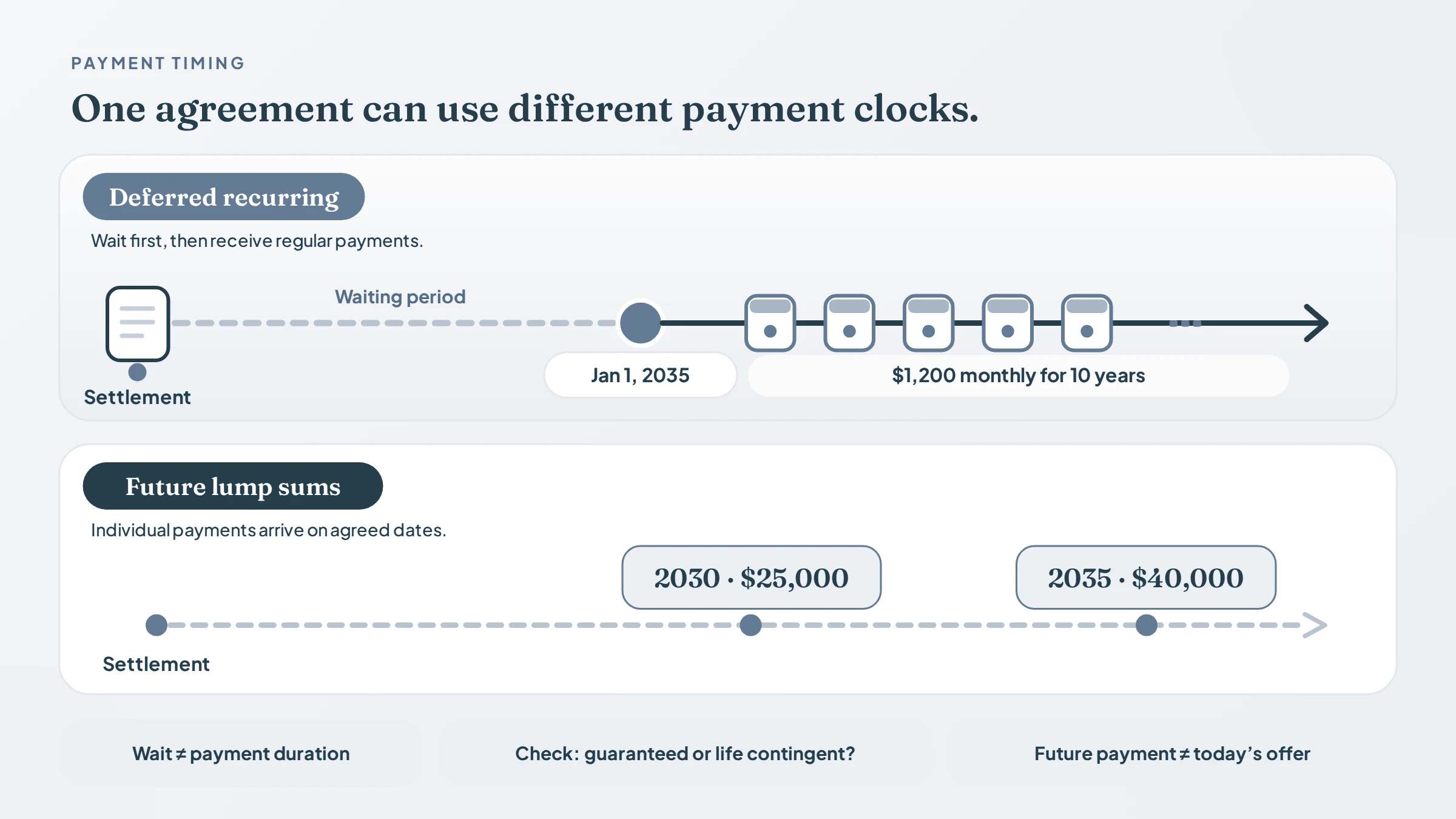
A schedule may start paying soon after settlement or delay payments until a later date. Recurring payments can arrive monthly, quarterly, semiannually or annually. The CFPB’s payment guidance also recognizes schedules containing several lump sums.
Deferred Recurring Payments
These start later and then follow a recurring schedule. A hypothetical arrangement could pay $1,200 per month for 10 years, beginning on January 1, 2035. The waiting period and the payment duration describe separate parts of the arrangement.
Scheduled Future Lump Sums
These are individual amounts due on agreed future dates. They can stand alone or sit alongside recurring payments. A schedule might include $25,000 in 2030 and $40,000 in 2035.
A future lump sum can be guaranteed or contingent on life. Check whether the payment remains payable after the covered person dies. It is also different from a buyer’s offer today to purchase the right to future payment.
Combining Different Payment Arrangements
A settlement can address several needs in a single agreed schedule. Some compensation may be paid upfront, with another portion funding future payments.
Hypothetical example: the arrangement provides upfront cash, monthly payments for life with 20 years guaranteed, and a $30,000 payment due in 2035. Each component needs its own amounts, dates and conditions.
The lifetime payments and the future lump sum may have different survival requirements. Read each line separately. Calling the overall arrangement a hybrid does not tell you what every payment guarantees.
Specialist Products and Funding Methods
Some arrangements include index-linked or interest-rate-linked features, with outcomes governed by the product’s rules. Market-based arrangements can include investment-dependent payments. Review which amounts are guaranteed and which depend on investment results.
Treasury funding describes what backs payments. 26 U.S.C. § 130(d) allows qualifying U.S. government obligations as funding assets, alongside qualifying annuity contracts. It does not describe how often payments arrive.
Product guarantees, tax treatment and transfer eligibility need separate review. An index-linked settlement feature should also be distinguished from a retirement product marketed as a “structured annuity.”
Identify Your Own Payment Arrangement
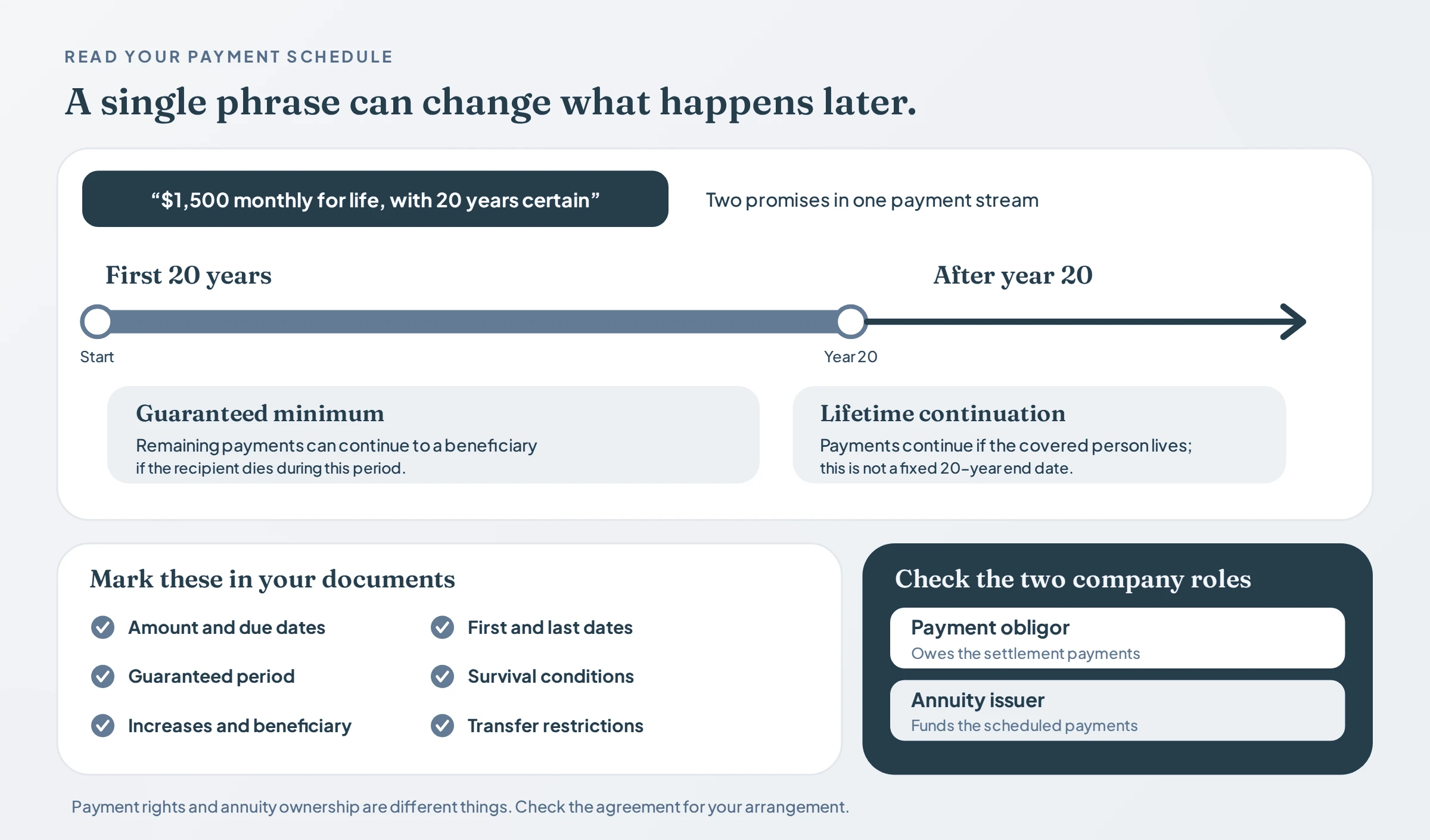
Start with the settlement agreement and payment schedule. The annuity documents can clarify funding and benefit provisions. Highlight:
- Each payment amount and due date.
- The first and last scheduled dates.
- Any guaranteed period and its end date.
- Survival conditions for each payment stream.
- Increases, beneficiary provisions and transfer restrictions.
Example wording: “$1,500 monthly for life, with 20 years certain.” This describes lifetime payments with a minimum guaranteed period. It does not describe temporary life payments ending after 20 years.
Also identify the payment obligor, the party owing the settlement payments, and the annuity issuer funding them. They can be different entities. Holding payment rights does not necessarily make you the annuity owner.
Missing the documents? NSSTA’s claimant guidance identifies the payment administrator, original attorney and assisting broker as possible sources of copies.
How Payment Types Affect a Sale
A buyer reviews the specific payment rights offered for transfer. Dates, guaranteed periods, survival conditions, and restrictions matter. At a positive discount rate, an otherwise identical payment due later has a lower present value.
Ask for the payments being transferred, the income you retain, all deductions and the net cash offer in writing. The total of future payments is a different figure from today’s purchase price.
Considering a partial sale? List the amounts and dates you would give up, then mark the payments you keep. Check whether that retained income would still cover your expenses.
Selling structured settlement payment rights follows applicable state rules and federal provisions, including the qualified-order framework in 26 U.S.C. § 5891. A payment label alone does not establish sale eligibility or approval.
Common Questions About Settlement Types
Are Monthly and Annual Payments Different Types?
They describe payment frequency. Either can have a fixed term, survival conditions or scheduled increases. Check frequency alongside duration, amounts and guarantees.
Can I Change My Payment Type Later?
Check for any options agreed in your documents. A qualified assignment transfers the payment obligation to an assignee under 26 U.S.C. § 130. Amounts and dates must be fixed and determinable, and the recipient cannot unilaterally change them.
An agreed schedule can include increases. Fixed and determinable does not mean level payments. A payment-rights sale follows a separate process.
Are All Payment Types Tax Free?
The underlying claim and tax rules determine that. 26 U.S.C. § 104 provides exclusions for qualifying physical-injury or physical-sickness damages and qualifying workers’ compensation payments. Punitive damages, for example, are generally taxable even in a physical-injury case. Choosing monthly payments does not create a tax exemption.
Talk Through Your Payment Documents
Considering a transfer? Ask MySettlement to review your payment details. Bring the schedule, amounts and conditions so the discussion focuses on the rights you actually hold.