



One specialist stays with you from your first call through funding.
October, 2026
Your settlement is complete, but your first monthly payment is still years away. That gap may be part of the original agreement. It doesn’t necessarily mean something has gone wrong.
Deferred structured settlement payments are payments scheduled to begin on an agreed future date. A recurring payment stream might start five years after the settlement and then pay monthly for ten years. Other settlement money could arrive earlier.
The first payment date indicates when income begins. Your documents also explain what happens during the wait, what survives your death and which rights you would give up through a sale.
How Deferred Payments Work
A structured settlement spreads compensation across an agreed schedule. Deferral adds a waiting period before a particular stream begins.
Think of the schedule in two parts: the wait before income starts and the period when payments arrive. Five years of waiting followed by ten years of monthly payments gives you ten years of payments, not fifteen.
What You Own During the Wait
In a common annuity-funded arrangement, an assignment company assumes the payment obligation and owns the annuity that funds it. You hold the right to receive the scheduled payments. That right is different from owning an account from which you can withdraw money.
The IRS discusses this ownership distinction in Revenue Ruling 2003-115. Annuity paperwork showing a value does not, by itself, establish that the amount is available to you as cash.
Similar Terms Mean Different Things
| Arrangement | What happens |
|---|---|
| Deferred recurring payments | A payment stream starts later, then follows its schedule. |
| Future lump sum | One larger payment arrives on a specified future date. |
| Delayed lawsuit payout | An unresolved claim or processing issue holds up money; this is a separate problem. |
| Retail deferred annuity | A separately purchased insurance product has its own ownership, access and tax rules. |
Why Choose a Later Start?
A later start can match an expected change in your finances. Someone who still earns a salary might plan settlement income for retirement. A family might arrange payments around a child’s future living or education costs.
The National Structured Settlements Trade Association describes future start dates as one planning option. The useful question is how that date fits the recipient’s expenses.
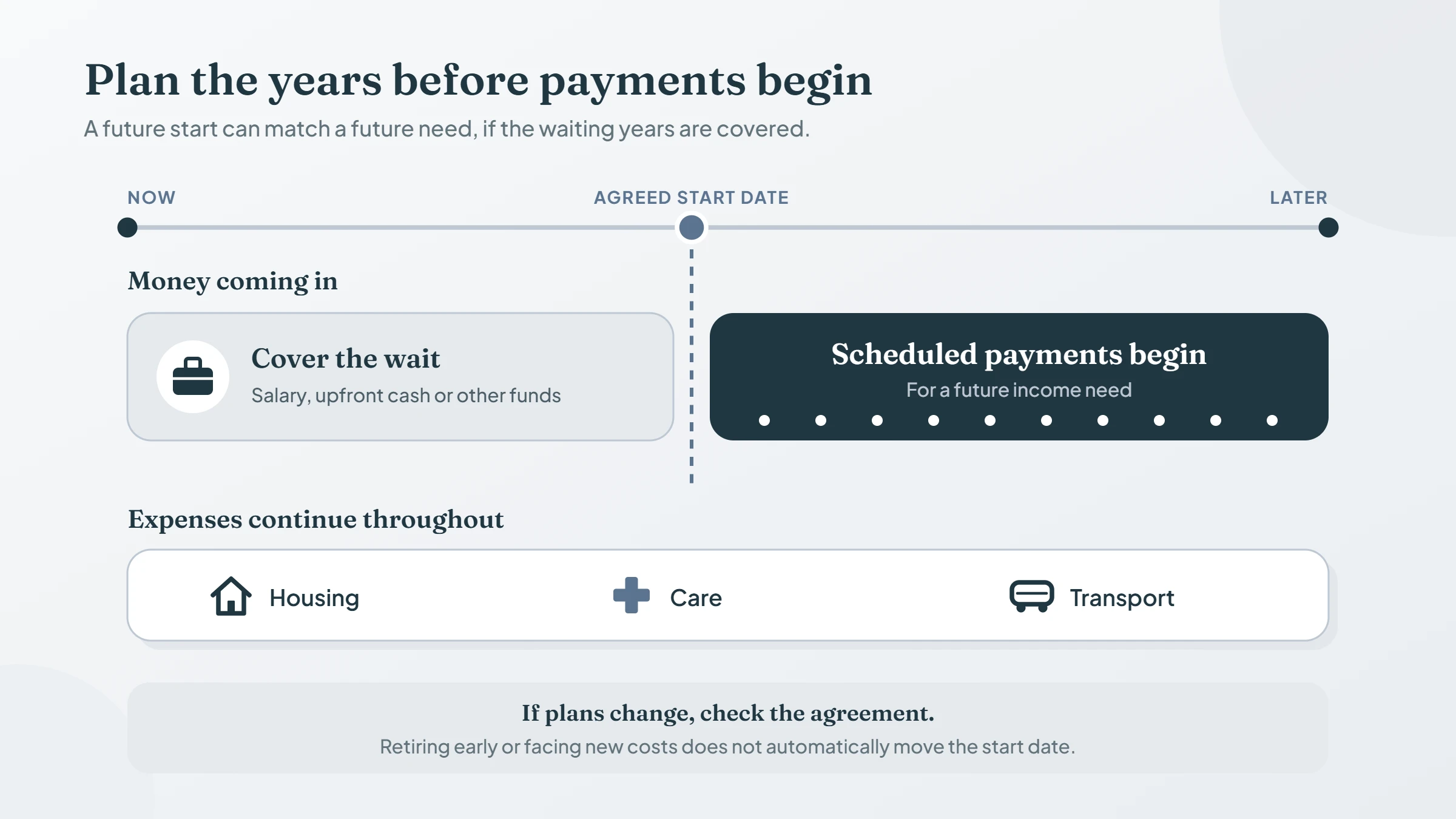
Before agreeing to a deferred stream, work through these questions:
- What pays the bills during the wait? Include housing, treatment, transport and emergency expenses.
- What happens if plans change? Early retirement or additional care may bring costs forward.
- Is some cash needed now? The original settlement can combine upfront money with later payments.
- How long must the income last? A fixed payment term and lifetime income meet different needs.
A date chosen around retirement generally stays a scheduled date. Retiring early doesn’t automatically bring the checks forward. The same applies when education or medical plans change: check the agreement’s actual conditions.
Read Your Payment Calendar
Ask for the complete schedule, not just the total payout. A headline amount leaves out the dates that determine when you can actually spend the money.
Consider this hypothetical stream: $1,000 monthly for 120 certain payments, beginning January 1, 2032. “Certain” means the specified payments do not depend on continued survival. Using January 1, 2027 as the comparison date, the wait is five years.
Check the first date, frequency, payment count, final date and any increases together. Also look for survival conditions and previous transfers that could change which payments remain yours.
Keep the original schedule and current remaining schedule side by side. A previous sale could mean the original first payment is no longer yours. Check who receives each payment, especially if a trust, guardian or servicing company is involved.
If a scheduled payment is already overdue, contact the issuer or administrator. That is a payment-delivery question, distinct from a future start date agreed in the settlement.
| Schedule detail | Hypothetical example |
|---|---|
| Comparison date | January 1, 2027 |
| First monthly payment | January 1, 2032 |
| Monthly amount | $1,000 |
| Number of payments | 120 |
| Final payment | December 1, 2041 |
| Total scheduled dollars | $120,000 |
Does Waiting Increase the Value?
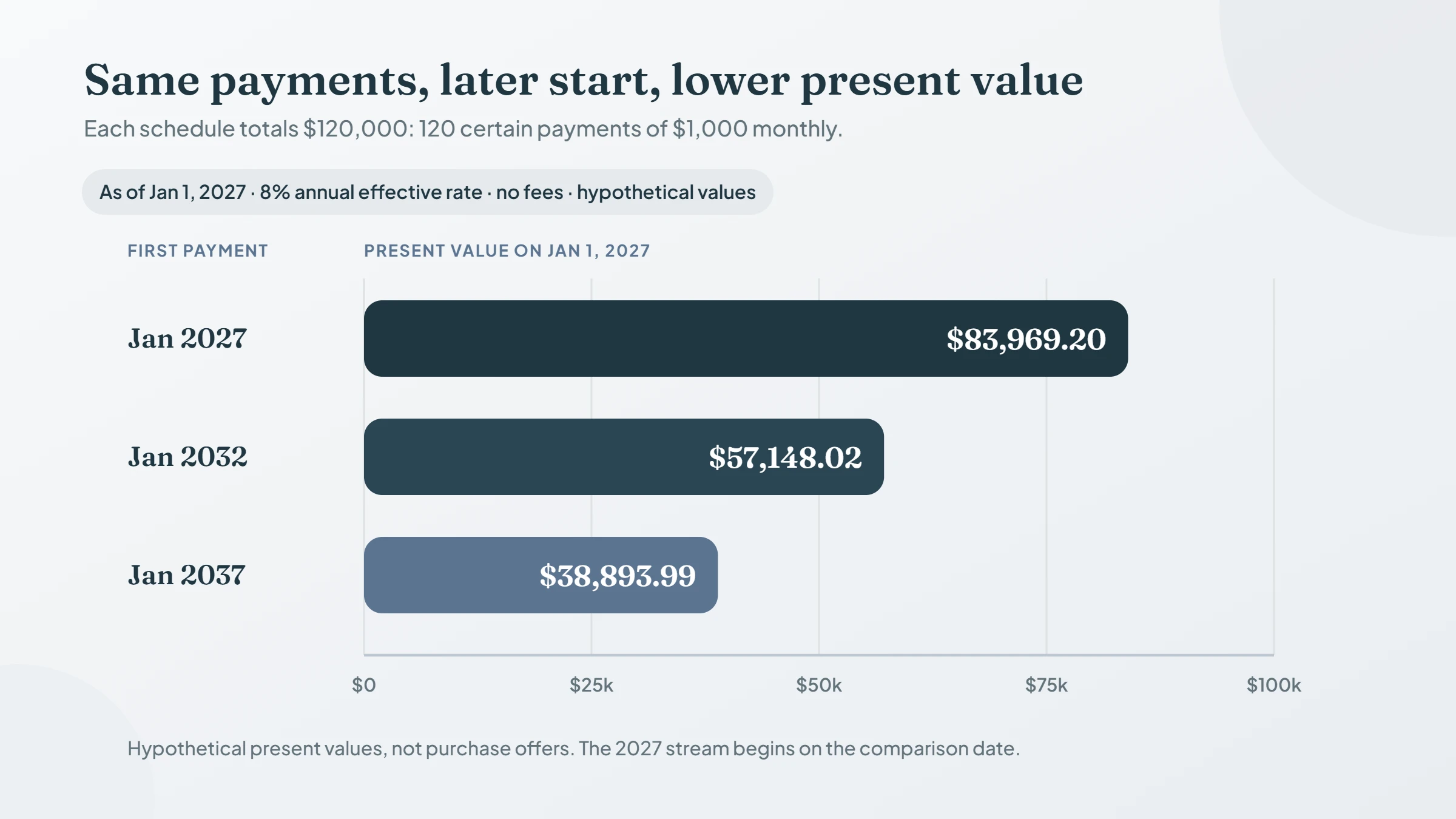
There are two different comparisons here. Keeping the same payment amounts but moving them further into the future reduces their present value at a positive discount rate. Present value expresses future payments as a value on a chosen comparison date.
Designing a new settlement involves a different question. A given funding budget may support larger later checks than earlier checks. Compare actual insurer illustrations, including the payments forgone during the waiting period, the duration, and the survival conditions.
Check Purchasing Power Too
Larger future checks can still buy less than expected if prices rise. At an assumed 3% annual inflation rate, $1,000 received five years later buys roughly what $862.61 buys today. That is a hypothetical calculation, not an inflation forecast.
BLS explains purchasing power as the goods and services money can buy. If your payments increase, check when those increases start. A fixed annual increase does not guarantee that payments keep pace with prices.
The Same Dollars Arriving Later
This comparison holds the amount and count steady: $1,000 monthly for 120 certain payments. All values are calculated as of January 1, 2027 using an illustrative 8% annual effective discount rate, converted to an equivalent monthly rate, and no fees.
The 8% assumption is neither an industry standard nor a predicted offer. The first row includes a payment on the comparison date itself; the other rows move that entire schedule later.
| First payment | Scheduled total | Hypothetical present value |
|---|---|---|
| January 1, 2027 | $120,000 | $83,969.20 |
| January 1, 2032 | $120,000 | $57,148.02 |
| January 1, 2037 | $120,000 | $38,893.99 |
Death Before Payments Begin
A delayed start does not tell you what happens after death. The answer comes from the payment guarantee, survival conditions and beneficiary provisions.
Certain payments can remain payable after the measuring person dies. Life-contingent payments depend on that person being alive at the required time. An arrangement may combine these features, so read each component separately. The Society of Actuaries’ benefit definitions distinguish these payment designs.
Ask the issuer or administrator:
- Whose survival controls these payments?
- What remains payable if that person dies before the first check?
- When does any guaranteed period begin and end?
- Who receives the remaining benefits?
- Does the contract provide a lump-sum death benefit or commutation, meaning conversion of specified future benefits into cash?
A beneficiary designation identifies a recipient; it does not create benefits the contract never promised. A commutation amount is calculated separately and may be lower than the total of future checks.
Ask for the answer separately for death during the waiting period and death after payments begin. Those provisions can differ. Keep beneficiary details current, and give the person handling your affairs the issuer’s contact information and relevant documents.
“Guaranteed” describes the payment obligation. It is not a federal guarantee: an insurer’s promise depends on its ability to pay claims.
Can Payments Begin Sooner?
Usually, you cannot simply ask the insurer to move your schedule forward. IRC §130(c)(2) requires qualified-assignment payments to have fixed, determinable amounts and timing, and prevents recipients from unilaterally changing them.
An agreed future start is therefore different from deciding later that you want the money now. Start by asking the issuer what your existing documents permit.
Ask About Issuer Programs
Some arrangements may have an issuer-related hardship option. Berkshire Hathaway’s payee resources, for example, direct recipients to a Hardship Exchange Program.
Ask about eligibility, pricing, which rights change hands and required approval. A program can involve a purchase of payment rights; its existence does not establish an ordinary withdrawal right. Other issuers may have different options or none.
Check What an Advance Changes
A separate sale may also be possible before the first payment. Calling an arrangement a “loan” or “advance” does not settle its legal treatment. IRC §5891(c)(3) includes certain pledges and encumbrances within its factoring definition, subject to exceptions.
Have the actual agreement reviewed. Identify whether your future rights are being sold, assigned or pledged, and what obligations remain if the proposed transaction falls through.
Selling Before the First Payment
You may be able to sell eligible, established payment rights even when checks have not started. Eligibility depends on the documents, applicable law and proposed transaction. The first payment’s distance also affects valuation.
The federal factoring framework and state structured settlement protection laws govern these transactions. Advance approval is central to the process; applicable findings include the recipient’s best interests and dependents’ needs. A buyer’s willingness to proceed does not guarantee approval.
The offer should identify the difference between total future dollars and cash paid now. A $24,000 payment stream does not imply a $24,000 purchase price. Review the discount and deductions alongside the expenses the transferred payments were intended to cover.
Questions Before Signing
The Consumer Financial Protection Bureau recommends reviewing costs, alternatives, independent advice and cancellation rights. Get these answers in writing:
- Payments sold: Which exact amounts and dates are included?
- Cash received: What is the net payment after every deduction?
- Income retained: What remains, when does it arrive and who delivers it?
- Independent advice: Whom does the adviser represent, and who pays them?
- Cancellation: What is the deadline and procedure? What happens to any advance if you cancel or approval is denied?
Advice requirements vary. North Carolina requires independent professional advice; New York permits a specified written waiver. A purchaser’s attorney connection does not automatically meet the applicable independence rules.
A Partial Sale Changes Your Calendar
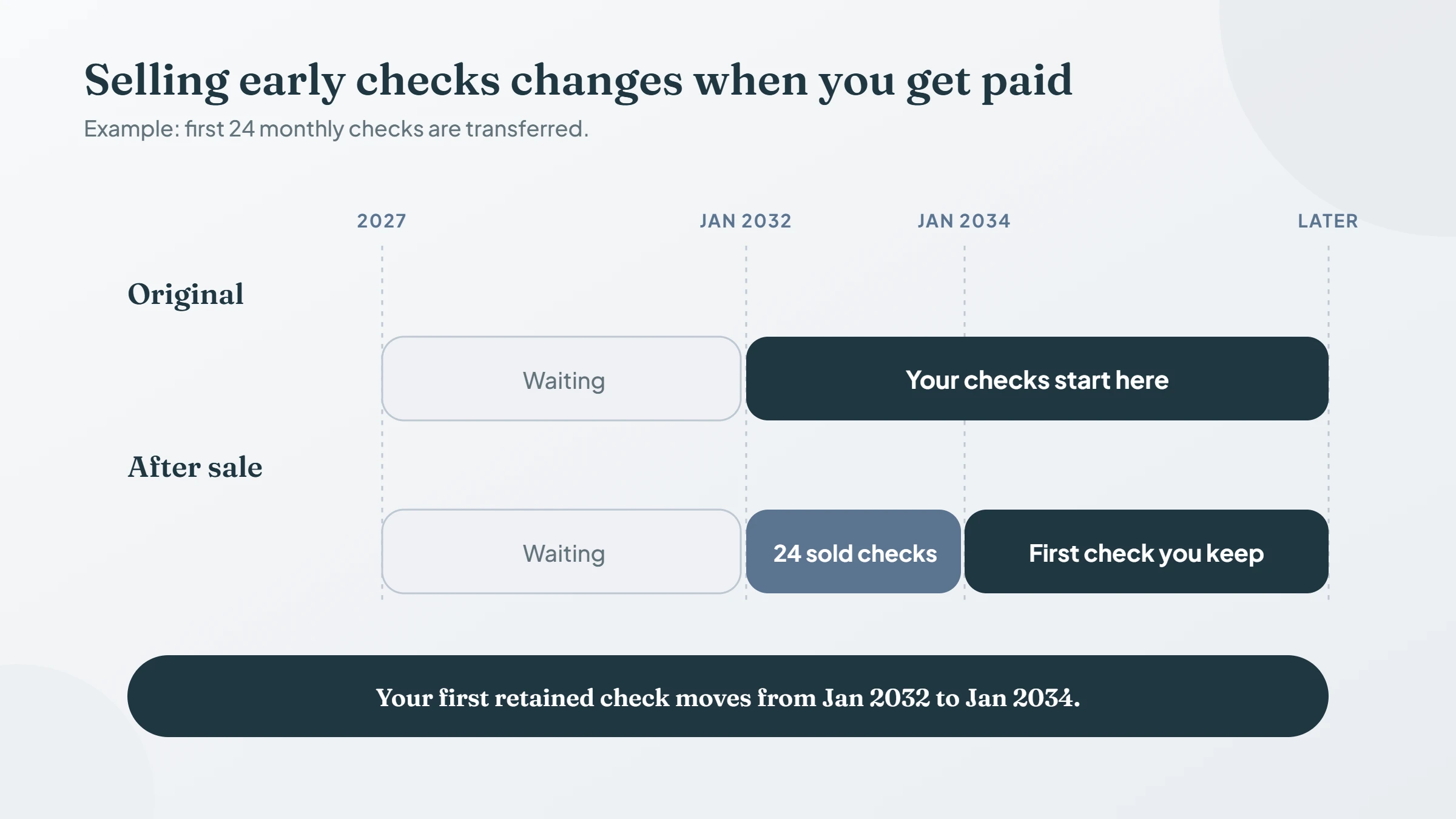
Return to the $1,000 monthly example starting in January 2032. Selling the first 24 checks would remove January 2032 through December 2033 from your retained income. Your first retained check would move to January 2034.
Selling the final 24 would affect different years. These hypothetical choices transfer the same scheduled dollars, but have different present values and budget consequences. Neither option’s availability is assumed.
| Payment rights sold | Scheduled dollars sold | First retained payment |
|---|---|---|
| None | $0 | January 1, 2032 |
| First 24 checks | $24,000 | January 1, 2034 |
| Final 24 checks | $24,000 | January 1, 2032 |
Now you know the number. Ready to act on it?
Most buyers won’t tell you what your settlement is actually worth. Now you know. Let’s get you a real offer.
Taxes and Public Benefits
Delaying payments does not automatically make them tax-free or protect benefit eligibility. These are separate questions.
Tax Treatment Follows the Compensation
IRC §104(a)(2) generally excludes qualifying physical-injury or physical-sickness damages from federal gross income, paid as lump sums or periodic payments. Properly arranged qualifying payments can retain that treatment across later dates.
Employment wages, generally taxable punitive damages and separately awarded interest need different treatment. Previous medical-expense deductions can also matter. IRS Publication 4345 explains these distinctions.
Taking settlement cash and later buying a personal annuity does not automatically give its earnings the same exclusion. Arrange tax advice before accepting or gaining unrestricted access to the relevant funds.
SSI and SSDI Are Different
Supplemental Security Income, or SSI, has income and resource rules. A future start date alone does not determine eligibility. SSA’s resource rules consider ownership and the ability to convert property into cash for support; settlement-income rules also matter when money arrives.
Social Security Disability Insurance, or SSDI, follows different rules. SSA’s guidance distinguishes private disability payments, which do not affect SSDI under that guidance, from workers’ compensation and public disability payments that may reduce it.
Identify your benefit program and compensation source before choosing dates or selling rights. Medicaid and trust arrangements need their own review. Federal tax exclusion does not automatically establish protection under those programs.
What Is a Future Payment Worth Today?
Your settlement has a number. Let's make it work for you.
Get a free, no obligation quote from a specialist who actually knows what your payments are worth.
Common Questions About Deferred Payments
How Long Can Payments Be Deferred?
There is no single waiting period that applies to every structured settlement. Available terms depend on the funding arrangement and product. Check the actual first-payment date; a stated deferral period may not identify the precise day the first check arrives.
Must I Wait Until Age 59½?
No universal age-59½ requirement controls these payments. IRC §72(q)(2)(G) provides an exception to that subsection’s early-distribution tax for qualified funding assets. Your payment’s classification matters. The exception does not give you a right to accelerate scheduled income.
Does Turning 18 Release Every Payment?
No. A child’s later scheduled payments do not automatically become immediately payable at 18. Review the payment dates, access provisions and court orders. Separate blocked cash accounts may follow different rules from the settlement’s annuity-funded payments.
Is This Pre Settlement Funding?
No. This guide concerns payment rights under an existing settlement arrangement. Pre-settlement funding relates to a pending claim. An expected recovery and an established payment schedule are different starting points.
Where Can I Get My Schedule?
Contact the issuer or payment administrator through verified contact details. Request a current benefit letter and remaining schedule. New York Life’s service guidance offers an example of that process. Keep the settlement agreement, assignment documents, beneficiary information and any transfer orders together.
Check the Dates Before Deciding
Start with the first payment you still own, the income needed until then and the benefits a sale would remove. Those details make a cash offer easier to assess.
If you’re considering selling structured settlement payments, bring the complete schedule to the discussion. Ask which rights are eligible, what net cash is offered, and exactly what income remains afterwards.