



One specialist stays with you from your first call through funding.
October, 2026
Increasing structured settlement payments rise according to a schedule or formula agreed upon when the arrangement is established. Your monthly payment might increase by $50 each year, by a set percentage, or jump to a higher amount on specific dates.
That can help when today’s settlement needs to cover expenses years from now. But a larger check does not always mean greater buying power. The timing, calculation and conditions attached to each increase matter just as much as the amount.
Here’s how to read those terms, check the numbers and understand what happens if you sell some of your future payments.
How Do Payment Increases Work?
A structured settlement pays compensation over time. An increasing payment schedule builds changes into that arrangement from the start. The amount can change even though the terms governing those changes are fixed.
Two common approaches are dollar increases and percentage increases. They produce different results, even when the first payment is identical.
Fixed Dollar Increases
A schedule could start at $1,000 a month and add $50 on each annual anniversary. The monthly amount would become $1,050 in year two and $1,100 in year three.
Other arrangements use larger steps on selected dates. Payments might rise when a child reaches adulthood or when anticipated care expenses increase. “Step-up payments” can describe different schedules, so check the actual dollar amounts and dates in the agreement.
Percentage Increases
A percentage increase needs a little more explanation. Does the percentage apply to the original payment or the latest payment?
Also check which part of your settlement grows. A settlement can combine monthly income with scheduled future lump sums. An annual increase attached to the monthly stream does not automatically increase a separate lump sum. Each component needs its own payment terms.
An annual 3% increase, compounded on the previous amount, takes a $1,000 monthly payment to $1,030, then to $1,060.90. Adding 3% of the original $1,000 each year would produce $1,030, then $1,060. The difference grows over time.
The Society of Actuaries’ structured settlement guide discusses fixed annual increases and distinguishes them from actual inflation. A percentage written into your schedule does not automatically change when prices or interest rates change.
What Could Your Payments Look Like?
This illustration starts each schedule at $1,000 monthly. The first increase happens after 12 months, followed by one increase each anniversary. Each monthly payment stays at that year’s amount until the next adjustment.
The percentage calculation is:
Monthly payment in year N = $1,000 × 1.03^(N − 1)
Year ten contains nine increases because year one starts at the original amount. Figures retain full precision until rounded for display; a contract that rounds each annual adjustment can produce small differences.
These are arithmetic examples, not insurer quotes. Equal starting payments do not establish equal funding costs.
| Payment year | Level monthly payment | Add $50 each anniversary | Compound 3% each anniversary |
|---|---|---|---|
| 1 | $1,000.00 | $1,000.00 | $1,000.00 |
| 2 | $1,000.00 | $1,050.00 | $1,030.00 |
| 5 | $1,000.00 | $1,200.00 | $1,125.51 |
| 10 | $1,000.00 | $1,450.00 | $1,304.77 |
| 20 | $1,000.00 | $1,950.00 | $1,753.51 |
Do Increases Keep Up With Inflation?
They can help, but a fixed increase cannot promise that your payments will cover the same expenses forever.
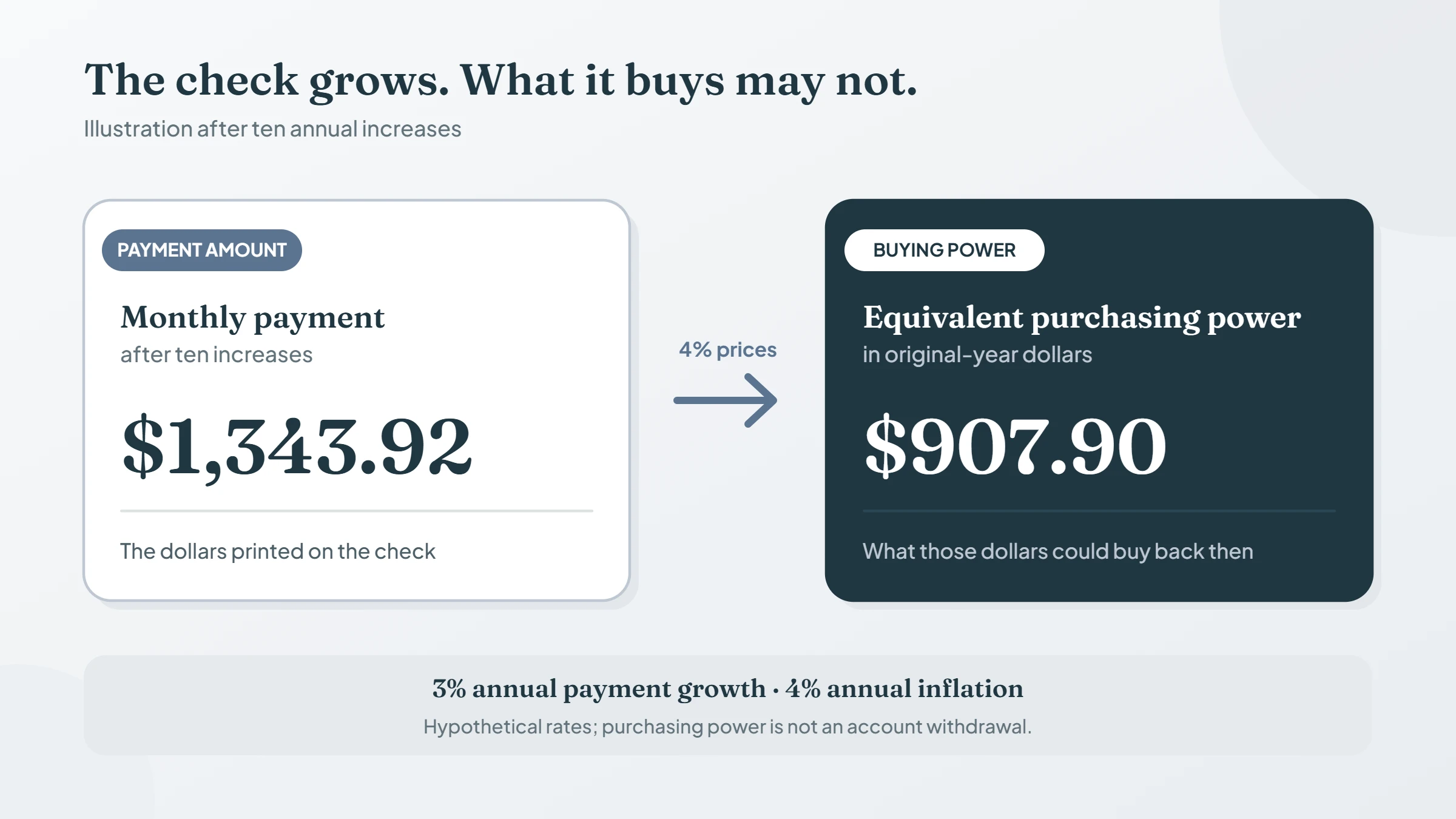
Take a $1,000 monthly payment that grows 3% annually. After ten increases, it reaches $1,343.92. If prices rise by a hypothetical 4% annually over the same period, that larger payment has about $907.90 in the original year’s buying power.
You receive more dollars, yet those dollars buy less. Both rates in this example are assumptions, not forecasts. Your own expenses may also change differently from a national price index, particularly if care costs make up a large share of your budget.
Does COLA Mean Inflation Matching?
COLA stands for cost-of-living adjustment. In structured settlement materials, the label can refer to a predetermined percentage, such as 3% annually. It does not necessarily mean that payments track the Consumer Price Index, or CPI.
A true CPI-based formula needs to identify the index, the measurement period, and the adjustment method. Caps or floors may also limit the result. The Bureau of Labor Statistics’ escalation guidance explains these details; it does not establish that every insurer offers a CPI-linked settlement option.
Are Market Linked Payments Different?
Yes. A stock-market index measures something different from consumer prices. Product rules also differ.
Pacific Life’s ILAPA guide describes S&P-linked annual adjustments with a 5% cap and no reduction in payments for flat or negative index performance. Its Payout Plus guide describes a different mechanism: payments can fluctuate above a guaranteed baseline. A guaranteed minimum does not necessarily preserve the highest payment previously received.
Some products apply index-linked growth only before payments begin. Prudential’s Income Advantage disclosure explains that payments become fixed after the deferral period. Ask whether adjustments happen before payments start, during payout, or both. Availability and insurer guarantees depend on the specific product and issuing insurer.
Why Might Starting Payments Be Lower?
Future increases have a cost. Given the same funding budget, payment duration and guarantees, allocating more money to later years can mean less income at the start. Actual insurer illustrations are needed to measure that trade-off.
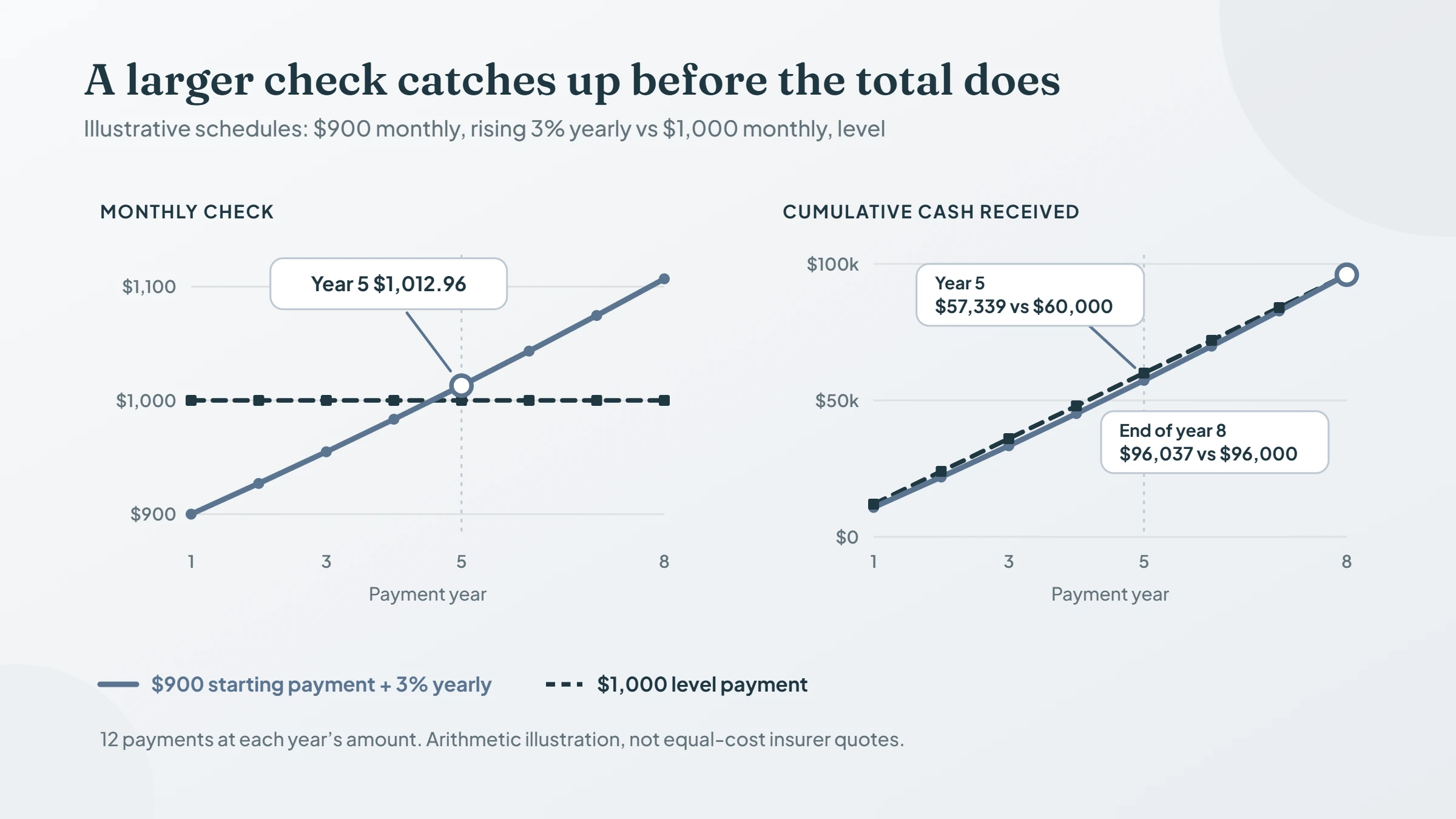
Also, catching up on the monthly payment is different from catching up on the total cash received.
Consider an illustrative $900 monthly payment increasing 3% each anniversary versus a level $1,000 monthly payment. Assume 12 payments at each year’s amount:
- Year five: The growing monthly payment reaches about $1,012.96.
- End of year five: Its cumulative payments total about $57,339, compared with $60,000 for the level schedule.
- End of year eight: Its cumulative total reaches about $96,037, compared with $96,000.
These chosen amounts are not equal-cost quotes. They show why a higher check does not immediately erase earlier income differences. Neither crossover establishes which arrangement has a better present value or meets your needs.
Your current budget matters here. Check whether the starting payment covers essential expenses before relying on increases several years away. If you are still arranging the settlement, ask for side-by-side illustrations using the same funding amount, start date, duration and death-benefit provisions. Changing those assumptions can make one option appear stronger for reasons unrelated to its rate of increase.
Check These Details in Your Agreement
Look at the settlement agreement and payment schedule alongside your latest benefit statement. A headline such as “3% annual increase” leaves several questions unanswered.
The most useful check is the next actual payment: how much should arrive, on which date, and what calculation supports it?
| Detail to find | Question it answers |
|---|---|
| Starting amount | Which payment amount is the calculation based on? |
| Increase method | Is it a dollar step, compounded percentage or conditional formula? |
| First adjustment date | When does the first increase take effect? |
| Adjustment frequency | Does the amount change annually or on another schedule? |
| Covered payments | Does the increase apply to every payment stream or only one? |
| End date | Do increases stop before the payments themselves stop? |
| Survival and guarantee terms | Must a named person be alive for that payment to be due? |
| Rounding rule | Are amounts rounded at each adjustment or only at another calculation stage? |
| Existing transfers | Have any of these payment rights already been sold? |
Now you know the number. Ready to act on it?
Most buyers won’t tell you what your settlement is actually worth. Now you know. Let’s get you a real offer.
Can You Change the Increase Later?
You generally cannot instruct the insurer to increase the agreed amount because your bills have risen faster than expected.
Internal Revenue Code Section 130(c)(2) requires payments covered by a qualified assignment to be fixed and determinable. It also prevents the recipient from unilaterally accelerating, deferring, increasing or decreasing them. A pre-agreed increase follows the arrangement’s terms; a later request for extra money is a different issue.
Court judgments can have separate rules. Certain New York periodic-damages judgments, for example, include statutory increases under CPLR Section 5041. That is not a nationwide increase requirement for negotiated settlements.
An expected increase that fails to arrive deserves a records check. Compare the payment date, anniversary and calculation with your documents, then contact the insurer or payment administrator. A higher inflation figure alone does not establish an underpayment.
Keep a copy of the statement showing the previous amount and identify the first payment you believe should have changed. Ask the administrator to explain the calculation in writing. That makes it easier to distinguish a missed adjustment from a date misunderstanding or a small rounding difference.
Selling Payments That Include Increases
Increasing payments may be proposed for sale, but eligibility and approval depend on the arrangement and applicable law. The proposed transfer must identify exactly which future rights the buyer would receive.
Start with the payment schedule, not just today’s monthly amount. A transaction may include several years of larger future payments, and those increases affect both what is transferred and what remains available for your expenses.
Who Keeps the Future Increases?
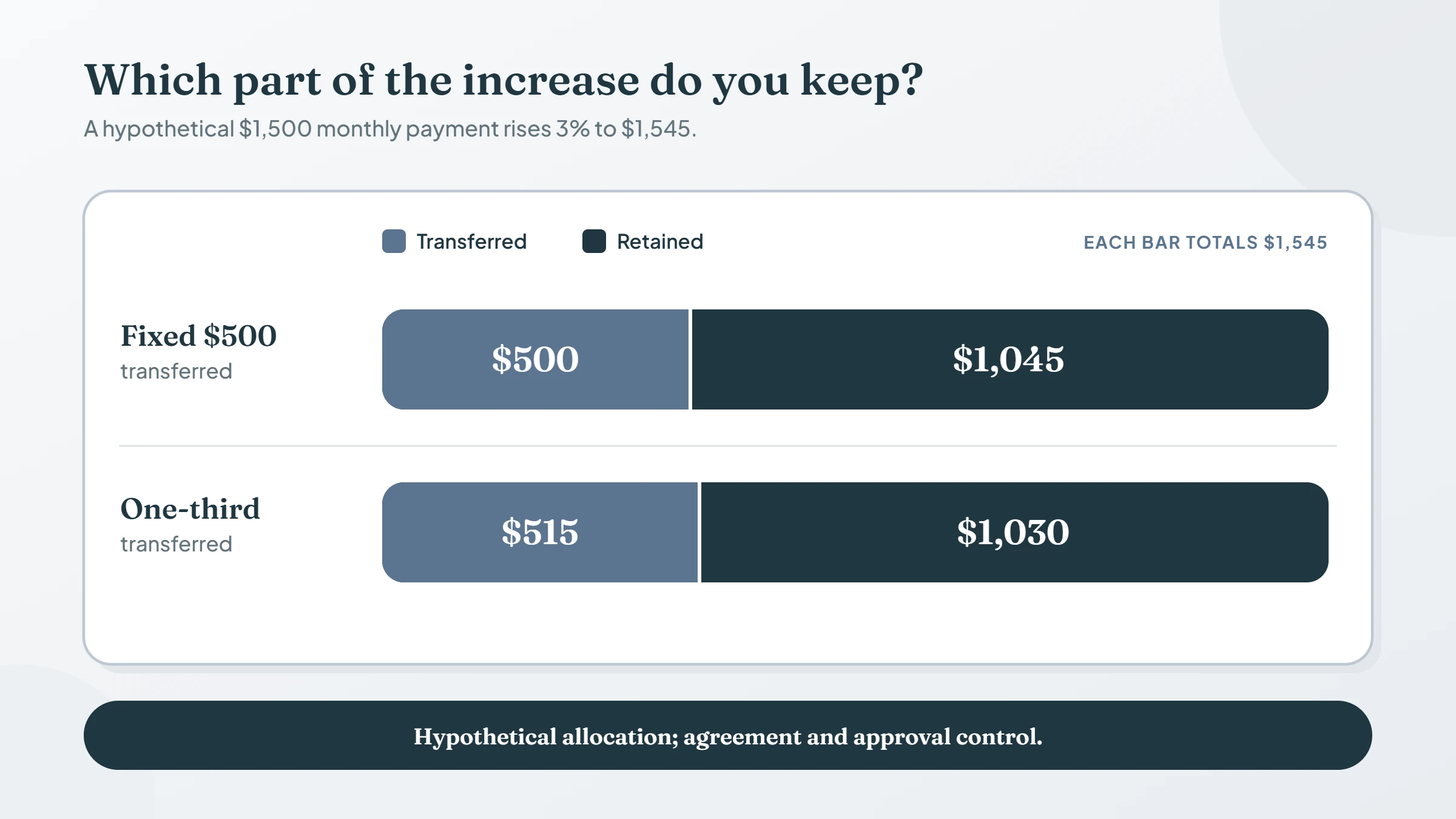
The wording matters. Consider a hypothetical $1,500 monthly payment that rises 3% to $1,545. Transferring a fixed $500 and transferring one-third of each payment produce different retained amounts.
These examples illustrate allocation only. They do not establish that either transaction is available or approvable for your settlement.
Check How Retained Payments Arrive
Keeping part of a payment does not establish that the insurer will send that portion directly to you. A servicing arrangement may handle the split. New York General Obligations Law Section 5-1707(c), for example, says the issuer and obligor cannot be required to divide a periodic payment among recipients under that section.
Ask who receives the insurer’s payment, who forwards your share, how increases are allocated and what costs apply. Get the retained schedule and late-payment contact details in writing.
Compare the Offer and Remaining Income
The Consumer Financial Protection Bureau recommends reviewing costs, future needs and independent advice before giving up payments. Check:
- Every payment amount and date included in the sale.
- The increases included in those transferred rights.
- Gross purchase price, fees and net cash payable to you.
- Payments you retain and the expenses they must cover.
IRC Section 5891 establishes a federal tax framework that encourages qualifying advance approval of transfers. State protection laws supply additional requirements. Approval involves substantive review; signing an offer does not complete the process.
Taxes, Benefits and Death Provisions
An increase answers how much a payment may be. It does not, by itself, answer whether the payment is taxable, affects public benefits or continues after death. Each issue has separate rules.
| Issue | What to check |
|---|---|
| Federal income tax | Qualifying physical-injury or physical-sickness damages can be excluded under IRC Section 104(a)(2). Scheduled growth does not automatically become taxable merely because the payment increases. Claim type and exceptions matter. |
| Separately awarded interest | The IRS states that settlement interest is generally taxable. Distinguish this from scheduled increases forming part of qualifying periodic damages. |
| SSI | Social Security guidance addresses settlement income, exclusions and trust arrangements. A federal tax exclusion does not establish SSI protection. |
| Payments after death | Increasing amounts and guaranteed duration are different features. Check the measuring life, remaining guaranteed payments and beneficiary provisions to determine which future payments remain due. |
Your settlement has a number. Let's make it work for you.
Get a free, no obligation quote from a specialist who actually knows what your payments are worth.
Questions About Increasing Payments
Is There a Standard Annual Increase?
There is no single percentage that applies to every negotiated structured settlement. The 3% used here illustrates the calculation. Your documents establish your schedule, and particular judgment rules may apply separately.
Does Annual Mean Every January?
Not necessarily. An adjustment may occur on the payment anniversary or another specified date. Monthly payment frequency also does not mean the increase applies every month. Check both dates in the schedule.
Is Payment Growth an Investment Return?
A 3% payment increase describes how the checks change. It does not establish a 3% return on investment. Calculating a return requires the cost of funding, payment dates, amounts, and any relevant survival assumptions.
Can a Calculator Value Increasing Payments?
Only if its calculation supports the actual schedule. A form that accepts one unchanged payment amount may miss future increases. Valuation also needs appropriate discounting and any conditions affecting payment. A calculated present value is different from the net cash in a buyer’s offer.
What Should You Check Before Selling?
Put your current payment schedule beside the proposed transfer schedule. Identify every increase you would give up and every payment you would retain. Those details determine the income available after the transaction.
You can contact MySettlement to discuss a proposed sale. Have your payment schedule and any earlier transfer orders ready so the conversation starts with the rights you currently hold.