
Sell Johnson & Johnson Talcum Powder Settlement: Payouts, Timeline, and Payment Options



One specialist stays with you from your first call through funding.
November, 2026
A settlement announcement can bring a sense of relief after years of waiting. It can also raise a new set of questions.
How much will you receive? When will your payment arrive? What happens if you need money before then?
In July 2026, Johnson & Johnson announced a proposed resolution of approximately 76,000 claims alleging that its talc-based products caused ovarian cancer. The company committed $5.5 billion, subject to certain conditions, including participation representing at least 95% of the remaining claims.
The proposal has moved into a claims resolution process, but individual eligibility, settlement amounts, and payment dates depend on each claim.
This guide explains what we know about the Johnson & Johnson talcum powder settlement, how the claims process works, and what options may be available if you are waiting for money.
Talcum Powder Settlement at a Glance
| Question | What We Know |
|---|---|
| What is the proposed settlement worth? | Johnson & Johnson announced a $5.5 billion commitment. The claims program describes this as a guaranteed minimum, subject to the settlement’s terms. |
| How many claims are involved? | J&J described approximately 76,000 remaining ovarian talc claims when it announced the proposal. |
| Is the settlement final? | The agreement is subject to participation and other conditions. An individual claimant’s status depends on their enrollment and claim review. |
| Which cancers does the program cover? | The program describes eligible non-mesothelioma claims involving epithelial cancer of the ovaries, fallopian tubes, or peritoneum. |
| When will J&J make its first payment? | The company said its first payment would be no more than $3 billion in 2027. No additional company payments are due before 2028. |
| When will individual checks arrive? | A payment date for every claimant has not been announced. |
| Can you sell your settlement? | It depends on the payment arrangement, applicable law, and your documents. The company’s funding schedule alone does not establish that a claimant has structured payments to sell. |
The Talc Claims Resolution Program provides an overview of the program. J&J’s SEC filing describes the company’s commitment and payment schedule.
What Is the Johnson & Johnson Talcum Powder Settlement?
The Johnson & Johnson talcum powder settlement is a proposed agreement intended to resolve eligible claims alleging that the company’s talc-based products caused ovarian cancer and certain related cancers.
J&J announced the proposed resolution on July 27, 2026, after negotiations with plaintiff firms leading federal and related state court proceedings. The agreement calls for individual claim payments and is subject to participation and other conditions.
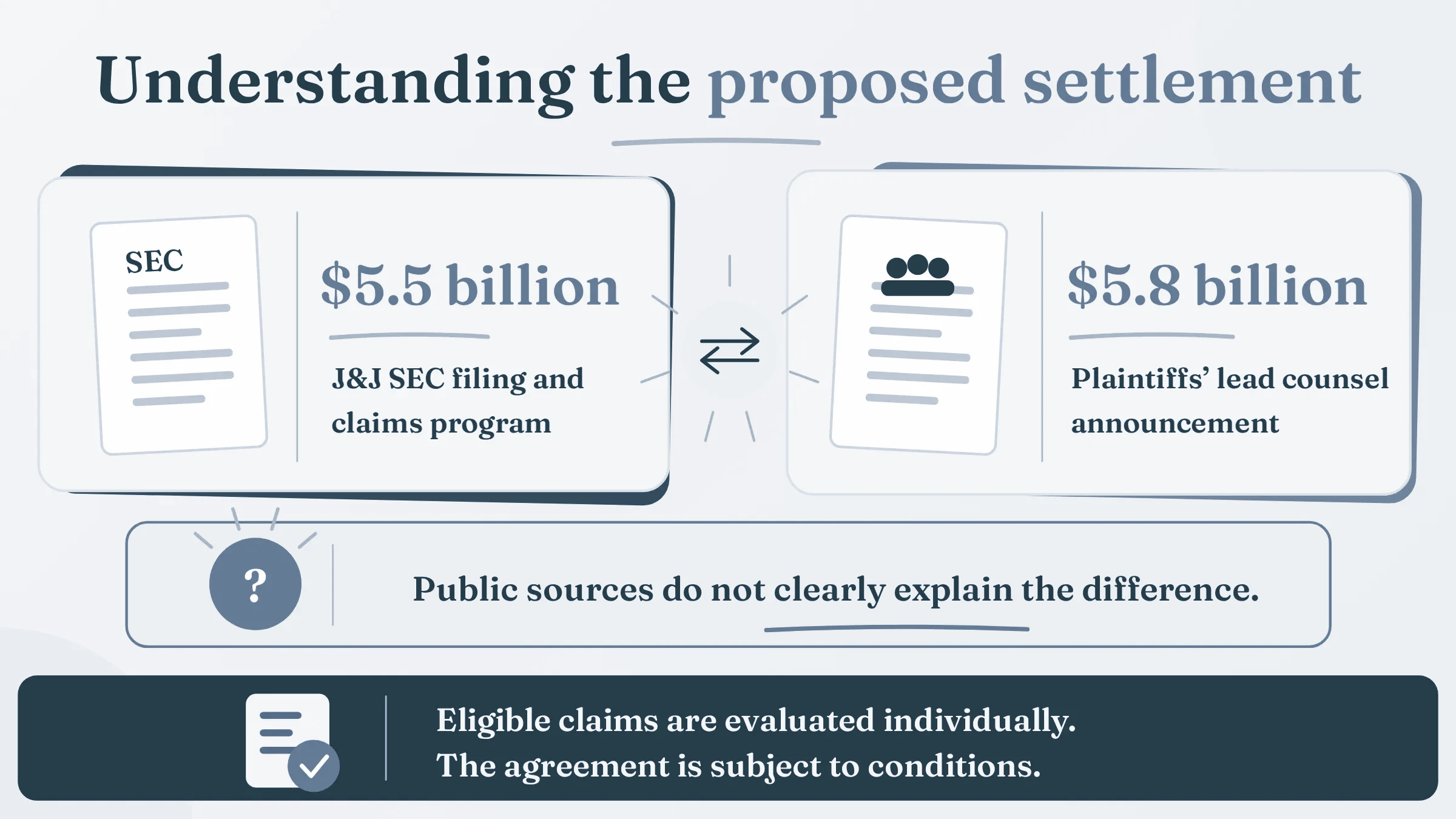
The claims program describes a $5.5 billion guaranteed minimum and says the resolution has no overall funding cap if the required participation condition is met. An uncapped settlement does not mean every claimant receives the same amount. Each eligible claim is evaluated individually under the program’s terms.
Johnson & Johnson denies the allegations and says its talc products were safe. The program states that the settlement is not an admission of wrongdoing or liability.
Why Do Some Reports Mention $5.8 Billion?
You may have seen headlines describing the settlement as worth $5.8 billion.
J&J’s SEC filing states a $5.5 billion commitment. Plaintiffs’ lead negotiation counsel announced a $5.8 billion minimum. The public sources do not clearly explain the difference between those figures.
The claims program itself currently describes a $5.5 billion guaranteed minimum. Your attorney can explain the terms that apply to your claim.
Why Were Talcum Powder Lawsuits Filed?
Thousands of people sued Johnson & Johnson over allegations involving its talc-based baby powder and other products.
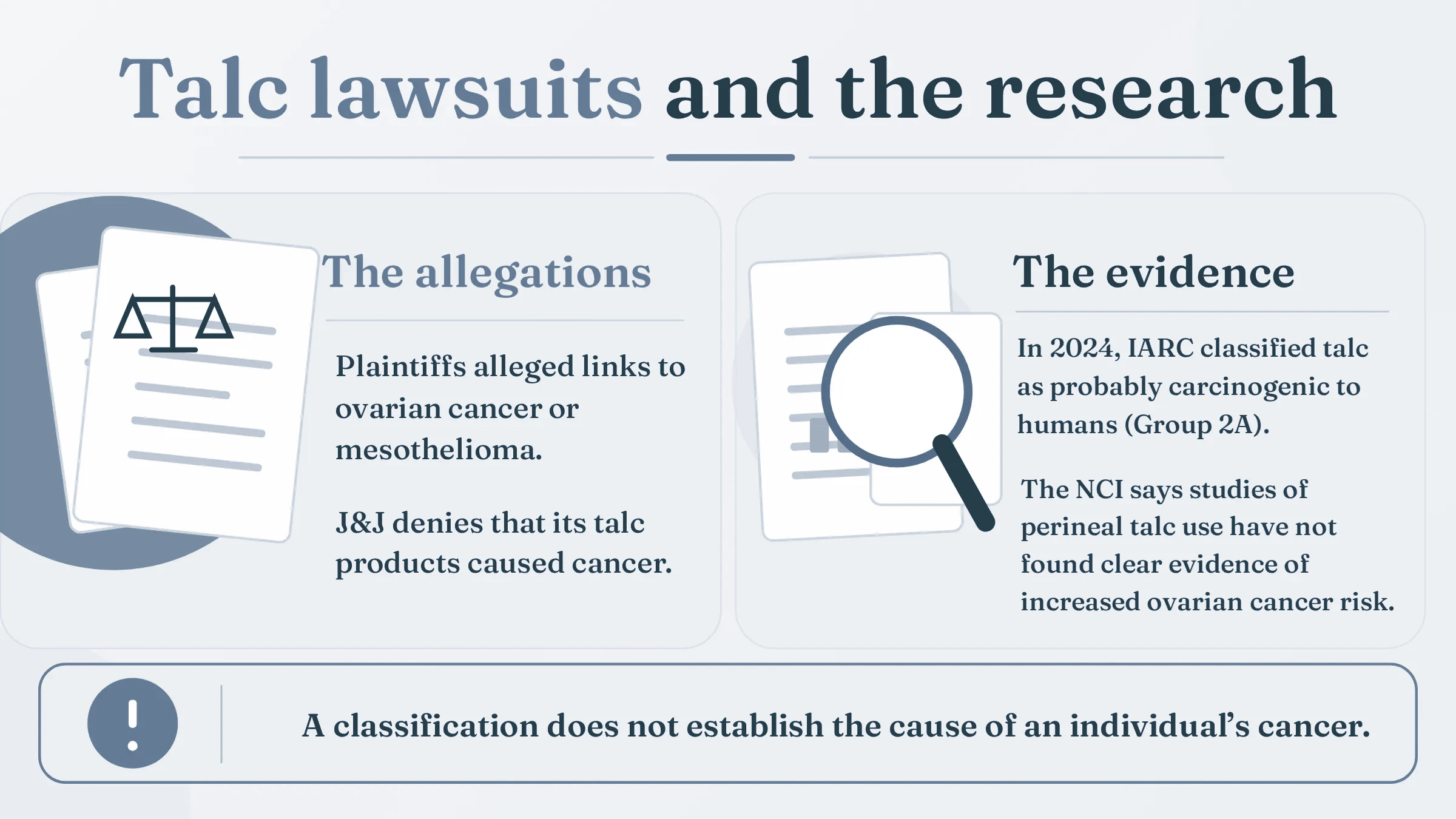
Many plaintiffs alleged that long-term use of the products caused ovarian cancer. Other lawsuits involved mesothelioma and alleged exposure to asbestos in talc-containing products.
Johnson & Johnson has denied that its talc products caused cancer. The company has won some cases at trial and faced substantial verdicts in others. Individual verdicts can be reduced, challenged, or overturned, so a headline about one case does not tell other claimants what they will receive.
What Does the Research Say About Talc and Cancer?
The scientific evidence is an important part of the litigation, and it needs careful explanation.
In 2024, the International Agency for Research on Cancer classified talc as “probably carcinogenic to humans,” or Group 2A. Its evaluation considered limited evidence in humans for ovarian cancer, evidence from animal studies, and other scientific evidence. The classification does not determine what caused an individual person’s cancer. Read the IARC evaluation.
The National Cancer Institute says studies of talc used on the perineal area have not found clear evidence of an increased ovarian cancer risk. Its ovarian cancer prevention summary discusses the research.
J&J maintains that its products were safe and did not cause cancer. Questions about an individual diagnosis should be discussed with a qualified medical professional, while questions about an individual claim belong with the claimant’s attorney.
A Brief Timeline of the Talcum Powder Litigation
The proposed settlement follows years of lawsuits, court proceedings, and earlier attempts to resolve the claims.
| Date | What Happened |
|---|---|
| 2016 | Related federal cases were consolidated in the District of New Jersey as MDL No. 2738. |
| 2020 | J&J stopped selling talc-based Johnson’s Baby Powder in the United States. |
| 2023 | The company says it discontinued talc-based Johnson’s Baby Powder globally. |
| 2024 | J&J reached a separate $700 million multistate consumer-protection settlement concerning the marketing of talc products. |
| 2025 | A bankruptcy judge rejected an earlier plan proposed through a J&J subsidiary to resolve talc claims. |
| July 2026 | J&J announced the proposed $5.5 billion ovarian talc resolution. |
| October 2026 | A federal court order reported that 313 law firms representing more than 66,500 talc claimants had signed program participation agreements. |
The federal court’s MDL page identifies the litigation as In re: Johnson & Johnson Talcum Powder Products Marketing, Sales Practices and Products Liability Litigation.
An MDL, or multidistrict litigation, brings related federal cases together for coordinated proceedings. Each person’s claim remains an individual claim.
Is the $700 Million Settlement the Same as the $5.5 Billion Proposal?
No. The $700 million settlement resolved allegations brought by state attorneys general concerning the marketing of J&J’s talc-based products. It is separate from the proposed 2026 resolution of individual cancer claims.
The Arizona Attorney General’s announcement explains the multistate agreement.
Who May Qualify for the Talcum Powder Settlement?
The Talc Claims Resolution Program is designed to address eligible non-mesothelioma claims alleging that J&J talc products caused epithelial cancer of the:
- Ovaries
- Fallopian tubes
- Peritoneum
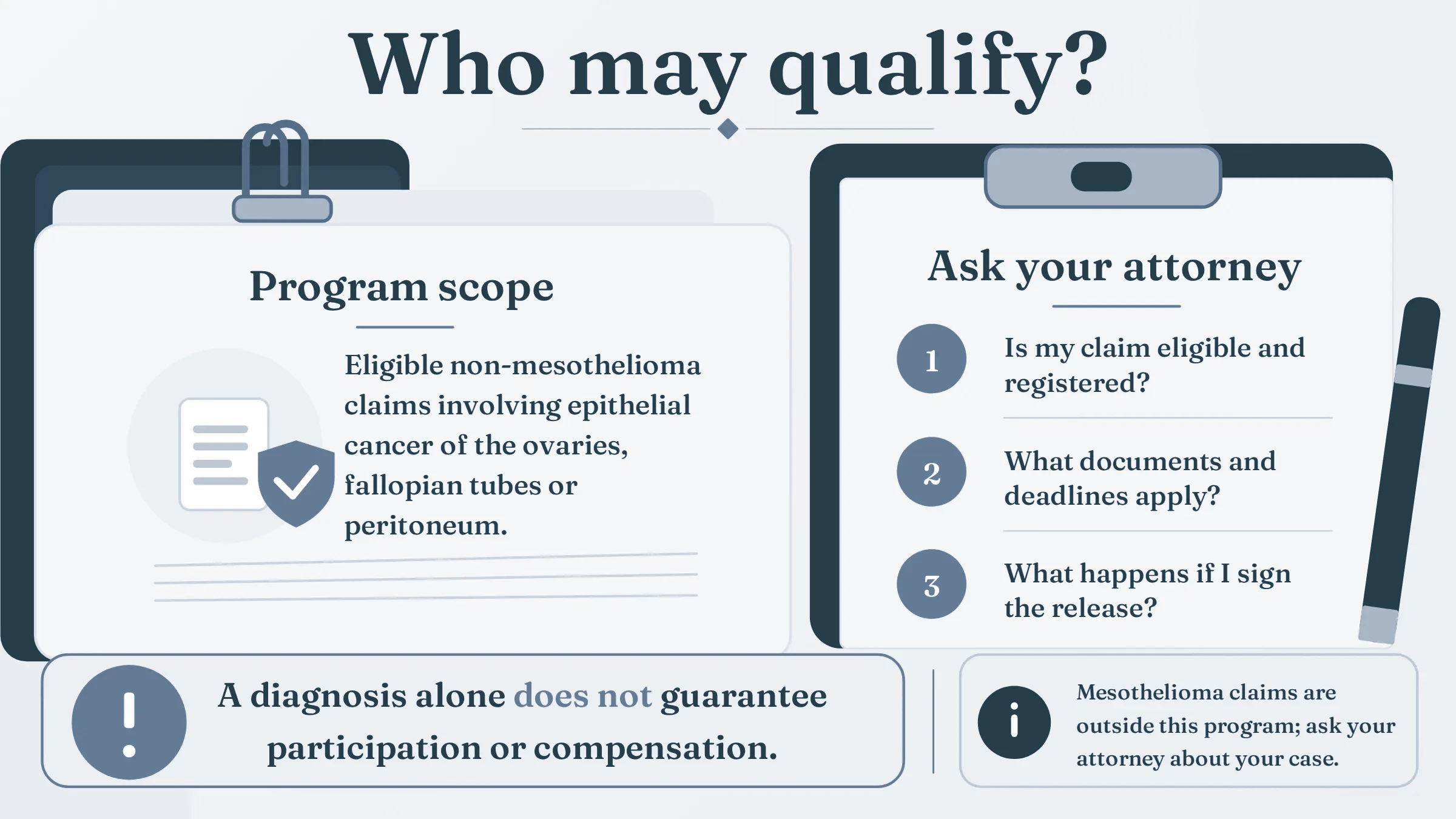
A diagnosis alone does not guarantee participation or compensation. The program has governing requirements, and your attorney must review your claim against those terms.
The program’s website addresses law firms representing people who have filed talcum powder claims against J&J. If you already have an attorney, ask your firm:
- Is my claim eligible for the program?
- Has your firm signed a participation agreement?
- Has my claim been registered?
- What documents and deadlines apply to me?
- What happens to my lawsuit if I sign the release?
People who have not filed a claim should not assume they can enroll through a public form. An attorney can explain available legal options and any applicable filing deadlines.
Does the $5.5 Billion Settlement Cover Mesothelioma?
The current claims program describes its scope as non-mesothelioma claims involving the cancers listed above. J&J’s third-quarter SEC filing says the proposed ovarian talc agreement does not affect the ongoing mesothelioma docket.
A person pursuing a mesothelioma claim should ask their attorney about the status and settlement options for that specific case.
How Does the Talc Claims Resolution Program Work?
The Talc Claims Resolution Program, often called the TCRP, is a private program established to process eligible claims. The program identifies Archer Systems, LLC as its settlement administrator.
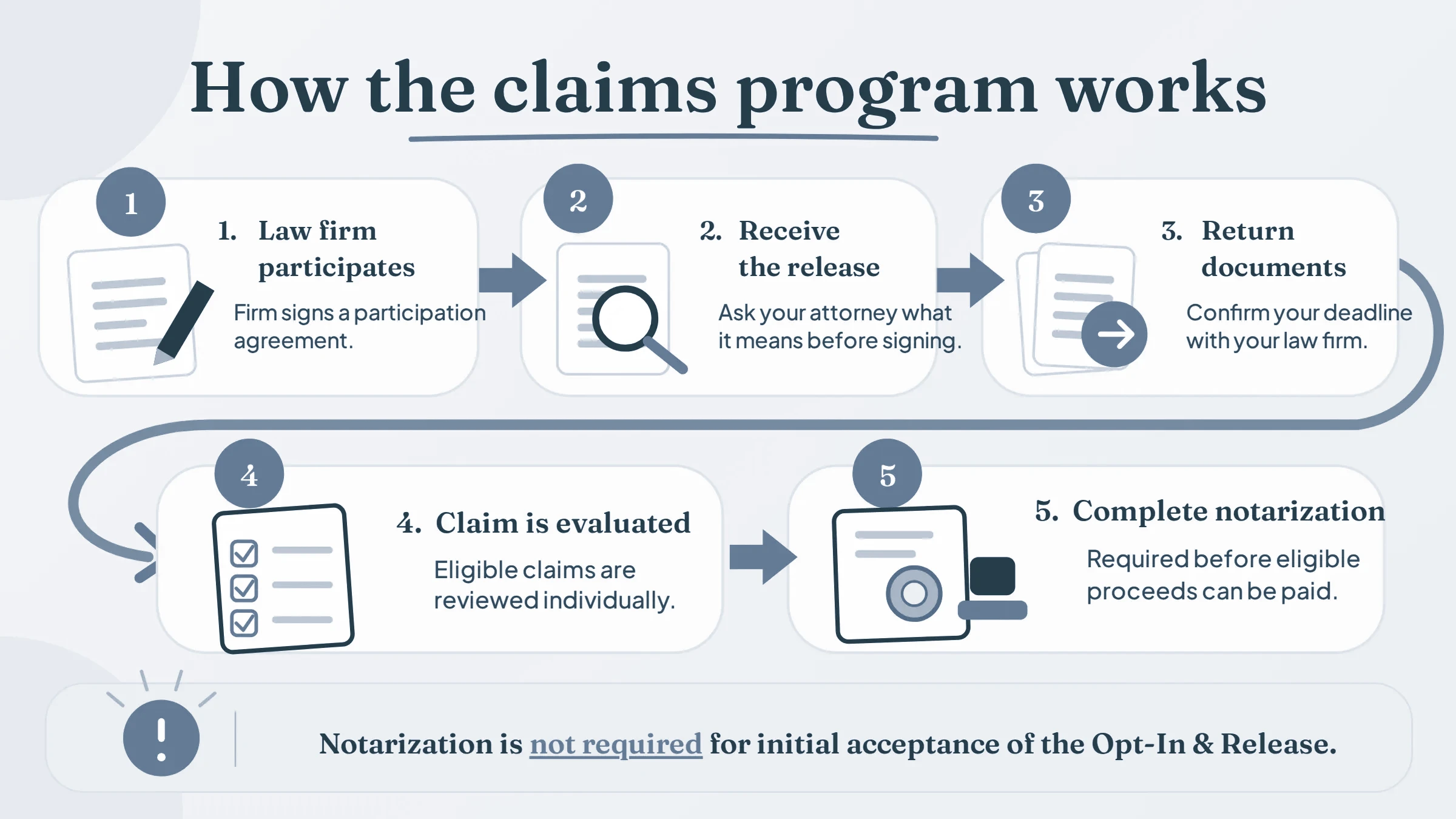
The process involves the claimant’s law firm and may include the following steps.
1. Your Law Firm Participates
A law firm must sign a participation agreement before its clients can enroll through the program. The agreement contains governing terms that may affect the firm and its clients.
2. You Receive an Opt-In & Release
If your law firm identifies you as eligible, you may receive an Opt-In & Release electronically or through the mail.
This document is important. The program says signing and submitting it is part of electing to participate, releasing specified parties, and authorizing dismissal of the claim. Ask your attorney to explain what you are agreeing to before signing.
3. You Return Your Documents
The claimant-help website describes a 30-day period to return the Opt-In & Release and tells claimants to check their own communication for the exact deadline.
The attorney-facing and claimant-facing pages describe the starting point of that period differently. Your safest step is to check the date on your packet and confirm the deadline directly with your law firm.
4. Your Claim Is Evaluated
The administrator evaluates claims individually through the program’s claims-processing platform. Your attorney can explain what records are needed and answer questions about your potential settlement amount.
5. Notarization Is Completed
The claimant website says notarization is not required for acceptance of the initial Opt-In & Release. It does say notarization will be required before eligible settlement proceeds can be paid.
A claimant who has trouble completing an electronic or mailed document should contact their law firm for help.
Is the Talcum Powder Settlement Final?
The proposed agreement has made progress, but its public terms include participation and other conditions.
An October 7, 2026 federal court order reported that 313 law firms representing over 66,500 talc claimants had signed participation agreements and registered some or all potentially eligible claimants.
That figure shows activity at the law-firm and registration stage. It does not mean every represented claimant has received an individual award or payment.
The most useful source for your personal status is your attorney. Your firm can tell you if you have been registered, what remains outstanding, and how the agreement affects your claim.
How Much Will Each Person Receive?
There is no single talcum powder settlement amount that applies to every claimant.
Plaintiffs’ lead counsel has described a tiered system that evaluates claims using objective criteria. The public information available does not provide enough detail to calculate a reliable award for every reader.
Your potential amount may depend on the program’s governing criteria and the information submitted for your claim. Your attorney can explain the applicable valuation process and discuss the amount, fees, and deductions connected to your case.
Can You Divide $5.5 Billion Among 76,000 Claims?
You can divide the figures mathematically, but the result would not be an official payout estimate.
The program evaluates claims individually, and its public summary describes a minimum commitment with no overall funding cap if the required participation condition is met. Individual deductions can also affect the amount a claimant takes home.
A number calculated from the headline figures cannot account for those differences.
Gross Settlement vs. Net Payment
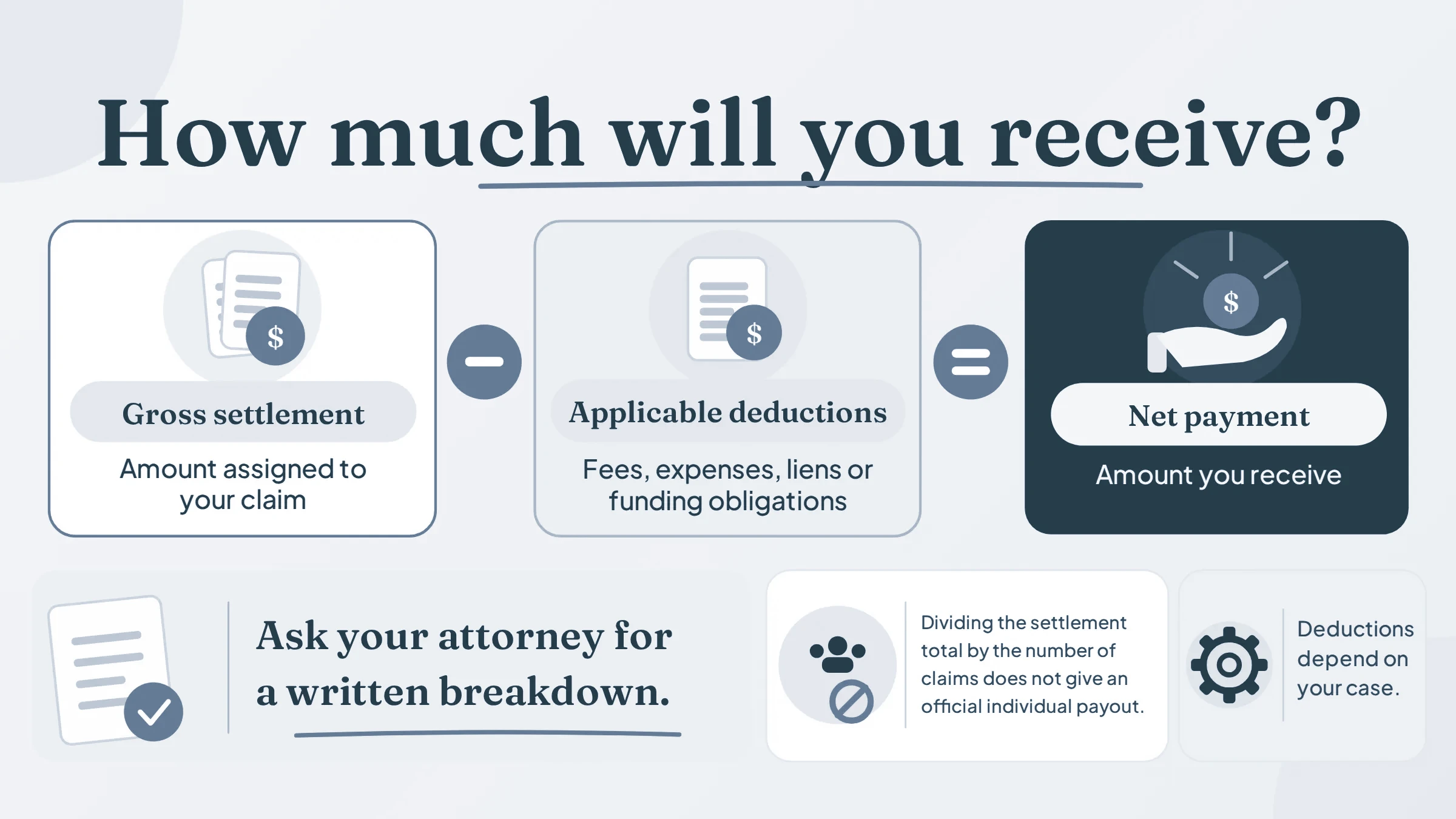
Your gross settlement amount is the amount assigned to your claim before applicable deductions. Your net payment is the amount you receive after those deductions.
Depending on your case, deductions may include:
- Attorney fees and case expenses.
- Applicable medical liens or reimbursement obligations.
- Existing lawsuit funding obligations.
- Other amounts required under your agreement.
The program says claimants will not be charged its administration costs, including the costs of settlement administration and lien resolution. That does not automatically remove an underlying lien or reimbursement obligation.
Ask your attorney for a written breakdown so you can see how your net amount is calculated.
When Will Talcum Powder Settlement Payments Be Made?
Johnson & Johnson’s announced schedule starts in 2027, subject to the agreement’s terms.
According to its July 2026 SEC filing:
- The first company payment will be no more than $3 billion in 2027.
- No additional company payments are due before 2028.
These dates do not guarantee that every claimant will receive a check in 2027. Individual payment timing can depend on enrollment, documentation, claim evaluation, applicable liens, and the distribution process.
Your attorney is best placed to explain where your claim stands and what needs to happen before payment.
Can You Sell a Talcum Powder Settlement?
Some settlement payment rights may be eligible for sale, but eligibility depends on the individual arrangement.
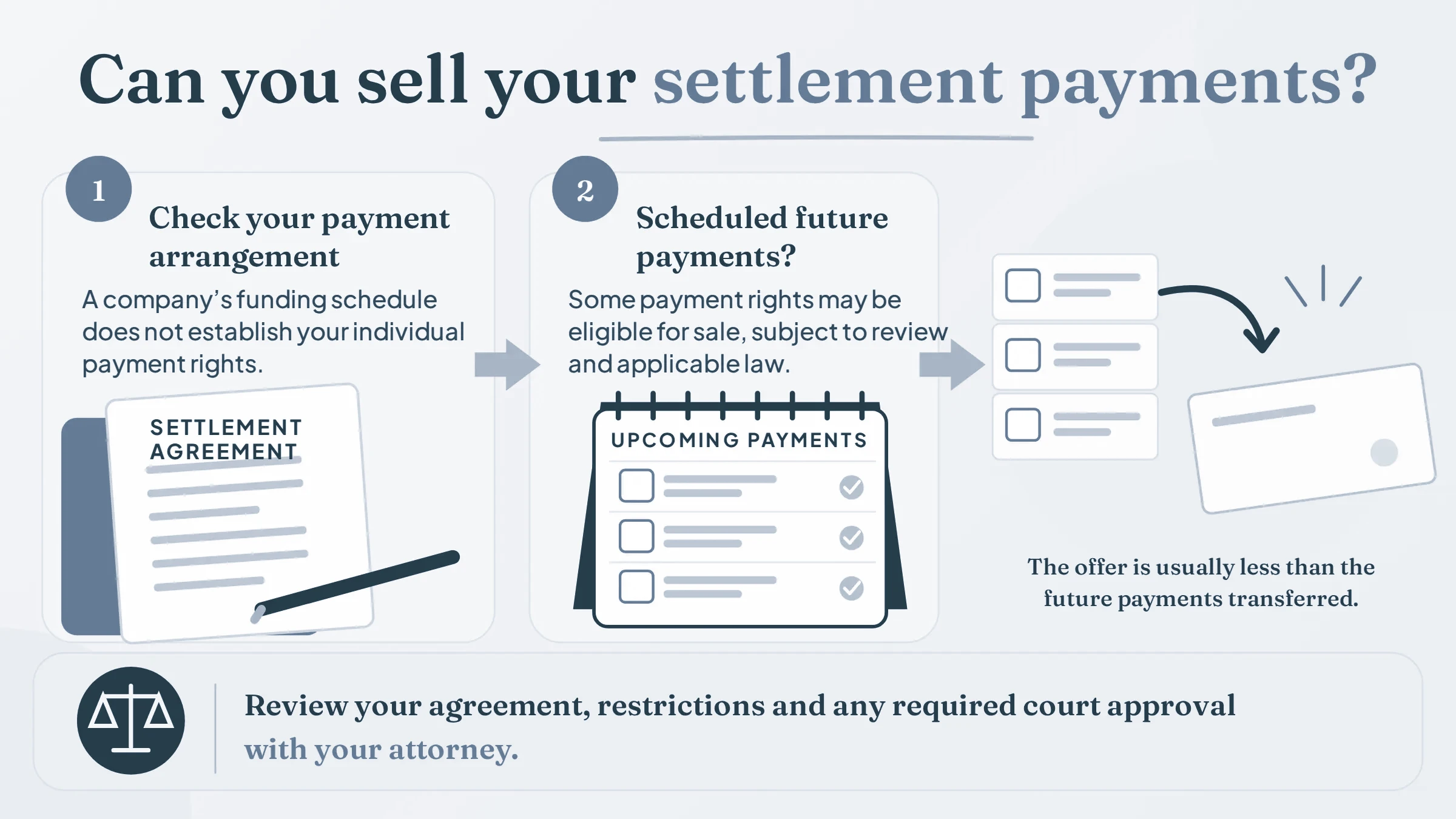
The distinction starts with a simple question: What payment rights do you actually have?
A company’s plan to fund a settlement over multiple years does not automatically mean each claimant receives a structured settlement. Some people may receive a lump sum. Others may have a different arrangement, or their payment rights may not yet be established.
A structured settlement generally involves scheduled future payments established under a settlement agreement. A person who holds eligible structured settlement payment rights may be able to sell some or all of those rights, subject to the agreement, applicable law, buyer review, and any required court approval.
The public summary of the talc program does not establish that every claimant will receive structured payments that can be sold. Your settlement documents and attorney can help identify your payment arrangement.
What Should You Check Before Exploring a Sale?
Ask your attorney for copies of your settlement agreement and payment schedule, if available. The following details matter:
- Is your claim settled, or is it still being evaluated?
- Are you receiving one payment or scheduled future payments?
- Who is responsible for making those payments?
- Does your agreement contain transfer restrictions?
- Are there liens, prior funding agreements, or other claims against the proceeds?
- Would a transfer require court approval?
A buyer will also consider the payment terms and applicable law before deciding if it can make an offer.
What Happens When You Sell Structured Settlement Payments?
A sale generally exchanges some future payment rights for a lump sum today. The amount offered is usually less than the total of the future payments being transferred.
For example, selling rights to $50,000 in future payments does not mean you will receive $50,000 today. The offer reflects factors such as when the payments are due and the costs and discount applied to the transaction.
A qualified transfer may require a court to consider the payee’s best interests. Internal Revenue Code Section 5891 sets out federal rules for structured settlement factoring transactions. State law and the terms of the individual arrangement also matter.
What If Your Talcum Powder Claim Is Still Pending?
A person who has not yet received a settlement may be exploring a different option: pre-settlement funding.
Pre-settlement funding provides an advance based on a pending legal claim. MySettlement’s pre-settlement funding service describes its funding as non-recourse, meaning repayment generally comes from a successful case.
Eligibility depends on the case, the funding agreement, applicable law, and the provider’s review. You should ask your attorney how an advance and its costs could affect your eventual proceeds.
What About a Settled Claim That Has Not Been Paid?
Some companies offer funding against a claim that has settled but is still awaiting payment. This is often called post-settlement funding.
The arrangement is different from selling an established stream of structured settlement payments. Availability depends on the provider, settlement documents, applicable restrictions, and the status of the individual claim.
Ask any funding company to explain its offer in writing, including the total repayment amount, fees, and what happens if payment is delayed.
Questions to Ask Before Accepting Funding
- How much money will I receive?
- What fees or charges apply?
- How much will need to be repaid at different points in time?
- Are there exceptions to non-recourse protection?
- Can the amount owed increase if my settlement takes longer?
- How will the funding affect my net settlement?
- Does my attorney need to review or sign any documents?
Are Talcum Powder Settlement Payments Taxable?
Federal tax treatment depends on what the settlement payment compensates you for and your individual circumstances.
The IRS generally excludes qualifying compensation received because of a personal physical injury or physical sickness from federal gross income. Exceptions can apply, including when certain medical expenses were previously deducted and provided a tax benefit.
Interest on a settlement is generally taxable. Punitive damages are generally taxable, even when connected to a physical injury or sickness. The IRS explains these distinctions in its settlement taxability guide.
Your settlement agreement and personal tax history matter. A tax professional can help you understand how the rules apply to your payment.
Could a Settlement Affect Government Benefits?
A settlement may affect eligibility for certain means-tested benefits, including Supplemental Security Income (SSI).
The result depends on the type of payment, how it is received, applicable exclusions, and your circumstances. The Social Security Administration’s guidance on awards and settlements explains that some amounts may count as income, while exclusions can apply.
Speak with a qualified benefits professional or attorney before making decisions about a settlement, funding agreement, or transfer of payments.
Frequently Asked Questions
Is the Johnson & Johnson talcum powder settlement approved?
J&J announced a proposed agreement with plaintiff firms in July 2026. The resolution is subject to participation and other conditions. A claims program is operating, but your attorney can explain the current status and what it means for your individual claim.
How much will I receive from the talcum powder settlement?
The amount depends on your individual claim and the program’s governing criteria. A headline figure or an estimate found online cannot reliably predict your award or the amount you will take home.
When will I receive my talcum powder settlement check?
No universal individual payment date has been announced. J&J’s first company payment is scheduled for 2027 under the announced terms, but claimants may receive their money on different timelines.
Can I file a claim if I have not already filed a lawsuit?
The program’s public website addresses law firms with filed talcum powder claims. An attorney can review your circumstances, explain available options, and advise you about applicable deadlines.
Does the settlement cover family members of someone who died?
A family member or estate representative may have questions about an existing claim. Eligibility, authority to act, and available compensation depend on the claim and applicable law. The attorney handling the case can explain the next steps.
Can I sell my talcum powder settlement for a lump sum?
A sale may be possible if you hold eligible future payment rights. Your documents, payment arrangement, state law, and any required court approval will determine what options are available. The proposed J&J funding schedule alone does not establish that your individual payments can be sold.
Can I get funding while waiting for my settlement?
Funding may be available for some pending or settled-but-unpaid claims. Approval and terms depend on the provider and your case. Ask your attorney and the funding company to explain the costs and repayment terms before you agree.
Who should I contact about my settlement documents?
Contact your law firm for questions about eligibility, settlement amounts, deadlines, or the meaning of the Opt-In & Release. The TCRP claimant-help website also provides information about completing documents and reporting suspected fraud.