



One specialist stays with you from your first call through funding.
November, 2026
A guaranteed structured settlement provides payments that remain payable for an agreed period, even if the person whose life is covered dies before that period ends.
Let’s say your settlement provides monthly payments for 20 years. If you die after eight years, the remaining guaranteed payments don’t simply disappear. They’re paid according to the beneficiary provisions in your settlement and annuity documents.
The word guaranteed can also describe an insurer’s promise to make payments for someone’s lifetime. That promise is different from a guaranteed payment period, so it’s important to understand which one your documents describe.
This guide explains how guaranteed payments work, what happens after death, and what to consider if you want to sell some of your future payments.
What Does “Guaranteed” Mean in a Structured Settlement?
A guaranteed payment is a scheduled payment that does not depend on the covered person being alive when it comes due.
The guarantee may apply to:
- Monthly or annual payments for a specified number of years.
- A lump-sum payment scheduled for a future date.
- A minimum payment period attached to a lifetime income stream.
Your settlement might include more than one of these features. It could provide guaranteed monthly payments for 20 years and a separate lump sum due in year 15, for example.
The payment schedule and beneficiary provisions tell you what is guaranteed, when each payment is due, and who may receive any remaining payments after your death.
The Society of Actuaries calls a fixed-term arrangement an annuity certain: payments continue for the specified period even if the annuitant dies before it ends.
How Does a Guaranteed Structured Settlement Work?
A structured settlement resolves a legal claim through scheduled payments over time. The payment terms are arranged when the settlement is established.
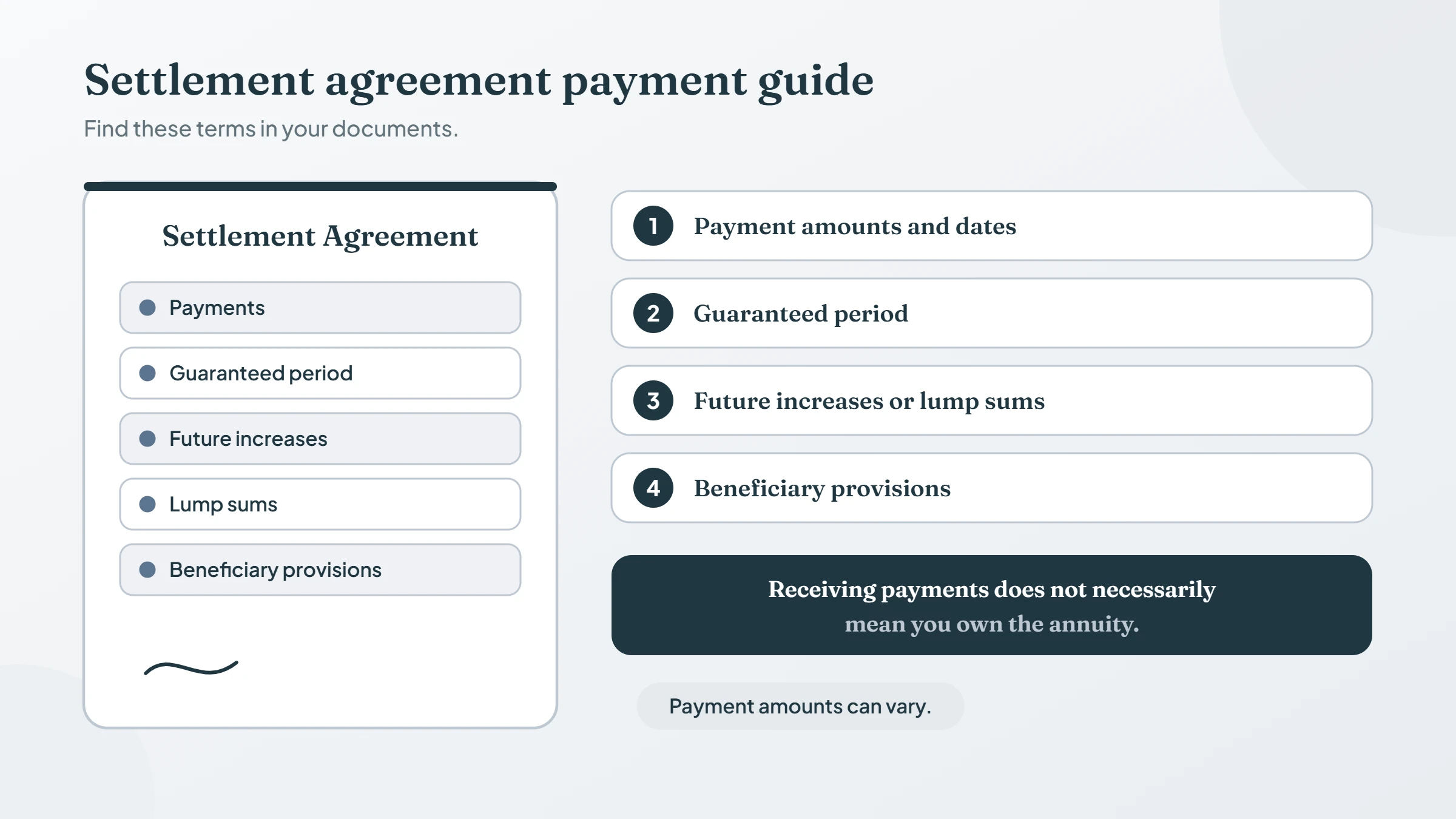
Many structured settlements are funded through an annuity issued by a life insurance company. The company responsible for the settlement payments and the insurer funding them may be different entities.
Your documents can identify:
- The amount and date of each payment.
- The length of any guaranteed period.
- Any scheduled increases or future lump sums.
- The person whose life determines any life-contingent payments.
- Your designated beneficiary.
- Restrictions or special provisions affecting the payments.
You usually hold the right to receive the payments. That does not necessarily make you the owner of the annuity contract funding them.
Do guaranteed payments have to be the same amount?
No. A payment schedule may include fixed increases, payments at different intervals, or future lump sums. The guarantee concerns the obligation described in your agreement; it does not necessarily mean every payment is identical.
Your structured settlement payment type describes several features at once: how long payments last, when they arrive, and how their amounts are determined.
Guaranteed Period vs. Life-Contingent Payments
The biggest difference is what determines when payments end.
| Payment arrangement | How long payments last | What happens after death? |
|---|---|---|
| Period certain | Payments continue for the specified term. | Remaining guaranteed payments follow the beneficiary provisions. |
| Life only | Payments continue during the covered person’s lifetime. | Payments stop at death under the pure life-only option. |
| Life with a guaranteed period | Payments continue for life, with a minimum guaranteed term. | Remaining guaranteed payments follow the contract if death occurs during that term. |
Period certain
A period-certain arrangement pays for a fixed term, such as 10 or 20 years. Payments end when the term finishes, even if the recipient is still alive.
Life with a guaranteed period
A life-with-period-certain arrangement combines lifetime income with a minimum payment term.
Imagine a settlement that pays $2,000 per month for life, with 20 years certain. If the covered person lives beyond 20 years, payments continue for life. If that person dies during the guaranteed period, the remaining guaranteed payments follow the beneficiary provisions.
The New York Department of Financial Services explains these payment options in more detail.
Guaranteed Structured Settlement Example
Suppose your agreement provides $2,000 per month for 20 years.
| Payment detail | Amount |
|---|---|
| Monthly payment | $2,000 |
| Guaranteed term | 20 years |
| Total scheduled payments | $480,000 |
Now imagine you die after receiving eight complete years of payments.
| Payment detail | Amount |
|---|---|
| Payments received during your lifetime | $192,000 |
| Years remaining in the guaranteed term | 12 |
| Remaining scheduled payments | $288,000 |
The remaining $288,000 represents the combined amount of future payments. It is not automatically paid as one lump sum. The beneficiary receives payments according to the agreement, including any applicable commutation provision.
What Happens to Guaranteed Payments After You Die?
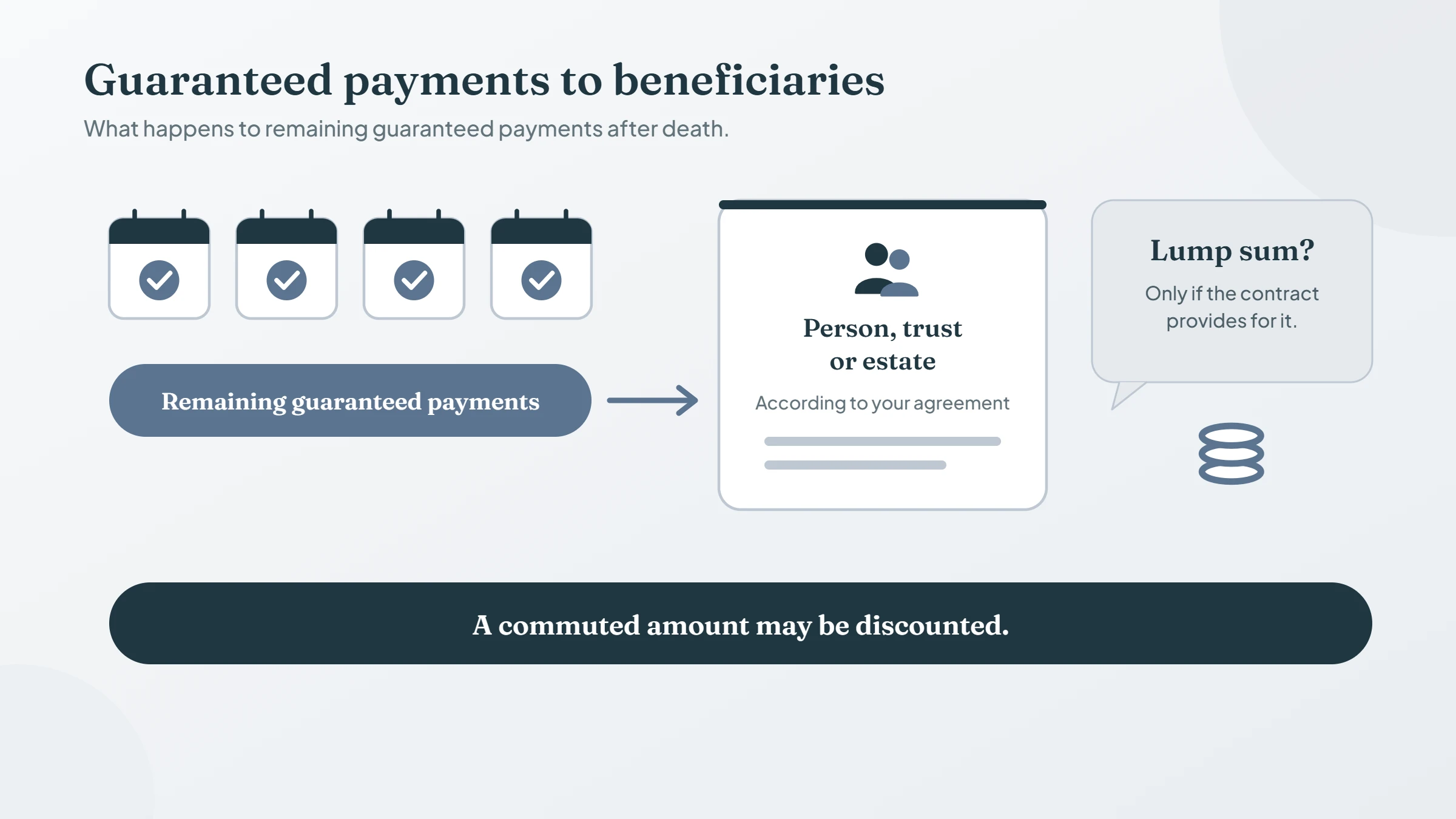
Remaining guaranteed payments generally pass according to the beneficiary terms in your documents. The beneficiary may be a person, a trust, or an estate, depending on the arrangement.
Remaining guaranteed payments generally pass according to the beneficiary terms in your documents. The beneficiary may be a person, a trust, or an estate, depending on the arrangement.
Your beneficiary will need to contact the company administering the payments and complete its death-claim requirements. The insurer can explain what documents it needs and how the remaining payments will be handled.
Can you change your beneficiary?
You may be able to change your beneficiary, but the process depends on your contract and the parties involved.
New York Life, for example, says beneficiary changes for guaranteed payments require review by the insurer and the annuity owner.
It’s a good idea to check your current beneficiary designation with the company administering your payments, especially after a major life change.
Can a beneficiary receive a lump sum?
Some agreements include a commutation provision. It may provide a lump sum in place of some or all remaining guaranteed payments after the recipient’s death.
The amount and conditions depend on the contract. A commuted amount may be calculated using a discount, so it should not be assumed to equal the total of every future payment added together.
Are Guaranteed Structured Settlements Safe?
A guaranteed payment is a contractual obligation, but the word guaranteed does not remove every risk.
Many structured settlements are funded by an insurance company’s annuity. The insurer’s ability to meet its obligations is therefore an important part of the payment arrangement. Pacific Life states that its annuity guarantees depend on the issuing company’s financial strength and claims-paying ability.
State guaranty associations may provide protection if an insurer fails. Coverage depends on state law, the contract, the payment rights involved, and other conditions. The National Organization of Life and Health Insurance Guaranty Associations explains that some states exclude certain rights acquired through a factoring transaction.
Other considerations include:
- Inflation: A fixed payment may buy less over time as prices rise.
- Payment duration: A period-certain schedule ends when its agreed term finishes.
- Access to cash: Future scheduled payments generally aren’t available on demand.
- Contract terms: Increases, beneficiary rights, and other features vary.
Now you know the number. Ready to act on it?
Most buyers won’t tell you what your settlement is actually worth. Now you know. Let’s get you a real offer.
Are Guaranteed Structured Settlement Payments Tax-Free?
The word guaranteed does not determine tax treatment. The answer depends on the underlying claim and applicable tax rules.
Qualifying damages received because of personal physical injury or physical sickness may be excluded from federal income under Section 104(a)(2) of the Internal Revenue Code. Other types of damages and settlements may be treated differently.
Your attorney or tax professional can help you understand the treatment of your specific payments, including any proposed sale.
Can You Sell Guaranteed Structured Settlement Payments?
You may be able to sell some or all of your remaining guaranteed payment rights for a lump sum. The available options depend on your agreement, payment schedule, applicable law, and the buyer’s review.
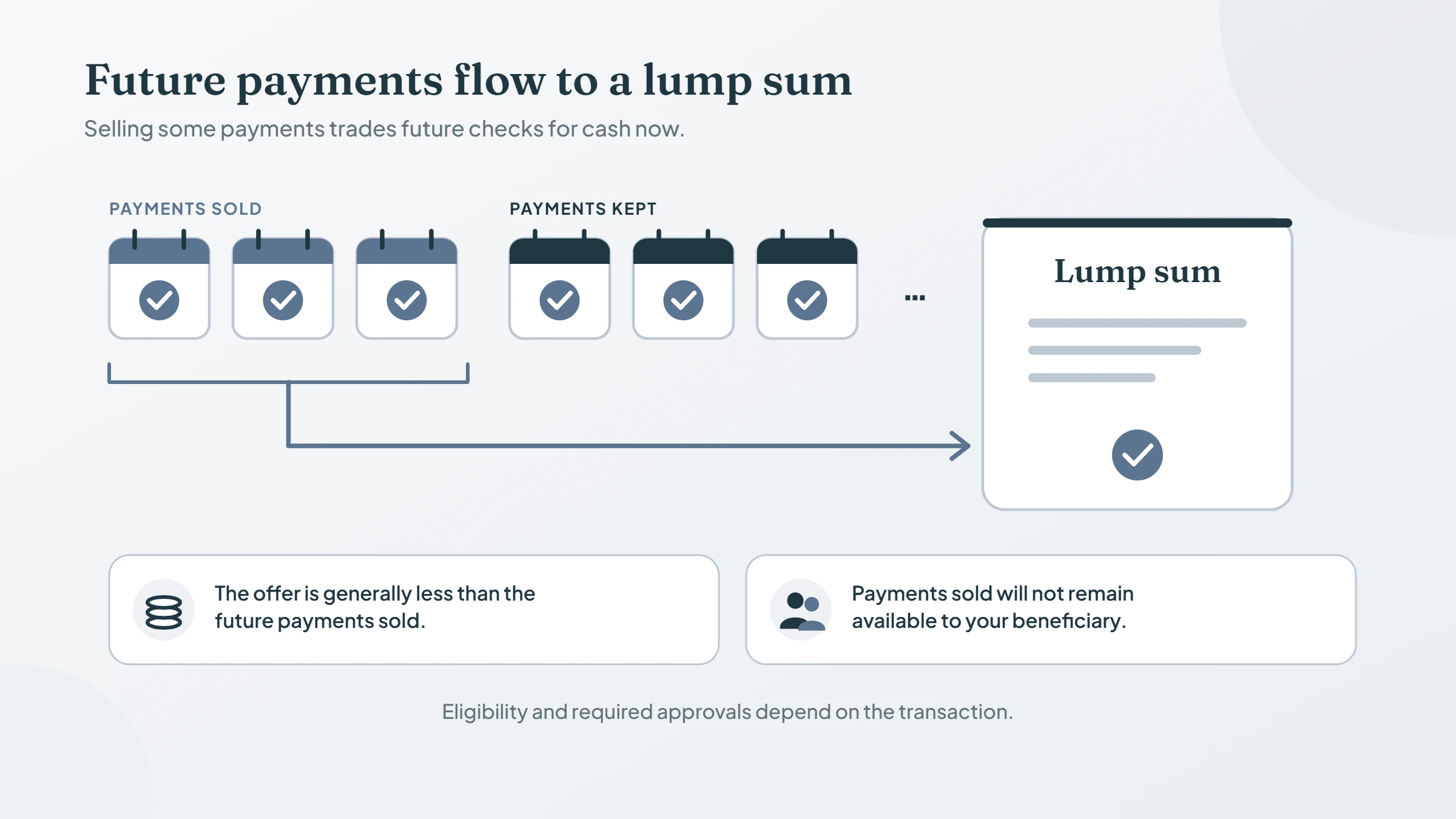
A sale involves transferring selected future payment rights to a purchasing company. In exchange, you receive an agreed lump sum after the required approval and transaction steps are completed.
The offer will generally be less than the total future payments being sold. A payment due years from now is being exchanged for money today, so the buyer applies a discount when valuing it.
Consider these questions before accepting an offer:
- Which payment amounts and dates would you transfer?
- Which payments would you keep?
- What is the net amount you would receive?
- How would the sale affect your future income?
- What guaranteed payments would remain available to your beneficiary?
That last question matters. Payments you sell are transferred to the buyer; those same payment rights will no longer be available to your beneficiary.
A partial sale may allow you to keep other payments, subject to the terms of your transaction. Court approval is generally required for a covered structured settlement transfer.
How Can You Check Your Guarantee?
Start with your settlement agreement and payment schedule. Look for terms such as “period certain,” “guaranteed period,” or “life with 20 years certain.”
Your annuity documents may provide more detail about the beneficiary designation and any commutation provision. If you don’t have a current schedule, contact the company administering your payments and ask for a statement of the payments remaining.
Keep records of any previous payment sales too. Those documents help show which rights you still hold.
Your settlement has a number. Let's make it work for you.
Get a free, no obligation quote from a specialist who actually knows what your payments are worth.
Frequently Asked Questions
Is a guaranteed structured settlement paid for life?
Not always. A period-certain settlement ends when its agreed term finishes. A life-with-period-certain arrangement can continue for the covered person’s lifetime, including beyond the guaranteed period.
Does my beneficiary receive every payment after I die?
Your beneficiary may receive the guaranteed payments that remain available under the agreement. Payments that have already been received or transferred in a sale are not part of that remaining schedule.
Can a guaranteed settlement include a future lump sum?
Yes. A settlement can include a guaranteed lump sum due on a specified future date. Your documents will show the amount, timing, and beneficiary provisions.
Can I sell only part of my guaranteed payments?
A partial sale may be possible. The payments available for transfer depend on your agreement, the buyer’s review, applicable requirements, and court approval.
Want to Discuss Your Guaranteed Payments?
MySettlement can review your payment schedule and help you understand whether some of your future payments may be eligible for purchase.
Bring your settlement documents and any records of previous sales. Our team can discuss your options and explain which payments would be included in an offer.