
- Structured Settlements
- What are Structured Settlements
- Best Structured Settlement Buyers
- How Selling Works
- Eligible Cases
- Eligibility Criteria
- Structured Settlement Regulations
- J&J Settlement
- Maui Wildfire Settlement
- Types of Structured Settlements
- Guaranteed Structured Settlements
- Increasing Structured Settlements
- Deferred Structured Settlements
- Life-Contingent Structured Settlements
- Future Lump Sum Settlements
- Annuities
- What Is An Annuity
- Guide to Selling an Annuity
- Income Annuities
- How Are Annuities Taxed?
- 7 Common Annuity Mistakes & How to Avoid Them
- Annuity Beneficiaries
- Types of Annuities
- Fixed Annuities
- Fixed Index Annuities
- Variable Annuities
- Immediate Annuities
- Deferred Annuities
- Registered Index-Linked Annuity
- Pre-Settlement Funding
- What is Pre-Settlement Funding
- How Pre-Settlement Funding Works
- Eligible Cases for Pre-Settlement Funding
- Pre-Settlement Funding Criteria
- Pre-Settlement Funding Regulations
- Types of Pre-Settlement Funding
- Non-Recourse Cash Advances
- Structured Pre-Settlement Funding
- One-Time Lump Sum Cash Advances
- Compounding Interest Funding
- Flat-Fee Structured Funding
- Structured Settlement Calculator



One specialist stays with you from your first call through funding.
November, 2026
A variable annuity can help you invest for retirement and arrange future income. Your account can also lose money, and the guarantees you pay for may protect a particular benefit, not the amount you could cash out today.
That distinction matters when you’re comparing contracts or looking at one you already own. A statement showing a $120,000 income benefit doesn’t necessarily mean you have $120,000 available to withdraw.
Here’s how the investments, fees, income options, and tax rules fit together.
What Is a Variable Annuity?
A variable annuity is an insurance contract that combines investment options with features such as income payments and death benefits. Its value changes with the performance of your selected investments, after expenses and other contract activity.
You typically invest through subaccounts, which hold underlying funds. Those funds may invest in stocks, bonds, or other assets. Investment gains can increase your account value; losses and charges can reduce it, including your original investment.
Variable annuities are securities as well as insurance products. Federal securities regulation and state insurance regulation both apply. Registration with the SEC does not mean the government approves the investment or guarantees its performance. The SEC’s variable annuity guide explains these basics.
Our introduction to what an annuity is covers the broader contract structure.
How Your Money Gets Invested
A deferred variable annuity gives your money time to accumulate before annuitized payments begin. You select investments from the contract’s menu and may be able to change allocations as your needs change.
An immediate variable annuity starts income much sooner. Variable describes investment exposure; immediate or deferred describes timing. These labels answer different questions.
Your Investment Choices Have Boundaries
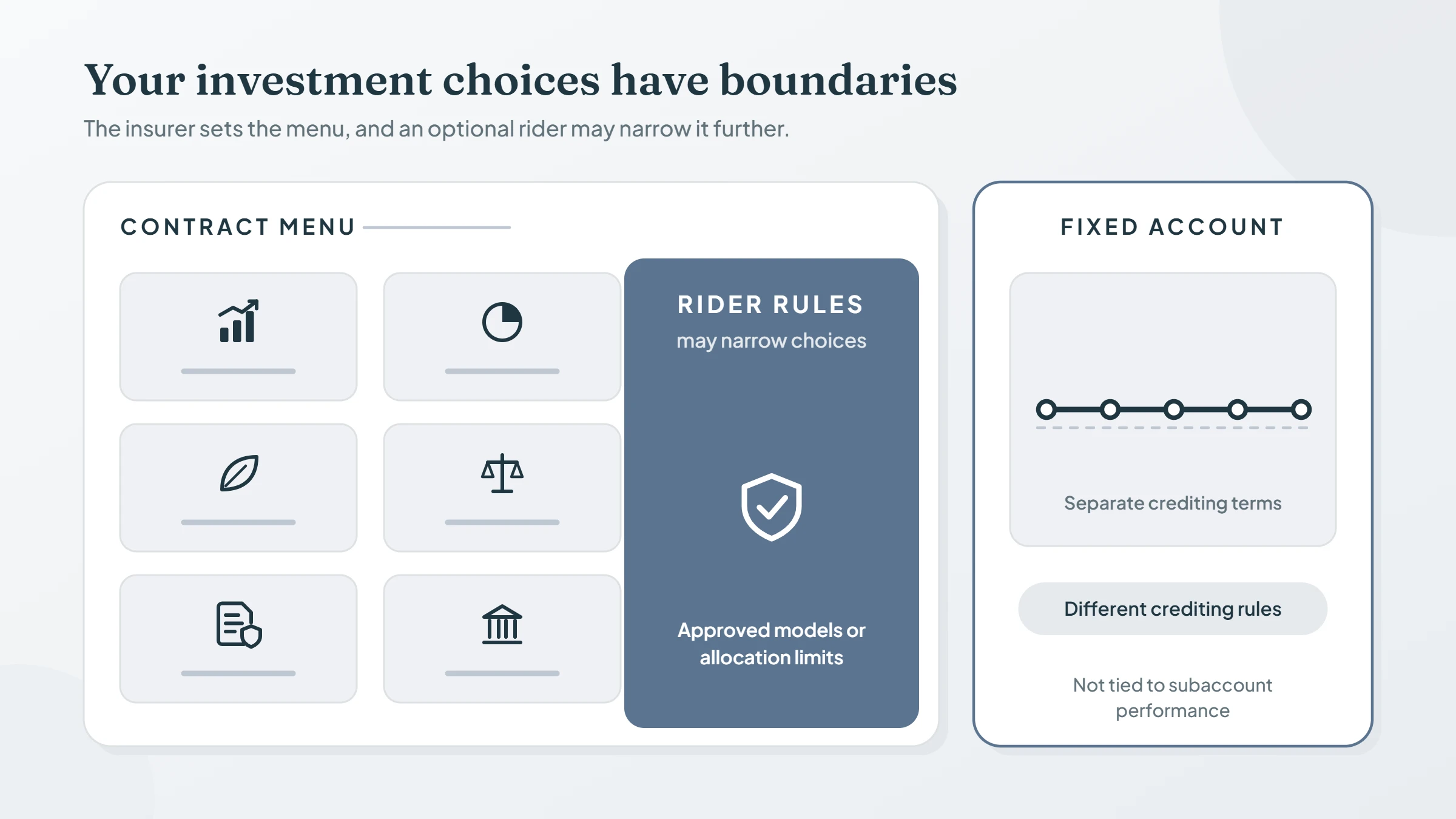
You don’t necessarily get access to every fund or ETF available in a brokerage account. The insurer determines the menu, and an optional income guarantee may narrow your choices further.
Some riders require approved allocation models or limit exposure to certain investments. MassMutual, for example, identifies investment restrictions associated with its optional guaranteed lifetime withdrawal benefits. That’s a product condition worth checking before choosing a guarantee.
A contract may also offer a fixed account with separate terms. Money allocated there follows that account’s crediting rules, not the performance of your variable subaccounts.
Four Values That Mean Different Things
Your statement may show several balances. Each answers a different question.
The benefit base is especially easy to misunderstand. It may be used to calculate guaranteed withdrawals, yet have no equivalent cash value. FINRA specifically identifies the difference between benefit bases and cash values as an important issue when evaluating annuity exchanges.
| Value | What it tells you | Can you cash it out? |
|---|---|---|
| Account or contract value | The current value inside the contract | Withdrawal rules, charges, and taxes affect what you receive |
| Cash surrender value | The amount available if you terminate the contract, after applicable contract deductions | Generally yes, before applicable taxes and withholding |
| Income benefit base | The figure used to calculate a particular guaranteed income benefit | Generally not a separate cash balance |
| Death benefit | The amount payable after a qualifying death under the contract | It is a beneficiary benefit, not an owner’s withdrawal balance |
What Variable Annuity Fees Cover
Costs depend on the contract, investments, optional benefits, and how you buy the annuity. A single “average annual fee” can hide those differences.
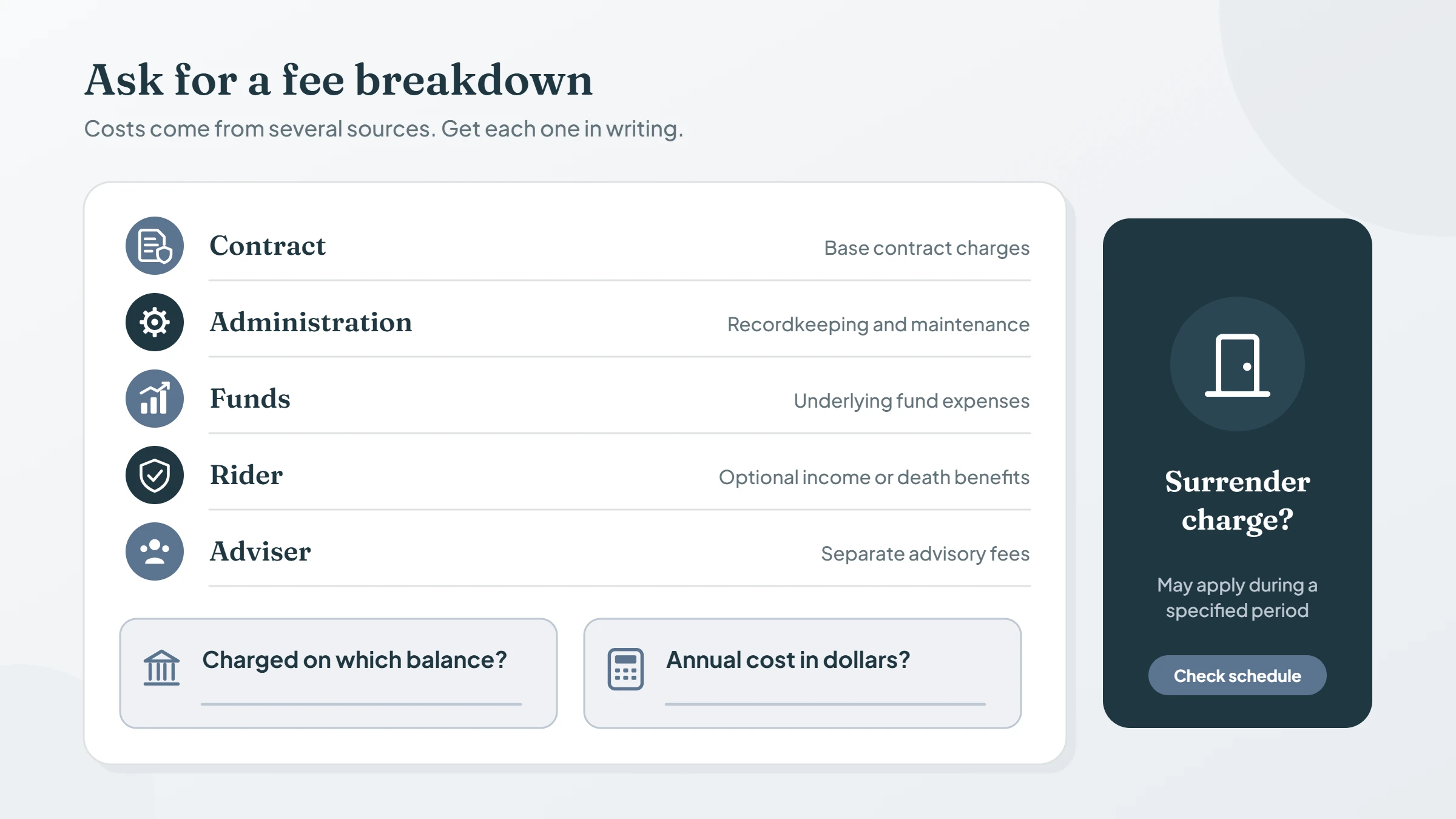
Ask for a breakdown covering:
- Base contract charges: Often include a mortality and expense risk charge, commonly called M&E.
- Administration charges: May cover recordkeeping and account maintenance.
- Underlying fund expenses: Reduce the investment funds’ returns.
- Rider charges: Pay for optional income or death benefits.
- Surrender charges: May apply when you withdraw money during a specified period.
- Separate advisory fees: May be charged under an agreement with your financial adviser.
Some variable annuities have no surrender charge. That does not mean they have no ongoing expenses. Share classes and distribution arrangements can also produce different combinations of fees and withdrawal restrictions.
Ask Which Balance Each Fee Uses
A hypothetical 1% annual rider fee charged against a $120,000 benefit base equals $1,200 if that base stays constant. Against an $80,000 account value, that cost represents 1.5%.
That is one illustrative charge, not a total expense estimate. Actual deductions depend on the contract’s calculation method and changing balances.
An annual fee percentage also does not necessarily mean one annual deduction. Charges may accrue or be deducted more frequently. Ask for the estimated annual dollar cost, including fund expenses and any separate adviser fee, and check which charges are already reflected in reported performance.
What the Guarantees Actually Protect
A rider is an optional contract feature. It may provide valuable protection, but the name alone won’t explain its conditions.
Guaranteed Lifetime Withdrawal Benefits
A guaranteed lifetime withdrawal benefit, or GLWB, can provide withdrawals for life if you follow its rules. Qualifying payments may continue even after the account value reaches zero.
A hypothetical $120,000 benefit base and a 5% permitted annual withdrawal rate would produce $6,000 a year. That 5% is a withdrawal calculation—not a promised investment return.
The rider may specify a starting age, permitted investments, and withdrawal limits. Taking extra money can reduce future income, sometimes by more than the extra amount withdrawn. A guaranteed minimum withdrawal benefit, or GMWB, does not necessarily promise lifetime payments; check its duration.
Income and Accumulation Guarantees
A guaranteed minimum income benefit, or GMIB, generally establishes a minimum basis for income when you annuitize under specified conditions.
A guaranteed minimum accumulation benefit, or GMAB, protects a specified minimum account value at a future date, subject to its terms. It does not automatically establish a cash-out floor every day.
A rider’s advertised growth or “roll-up” rate may increase its benefit base while leaving your actual account value unchanged. Ask which number grows, when that growth stops, and what actions reduce the benefit.
Can You Lose Money?
Yes. Poor investment performance, fees, and withdrawals can reduce your account. A guarantee covering future income does not necessarily prevent those losses.
The timing of market losses also matters once you start withdrawing money. This is called sequence-of-returns risk.
Here’s a simplified example: two accounts start at $100,000 and experience the same two annual returns in opposite orders. Each owner withdraws $10,000 at year-end. The calculation excludes fees, taxes, and guarantees.
| Return order | After first return and withdrawal | After second return and withdrawal |
|---|---|---|
| −20%, then +20% | $70,000 | $74,000 |
| +20%, then -20% | $110,000 | $78,000 |
Three Ways to Receive Income
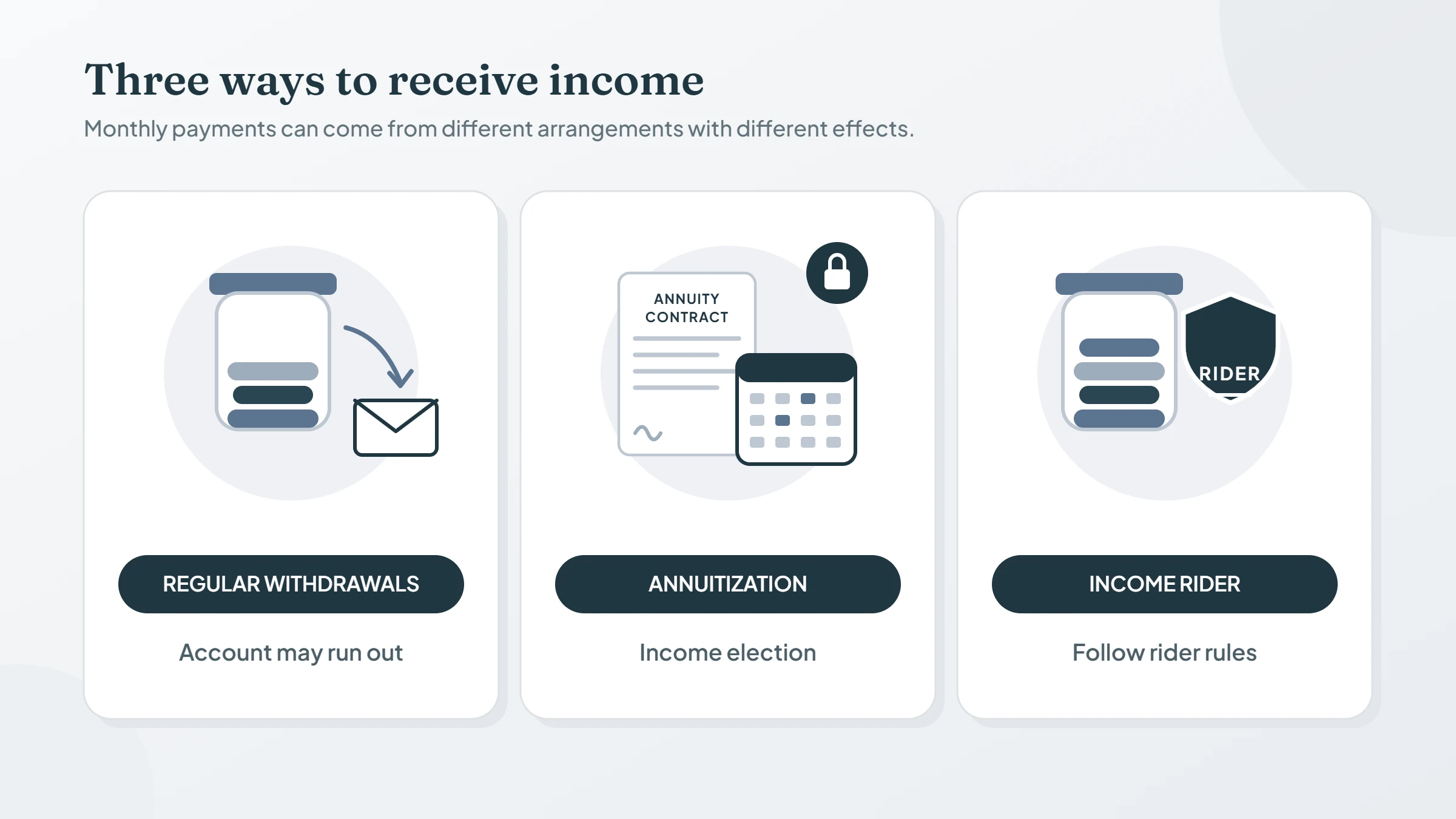
Monthly payments can come from different arrangements. Their effects on your remaining balance and future access to cash are not interchangeable.
Regular Account Withdrawals
Systematic withdrawals take money from your account on a schedule. You generally retain control of the remaining balance, subject to contract restrictions.
The account can run out. Setting up monthly withdrawals does not, by itself, create a lifetime guarantee.
Annuitization
Annuitization converts contract value into an income stream under a selected payout option. Choices may include lifetime payments, joint-life payments, or payments for a specified period.
The decision is generally irreversible. Existing living benefits and death benefits may end, with any subsequent beneficiary payments determined by the payout option.
Pacific Life’s 2026 prospectus provides a concrete example: annuitization terminates the contract’s existing living and death benefits and ends withdrawal access. Its annuitized payment could also be smaller than the rider payment the owner gives up. Get both figures before deciding.
Withdrawals Under an Income Rider
An eligible rider may provide guaranteed withdrawals while the contract remains unannuitized. Its rules determine the permitted amount and how additional withdrawals affect protection.
Check the latest annuitization date, too. A contract can require an income election at an advanced age; accumulation does not necessarily continue indefinitely.
Why Variable Income Can Fall
Variable annuitized payments may use an assumed investment return, or AIR, in their calculation.
The AIR is a benchmark, not a promised yield. Payments can decrease when the relevant net investment return falls below that benchmark—even if the investment return is positive. This mechanism applies to variable annuitized payments, not every income rider.
How Variable Annuities Are Taxed
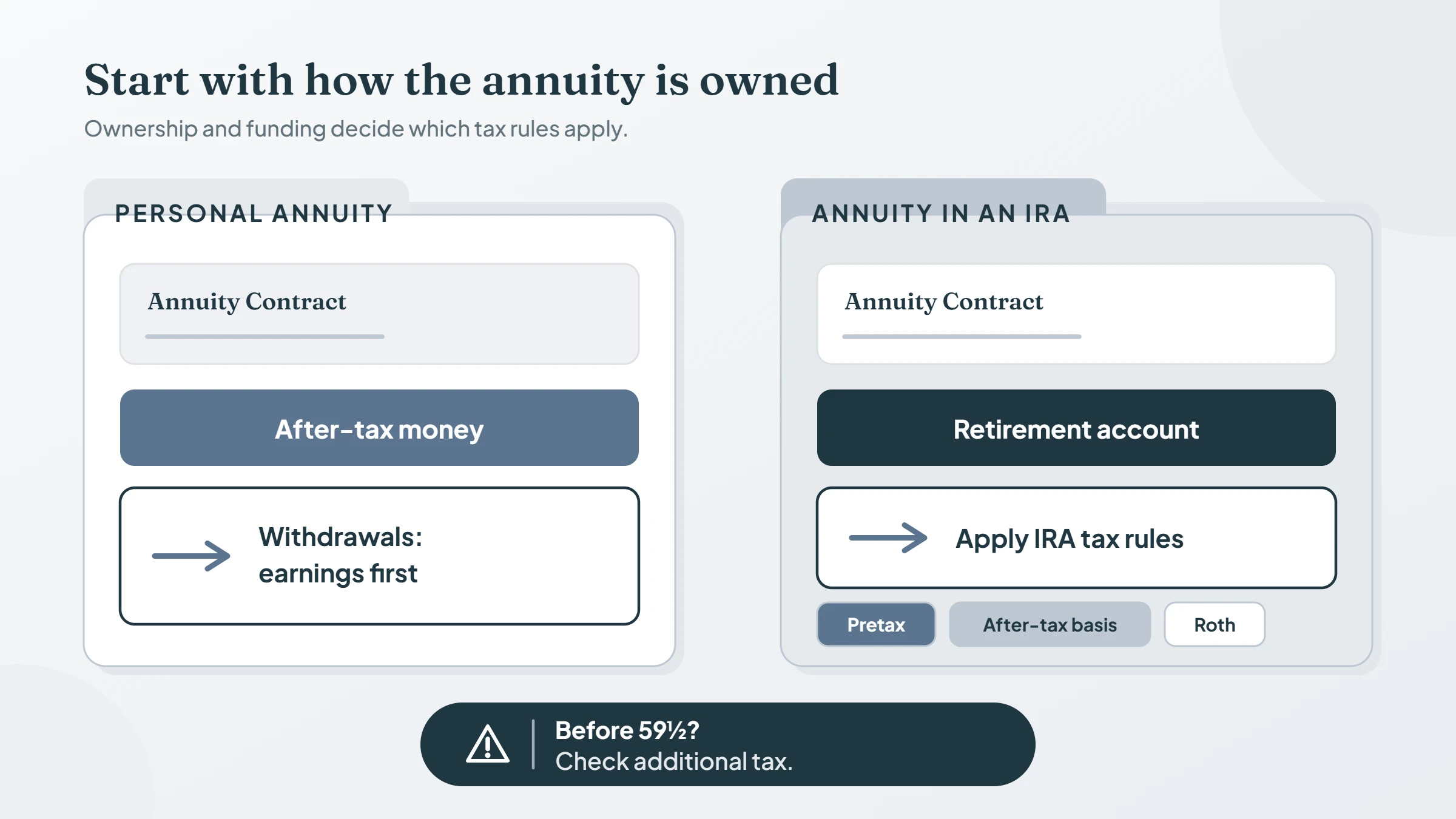
The starting question is how the annuity is owned and funded.
Annuities Bought With After-Tax Money
A personally owned nonqualified annuity is generally funded with money you have already paid tax on. Investment earnings usually grow tax-deferred while they remain inside the contract.
Partial withdrawals before annuitization generally come from taxable earnings first. Those earnings are taxed as ordinary income. Your remaining investment in the contract is generally recovered tax-free, though older contracts and certain transactions have different rules. IRS Publication 575 explains the distinctions.
Annuitized payments can contain taxable income and a tax-free return of your investment. Variable payments have specific cost-recovery calculations; applying the same exclusion percentage to every payment can be incorrect. IRS Publication 939 covers that calculation.
Annuities Inside Retirement Accounts
An annuity inside an IRA does not add another layer of tax deferral to the IRA.
Distributions attributable to pretax retirement money are generally taxable. After-tax basis and qualified Roth distributions require different treatment. Required minimum distributions may also apply, depending on the account and your circumstances.
Early Withdrawals and Other Taxes
Taxable amounts taken before age 59½ may face an additional 10% federal tax unless an exception applies. Exceptions for nonqualified annuities and retirement accounts differ. This tax is separate from an insurer’s surrender charge.
Tax deferral alone does not settle the investment comparison. Investments outside an annuity may qualify for lower long-term capital gains rates. Compare expected after-tax results, expenses, and insurance benefits together.
What Happens When You Die?
The death benefit depends on the contract and which person’s death triggers it. The owner, annuitant, and person covered by a rider may have different roles.
Some contracts provide the remaining account value. Others include a minimum or enhanced benefit, adjusted for withdrawals and other activity. A death benefit is not automatically a refund of every dollar originally deposited.
Beneficiaries may owe income tax on the taxable gain. They should also check distribution deadlines promptly: nonqualified annuities and inherited IRAs follow different rules.
Under Internal Revenue Code §72(s), nonqualified contracts generally face a five-year distribution rule when the holder dies before the annuity starting date. Qualifying beneficiary payment arrangements and spouse continuation can provide exceptions. That five-year rule should not be applied indiscriminately to IRA annuities.
Variable Annuities Compared With Other Types
The biggest difference is how each contract determines growth and allocates investment risk. “Indexed” and “variable” do not mean the same thing.
FINRA’s annuity overview explains these categories. Guarantees depend on the issuing insurer; charges and withdrawals can reduce values even where market-loss protection applies.
| Annuity type | How growth is determined | Main risk to understand |
|---|---|---|
| Fixed-rate annuity | Interest credited under the contract’s guarantees and renewal terms | Inflation, renewal rates, insurer strength, and access restrictions |
| Fixed indexed annuity | Index-linked interest calculated under limits and crediting rules | Limited upside; charges and withdrawals can reduce value |
| Registered index-linked annuity | Index-linked results with defined upside limits and downside protection | Losses beyond a buffer or under the contract’s floor structure |
| Traditional variable annuity | Performance of selected underlying investments | Market losses, expenses, and the limits of optional guarantees |
What If You Need a Lump Sum?
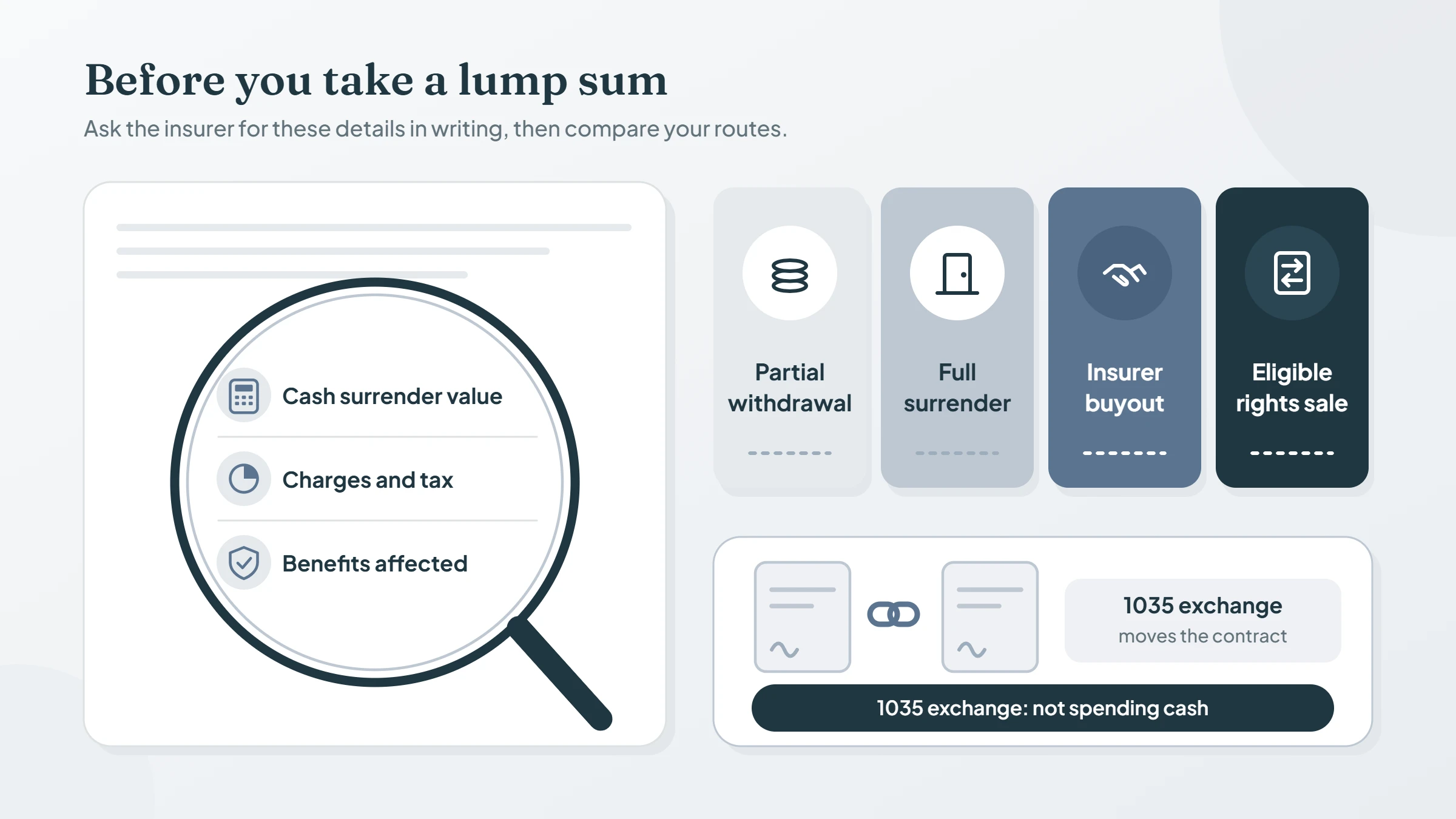
Start by asking the insurer for your current cash surrender value and a written explanation of how a withdrawal would affect each benefit.
Take a Partial Withdrawal
A contract may allow a specified amount to be withdrawn free of surrender charges. That allowance does not automatically eliminate taxes or protect your income rider.
Check the measurement period. A contract year may run from one anniversary to the next, while tax rules use calendar years. Even a required minimum distribution needs to be checked against the rider’s particular provisions.
Surrender the Contract
A full surrender closes the contract and pays its available surrender value. You give up the benefits that end with it.
Obtain the net payment estimate, applicable charges, and tax information before signing. A larger account balance does not necessarily mean a larger amount reaches your bank account.
Exchange or Accept a Buyout
A properly arranged Section 1035 exchange can move an eligible nonqualified annuity into another eligible contract while deferring recognition of gain. It does not provide spending cash. Receiving a check personally and buying another annuity is not automatically a qualifying exchange.
An insurer buyout is different again. It may offer compensation for surrendering a contract or giving up a benefit. The SEC’s buyout bulletin recommends examining the value of the guarantees you would lose.
Ask About Selling Eligible Payment Rights
A third-party purchase depends on transferable payment rights and a buyer willing to acquire them. Receiving monthly payments does not establish eligibility.
Individual retirement annuities under Internal Revenue Code §408(b) must be nontransferable by the owner. Retirement-account transfers and distributions follow separate rules.
MySettlement purchases eligible annuity payment rights. You can contact MySettlement for an eligibility review, but a variable annuity or rider payment should not be assumed eligible. Any purchase price would reflect the rights being sold, not automatically your original deposit or the total of future payments.
Questions Worth Asking Before You Decide
A variable annuity may suit someone who values its insurance benefits, accepts investment risk, and can hold the contract long term. It deserves closer scrutiny if near-term cash access is important or its benefits duplicate protection you already have.
Ask these questions:
- What does each guarantee protect, and what does it cost?
- Can I follow the investment and withdrawal restrictions?
- What would I receive if I surrendered today?
- How would an extra withdrawal affect future income?
- What happens to the benefits when I annuitize?
- How is the adviser compensated?
Keep the current prospectus, supplements, rider documents, and latest statement together. FINRA Rule 2330 requires specific reviews for recommended deferred variable annuity purchases and exchanges. Ask the professional to explain how the recommendation fits your financial circumstances.
Frequently Asked Questions
Are Variable Annuities FDIC Insured?
No. Buying one through a bank does not create FDIC coverage. Insurer guarantees depend on claims-paying ability. State guaranty association protection varies and does not cover investment losses you bear in variable accounts.
Do All Variable Annuities Guarantee Income?
They offer income options, but an account’s investment performance is not automatically guaranteed. Lifetime withdrawal protection requires an applicable benefit and compliance with its terms.
Can I Cancel a New Contract?
A free-look period gives you a limited opportunity to cancel. The deadline and refund calculation depend on applicable law and contract terms. A refund may reflect investment performance, so check the cancellation provisions promptly.
Does a Higher Benefit Base Mean More Cash?
No. A higher benefit base can support a larger calculated benefit, subject to the contract. It does not necessarily increase the account value or cash surrender value.