
- Structured Settlements
- What are Structured Settlements
- Best Structured Settlement Buyers
- How Selling Works
- Eligible Cases
- Eligibility Criteria
- Structured Settlement Regulations
- J&J Settlement
- Maui Wildfire Settlement
- Types of Structured Settlements
- Guaranteed Structured Settlements
- Increasing Structured Settlements
- Deferred Structured Settlements
- Life-Contingent Structured Settlements
- Future Lump Sum Settlements
- Annuities
- What Is An Annuity
- Guide to Selling an Annuity
- Income Annuities
- How Are Annuities Taxed?
- 7 Common Annuity Mistakes & How to Avoid Them
- Annuity Beneficiaries
- Types of Annuities
- Fixed Annuities
- Fixed Index Annuities
- Variable Annuities
- Immediate Annuities
- Deferred Annuities
- Registered Index-Linked Annuity
- Pre-Settlement Funding
- What is Pre-Settlement Funding
- How Pre-Settlement Funding Works
- Eligible Cases for Pre-Settlement Funding
- Pre-Settlement Funding Criteria
- Pre-Settlement Funding Regulations
- Types of Pre-Settlement Funding
- Non-Recourse Cash Advances
- Structured Pre-Settlement Funding
- One-Time Lump Sum Cash Advances
- Compounding Interest Funding
- Flat-Fee Structured Funding
- Structured Settlement Calculator



One specialist stays with you from your first call through funding.

November, 2026
A fixed indexed annuity can sound like a pretty appealing deal: earn interest when a market index rises and avoid a negative interest credit when it falls. Then you open the brochure. Caps, participation rates, benefit bases. Suddenly, the deal needs translating.
The basic idea is straightforward. An insurance company holds your money and calculates interest using an index and a formula in your contract. Your interest can be lower than the index’s gain, and accessing your money early can cost you.
Here’s how the pieces fit together, including the numbers worth checking before you commit.
What Is a Fixed Indexed Annuity?
A fixed indexed annuity, also called a fixed index annuity or FIA, is an insurance contract that credits interest based partly on changes in a specified market index. The S&P 500 is one common example. Buying the annuity gives you contractual benefits from the insurer; it gives you no ownership of the stocks in that index.
These contracts typically let money accumulate before you begin taking income. Many also offer an allocation that earns a declared fixed interest rate. Our guide to what an annuity is explains the broader arrangement between you and the insurer.
The word “fixed” can be confusing here. Indexed interest can change each crediting period. The protection comes from the contract’s guarantees, including its indexed interest floor. Annual returns can vary.
How Your Interest Is Calculated
Your insurer measures how an index changes over a set period, then uses your contract’s formula to calculate the interest credited to your annuity. A participation rate determines how much of that change enters the calculation, a cap limits the credit, and a spread reduces the calculated gain. Your contract may combine these features, so a 10% index gain could produce a much smaller interest credit.
Four Terms Worth Knowing
- Participation rate: The share of the measured index change used in the calculation. An 80% participation rate turns a 10% index gain into 8% before other limits.
- Cap: The maximum interest credit under that strategy for the specified period. A 6% cap sets a ceiling; earning 6% still depends on the calculation.
- Spread: A percentage point reduction in the formula. A 5% measured gain minus a 3% spread leaves 2%, assuming those are the only adjustments.
- Floor: The minimum indexed interest result. A 0% floor prevents a negative indexed interest credit, though other deductions can reduce your balance.
A positive index result can also produce zero interest. In a separate hypothetical strategy, a 2% index gain minus a 3% spread falls below a 0% floor, so the credit is zero. The market rose, but its gain was too small to clear that formula.
Some strategies combine several limits. Others use participation rates above 100% or have no stated cap. The complete formula matters more than whichever number looks most generous.
A Simple Interest Example
Let’s use a hypothetical one year strategy with 80% participation, a 6% cap and a 0% floor. These figures illustrate the calculation, exclude fees and withdrawals, and represent no particular insurer’s offer.
| Measured index change | After 80% participation | Interest credited after cap and floor |
|---|---|---|
| Up 12% | 9.60% | 6% |
| Up 4% | 3.20% | 3.20% |
| Down 15% | Negative 12% | 0% |
The Index and Dates Matter
Two contracts can follow the same index and credit different amounts. Their observation dates, calculation methods and limits may differ.
An annual point to point method compares the index at the beginning and end of a year. Averaging uses several observations. Monthly sum methods add monthly percentage changes under their own rules, which may cap positive months while including the full negative changes before applying the overall floor.
A trigger strategy pays a specified credit when its condition is met. Some qualify when the index finishes flat or higher. Others require an increase.
Annual reset adds another useful detail. After a down year, the next measurement can start at the lower index level. An index that moves from 100 to 80, then to 88, has risen 10% in the second year even though it remains below its original level. Your second year’s credit still depends on the formula.
Check What the Index Measures
Many familiar stock index strategies exclude dividends. Custom indices may include volatility controls, financing costs or other adjustments that change their results. A 150% participation rate on one index can produce less interest than an 80% rate on another.
Ask how much of the illustrated history comes from live index performance. Backtested figures apply a model to earlier data; they show neither actual customer earnings nor a promised future result.
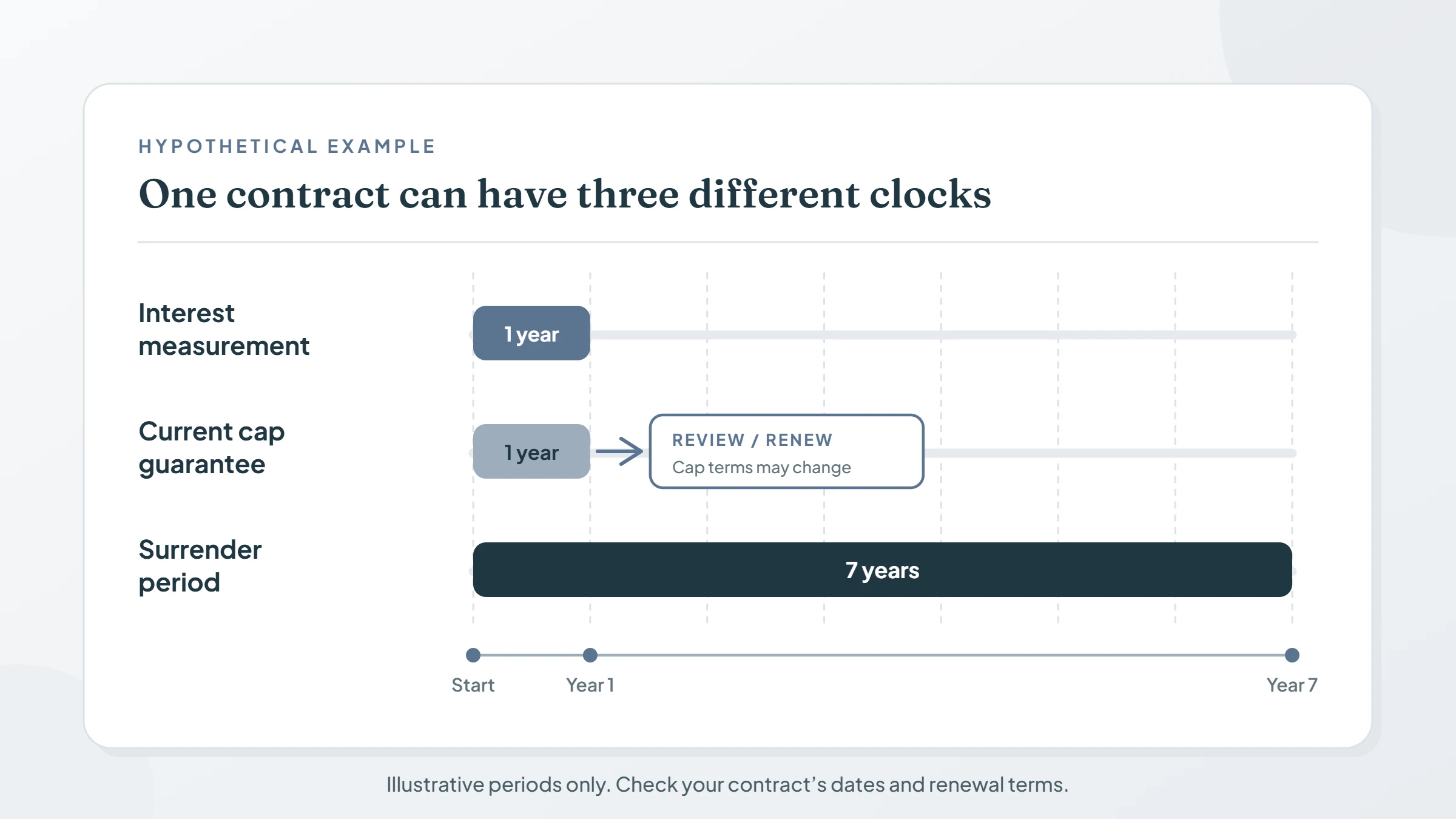
Watch Three Separate Timelines
Your crediting period, rate guarantee period and surrender period can run on different schedules. A contract could measure interest annually while restricting withdrawals for several years. Caps or participation rates might renew each year, although some products guarantee them across a longer initial period.
Also check annual versus total returns. A 12% credit over two years equals about 5.83% annualized. It does not mean you earned 12% in each year or could collect the full credit halfway through.
Can You Lose Money?
Yes. An FIA’s indexed interest floor protects against a particular cause of loss: a negative interest credit from the index falling. Your cash value can still decline for other reasons.
Take a simplified $100,000 account that earns 0% indexed interest and incurs a $1,000 contract charge. Its balance becomes $99,000. The floor did its job, but the charge still came out.
Other risks include:
- Early exit costs: Surrender charges, adjustments or bonus recapture may reduce proceeds.
- Inflation: Your money can buy less even when its dollar balance grows.
- Insurer failure: Contract guarantees depend on the issuing insurer’s ability to meet its obligations.
Costs That Deserve a Closer Look
The phrase “no annual product fee” answers only one question. You may still encounter:
- Charges for optional income or death benefits.
- Fees attached to particular indexed allocations.
- Surrender charges on withdrawals above the permitted amount.
- A market value adjustment on certain withdrawals.
- Recovery of an unvested premium bonus.
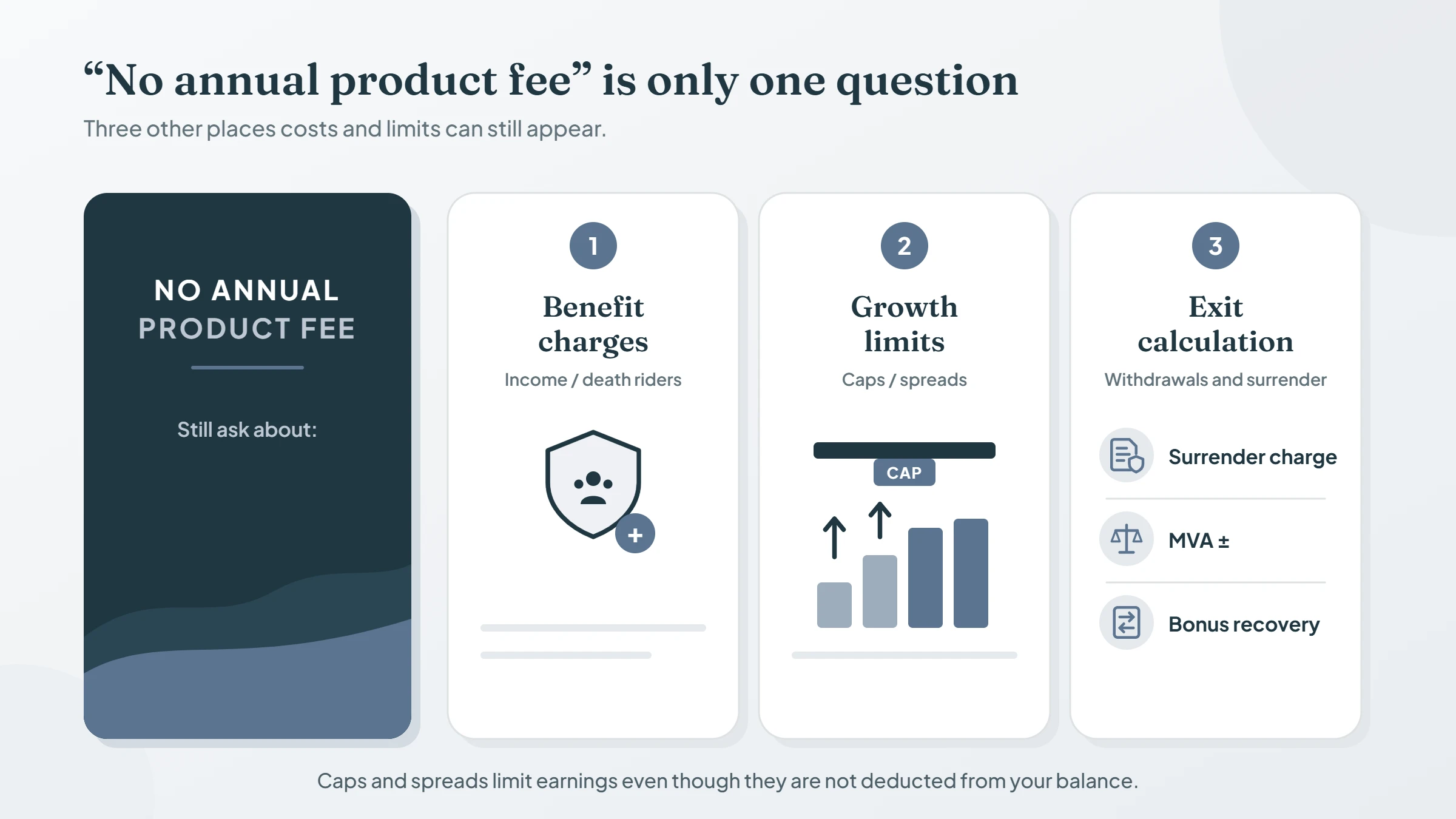
A market value adjustment, or MVA, can raise or lower withdrawal proceeds under the contract’s formula. It is separate from the equity index’s performance. Some contracts have an MVA even when they impose no surrender charge, so ask about both.
Caps and spreads also limit earnings, although they differ from fees deducted from your account. Ask how the salesperson or adviser is compensated and which costs you pay directly. A commission does not automatically mean the insurer deducts that amount from your initial deposit.
Read Bonus Offers Carefully
A bonus deserves the same scrutiny as the base contract. Ask when it becomes fully vested, which withdrawals trigger recovery and how the remaining terms compare with a contract offering a smaller bonus. A larger opening credit can come with a longer commitment or different growth limits.
Return of premium features also need a close read. Check the date the protection becomes available, any charge for it and how prior withdrawals reduce the amount protected. A guarantee available after several years answers a different question from the cash you could collect today.
Which Value Can You Spend?
An annuity statement can show several balances. Reading the biggest one as your available cash is an expensive misunderstanding, especially when an income bonus is involved.
A premium bonus may increase account value subject to vesting rules. An income base bonus increases a figure used to calculate benefits. It can improve future income while adding nothing to the amount available for an immediate withdrawal.
| Value on the statement | What it tells you |
|---|---|
| Account or accumulation value | The balance calculated under the contract after credits, withdrawals and applicable charges |
| Cash surrender value | The amount available on full surrender after applicable contract deductions or adjustments, before personal taxes |
| Income benefit base | A figure used to calculate an income benefit; generally unavailable as a cash withdrawal |
| Death benefit | The amount payable after a covered death under the contract’s terms |
How Lifetime Income Works
You can usually arrange withdrawals during accumulation, but ordinary withdrawals can exhaust an account. A lifetime income guarantee requires a qualifying contract provision and compliance with its rules.
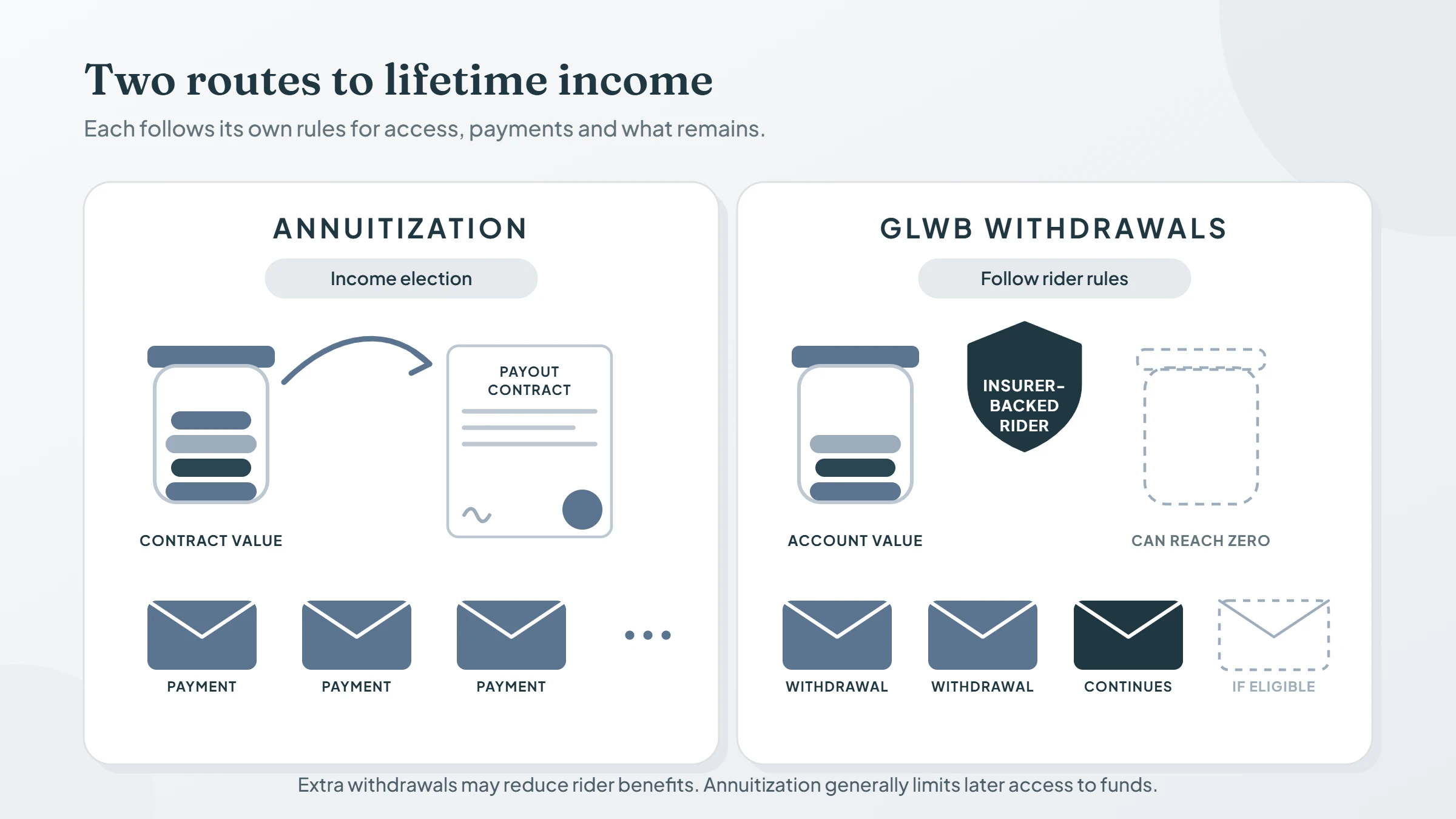
Annuitization converts value into a payment arrangement, such as income for one life or two lives. That election generally limits later access to the converted funds, so review its payment and death benefit options carefully.
A guaranteed lifetime withdrawal benefit, or GLWB, can provide lifetime withdrawals while preserving an account value that may remain accessible. Eligible payments can continue after that value reaches zero, subject to the guarantee’s conditions. Excess withdrawals can sharply reduce or terminate the benefit.
Income benefits may be optional or built in, and either arrangement can carry a charge. Some reward waiting through growth in a benefit base; others increase the withdrawal percentage. A quoted 7% benefit base growth rate is different from earning 7% on spendable savings.
Check whose lifetime is covered, the permitted starting age, annual costs and the effect of extra withdrawals.
Fixed Indexed Annuities and Alternatives
The tradeoff becomes clearer when you compare how each annuity earns money and handles market losses. Optional benefits can change specific guarantees, so treat this as a starting point for reading the contracts.
| Annuity type | How value grows | Main tradeoff |
|---|---|---|
| Fixed rate annuity | A declared interest rate for a specified period | More predictable interest; renewal rates can change |
| Fixed indexed annuity | Interest linked to an index formula | Indexed interest protection paired with limits on growth and access |
| Variable annuity | Performance of selected investment options | Greater market exposure, including potential investment losses |
| Registered index linked annuity | Index performance subject to specified limits and loss protection | Buffers or floors leave some market losses with the owner |
How Fixed Indexed Annuities Are Taxed
The account holding the annuity matters as much as the product. A personally owned nonqualified annuity generally uses money that has already been taxed. Its earnings usually grow tax deferred until distributed.
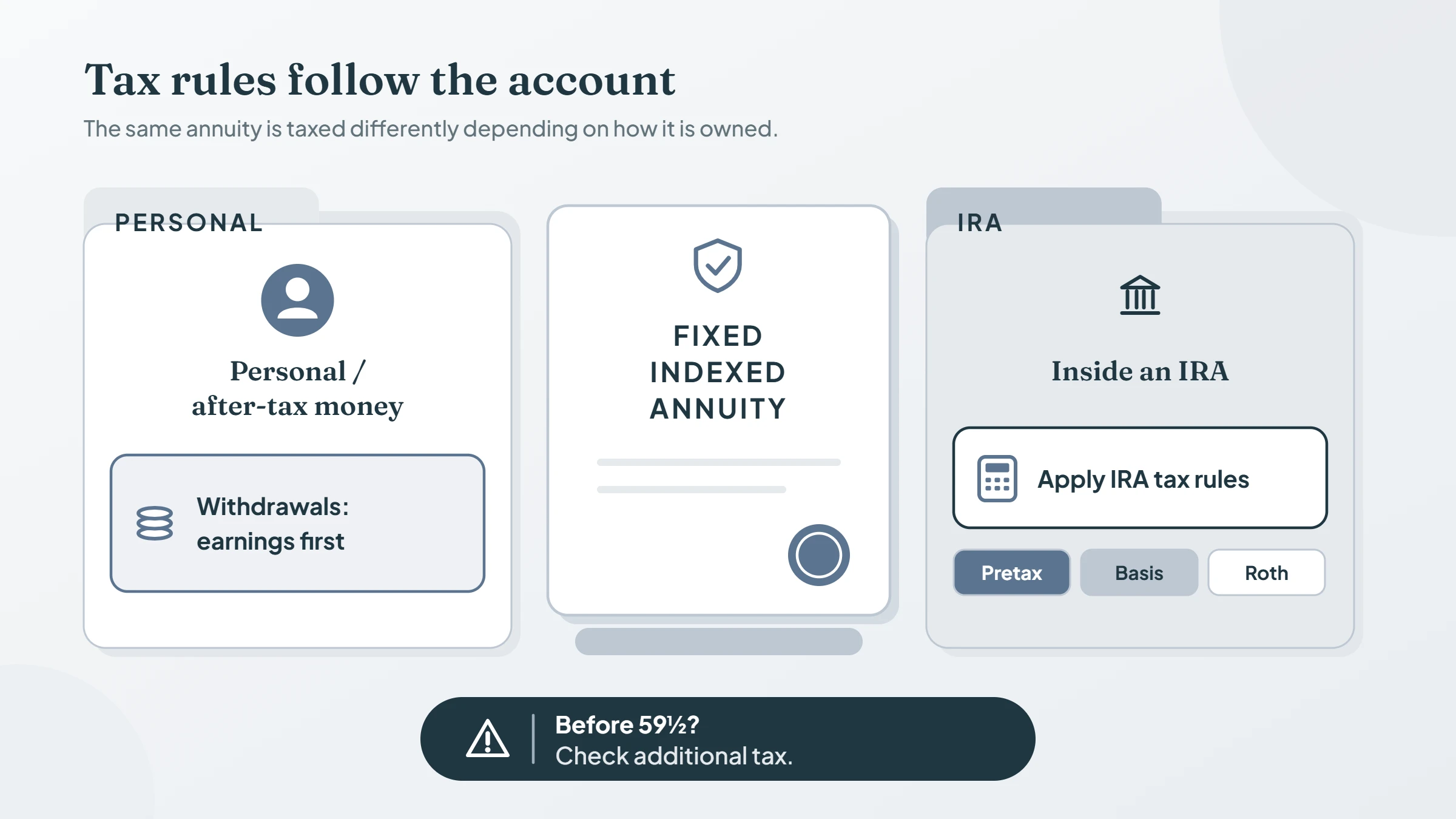
Under Internal Revenue Code Section 72, partial withdrawals before annuitization generally take taxable earnings out first. Those earnings are taxed as ordinary income. Once earnings are exhausted, withdrawals generally recover your investment in the contract, subject to applicable rules.
Annuitized payments use different tax calculations and may contain both taxable income and a return of your investment. The IRS pension and annuity guidance explains those calculations.
Keep these distinctions in mind:
- Early distributions: Before age 59½, the taxable portion may face an additional 10% federal tax unless an exception applies. This is separate from insurer charges.
- Retirement accounts: An annuity inside an IRA adds no extra layer of tax deferral. Pretax funds, after tax basis and Roth accounts follow their respective rules.
- Required distributions: IRA distribution requirements can apply even while an annuity has withdrawal restrictions. Ask how the contract accommodates them.
- Additional tax: Some nonqualified annuity income can enter the 3.8% net investment income tax calculation when applicable income thresholds are exceeded.
An eligible Section 1035 exchange can move value into another qualifying contract while deferring recognition of gain. It does not turn that value into tax free spending cash. Old surrender costs, lost benefits and new restrictions also deserve a calculation before any exchange.
What If You Need Cash?
Start by asking the insurer for a current withdrawal quote. Your statement balance alone may leave out charges, an MVA or pending interest you would give up.
Some contracts permit a limited annual withdrawal exempt from surrender charges. That allowance can still affect taxes, future interest or income guarantees. A withdrawal taken before the crediting period ends may forfeit interest on the amount removed; other contracts provide a partial credit under specified circumstances.
Ask for these figures in writing:
- Cash payable after all contract deductions and adjustments.
- Interest or bonus benefits lost through the withdrawal.
- The remaining account value and revised guaranteed income.
- The estimated taxable portion of the distribution.
Could You Sell Payment Rights?
Existing annuity payment rights may be eligible for a sale, depending on ownership, assignment restrictions, payment terms and applicable law. An accumulation account and an established stream of transferable payments are different situations.
MySettlement purchases eligible annuity payment rights. You can contact MySettlement to ask whether your particular payments qualify. A purchase offer represents a price for the rights sold, which may be substantially below their total future payments.
An individual retirement annuity under Section 408(b) must be nontransferable by its owner. Retirement account transfers and distributions follow separate rules. Monthly payments alone establish neither transferability nor eligibility for a sale.
Questions Before You Sign
An FIA may suit money reserved for later years when you value protection against negative indexed interest and can accept limits on growth and access. Money needed for upcoming bills or emergencies calls for closer attention to liquidity.
Before discussing products, write down the amount you can leave untouched, the income you need and the date you need it. Keep those figures beside each illustration. An attractive projected balance has limited use if the contract blocks access during the years you expect to spend the money.
Ask to see guaranteed values alongside illustrated outcomes. An illustration can help explain a formula, but a favorable historical period cannot establish your future interest credits. Compare the same deposit, withdrawal dates and income choices across proposals so differences in assumptions stay visible.
Bring these questions to the person recommending the contract:
- Which index and calculation determine my interest?
- Which terms can change, and what minimums are guaranteed?
- How much could I collect if I exit next year?
- What do the income benefits cost and permit?
- How are you paid for this recommendation?
- Which cancellation rights apply after delivery?
Common Questions
Does a Falling Index Reduce Interest?
A traditional FIA’s 0% indexed interest floor prevents a negative credit for that strategy. Already credited interest is generally protected against subsequent index declines. Fees and withdrawals remain separate deductions.
What Happens When the Owner Dies?
Beneficiary payments depend on ownership, the covered death and the contract’s provisions. Death benefits can differ from account value. Taxable earnings generally retain tax consequences, and distribution deadlines or continuation options depend on the beneficiary and account type.
Ask what happens if death occurs before an interest crediting period ends. Some contracts include a partial interest credit in the death benefit. Also review the beneficiary designation after a marriage, divorce or death in the family; the contract’s named recipient matters.
Can an FIA Guarantee Positive Annual Growth?
A 0% floor permits a year with zero indexed interest. Minimum guarantees or return of premium benefits may apply at particular times and carry conditions or charges. Ask which value is guaranteed, when it applies and how withdrawals affect it.