
- Structured Settlements
- What are Structured Settlements
- Best Structured Settlement Buyers
- How Selling Works
- Eligible Cases
- Eligibility Criteria
- Structured Settlement Regulations
- J&J Settlement
- Maui Wildfire Settlement
- Types of Structured Settlements
- Guaranteed Structured Settlements
- Increasing Structured Settlements
- Deferred Structured Settlements
- Life-Contingent Structured Settlements
- Future Lump Sum Settlements
- Annuities
- What Is An Annuity
- Guide to Selling an Annuity
- Income Annuities
- How Are Annuities Taxed?
- 7 Common Annuity Mistakes & How to Avoid Them
- Annuity Beneficiaries
- Types of Annuities
- Fixed Annuities
- Fixed Index Annuities
- Variable Annuities
- Immediate Annuities
- Deferred Annuities
- Registered Index-Linked Annuity
- Pre-Settlement Funding
- What is Pre-Settlement Funding
- How Pre-Settlement Funding Works
- Eligible Cases for Pre-Settlement Funding
- Pre-Settlement Funding Criteria
- Pre-Settlement Funding Regulations
- Types of Pre-Settlement Funding
- Non-Recourse Cash Advances
- Structured Pre-Settlement Funding
- One-Time Lump Sum Cash Advances
- Compounding Interest Funding
- Flat-Fee Structured Funding
- Structured Settlement Calculator



One specialist stays with you from your first call through funding.

November, 2026
A deferred annuity is an insurance contract designed to provide income at a future date. You pay the insurance company now, either through one premium or a series of premiums, and delay receiving scheduled income payments until later.
That delay gives you time to plan. It also raises a question that deserves attention before you commit your money: What happens if you need access to it sooner?
The answer depends on the contract. Some deferred annuities maintain an account value that you may be able to withdraw, subject to charges and taxes. Others purchase a future income stream and offer little or no access to cash before payments begin.
Fixed-rate deferred annuity sales reached $41.8 billion in the second quarter of 2026, according to LIMRA. That figure represents one category of deferred annuities, and it measures sales rather than investment performance.
Let’s look at how these contracts work, how they can provide income, and which details deserve a closer look.
How Does a Deferred Annuity Work?
A deferred annuity starts when you pay a premium to an insurance company. The contract sets out how your money is handled, which guarantees apply, and when income can begin.
Many deferred annuities have two stages:
- Accumulation phase: Your contract has time to accumulate value before scheduled annuity income begins.
- Payout phase: You receive income according to the payment arrangement you select or the terms established when you purchased the contract.
The accumulation phase does not necessarily end when you make your last premium payment. An account-based contract can continue to earn interest or experience investment gains and losses after you stop contributing.
The way its value changes depends on the annuity. A fixed deferred annuity credits interest under the insurer’s stated terms. A variable deferred annuity can gain or lose value based on the performance of its investment options.
You can learn more about the broader contract structure in our guide to how annuities work.
A Deferred Annuity Example
Suppose you contribute $100,000 to a hypothetical fixed deferred annuity. The contract credits a guaranteed 5% annual interest rate for five years.
Assuming annual compounding, no withdrawals, and no separate deductions, the account value would grow as follows:
| Point in time | Account value |
|---|---|
| At purchase | $100,000 |
| After one year | $105,000 |
| After two years | $110,250 |
| After three years | $115,762.50 |
| After four years | $121,550.63 |
| After five years | $127,628.16 |
The $27,628.16 increase illustrates how interest can accumulate inside the contract. The 5% rate is hypothetical; it is not a current rate or a promise about any available annuity.
The example also does not tell you what monthly income the annuity will pay. That amount depends on the contract, the income option, your age when payments begin, and other factors used in the insurer’s calculation.
Deferred Annuity vs. Deferred Income Annuity
A deferred income annuity, or DIA, is a type of deferred annuity designed to purchase income that begins on a future date. Its structure can differ substantially from an annuity built around an accumulation account.
| Feature | Deferred accumulation annuity | Deferred income annuity |
|---|---|---|
| Main purpose | Accumulate contract value and provide future distribution options | Purchase a future stream of income |
| Account value | Generally maintains an account value | Often does not maintain an accumulation account |
| Income amount | May be determined when value is converted into payments | Generally established when a premium purchases the future income benefit |
| Cash access | May permit withdrawals or surrender, subject to contract terms | Can have little or no cash surrender value |
New York’s Department of Financial Services explains that a deferred income annuity can use each premium to purchase a specified future income benefit. An accumulation annuity maintains an account value that can later be applied to an income option.
The cash-access distinction can be significant. One New York Life deferred income annuity, for example, has no cash value and does not permit withdrawals before its income-start date. The same disclosure says its life-only option provides no death benefit before or after that date. Those are product-specific terms, but they show why the contract matters.
Some income annuities offer features that permit limited payment acceleration or other access. Ask the insurer exactly when that feature becomes available and how it changes future payments.
Types of Deferred Annuities
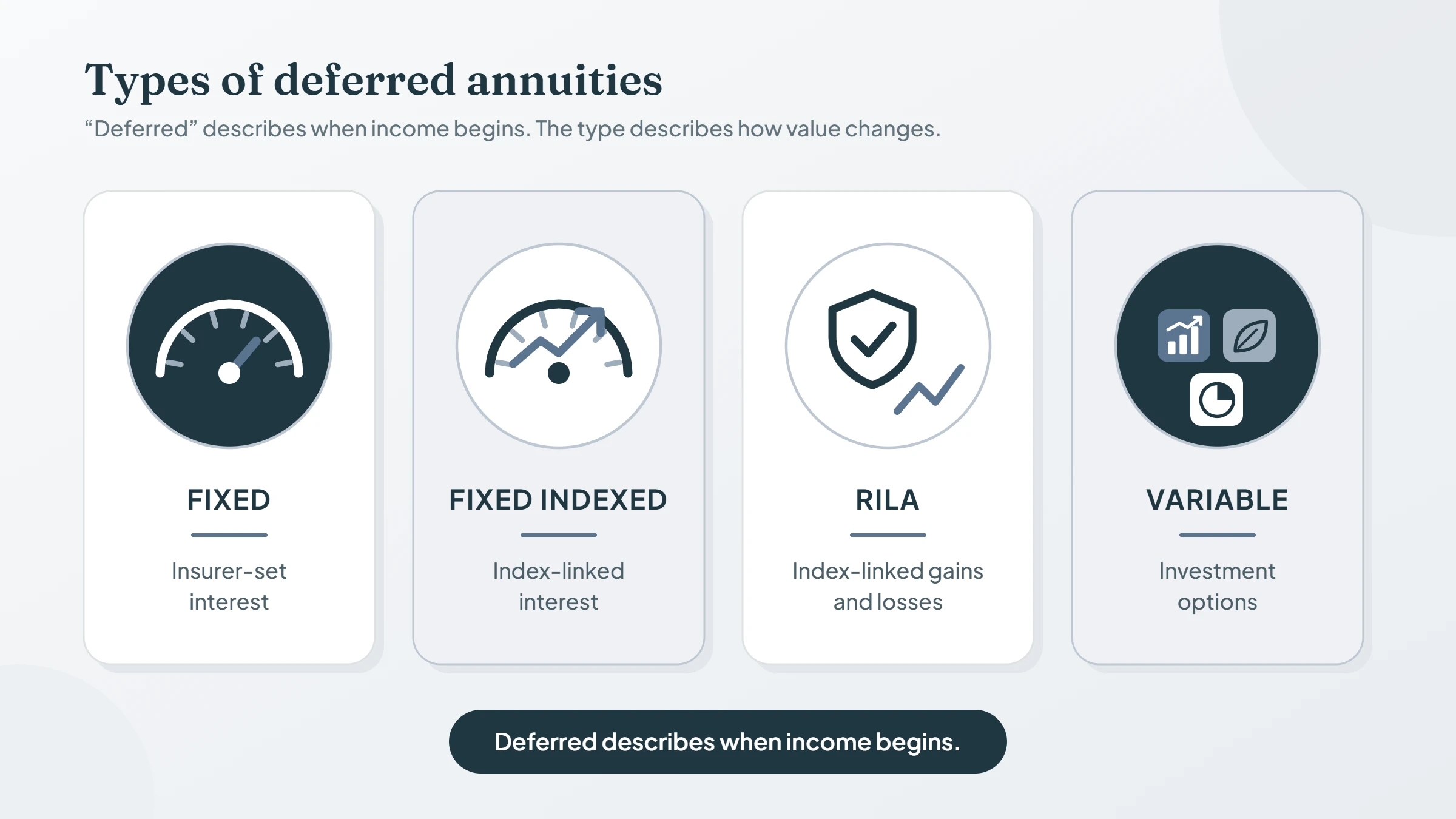
The word deferred describes when income begins. Other terms describe how the annuity’s value changes. That means a contract can be both fixed and deferred, or both variable and deferred.
Fixed Deferred Annuity
A fixed deferred annuity earns interest according to rates set by the insurance company. The contract states its guarantees and the period during which a particular rate applies.
A multi-year guaranteed annuity, or MYGA, is a fixed annuity that guarantees a stated rate for a specified number of years. The insurer may offer a new rate when that period ends.
Check two rates separately:
- The current guaranteed rate and how long it lasts.
- The minimum guaranteed rate that applies under the contract.
A five-year rate guarantee does not necessarily mean your annuity ends after five years. You may have a renewal decision, a withdrawal window, or other choices at that point.
Fixed Indexed Deferred Annuity
A fixed indexed annuity credits interest using a formula tied partly to an index, such as the S&P 500. You do not directly own the stocks in that index through the indexed strategy.
The formula can limit interest through features such as a cap, participation rate, or spread. A negative index result generally produces a 0% index credit under the applicable strategy, though charges, withdrawals, or adjustments can still affect the amount you receive.
Registered Index-Linked Deferred Annuity
A registered index-linked annuity, or RILA, also uses an index-based formula. Its selected strategy can produce a negative credit when the index declines beyond the protection provided by the contract.
A buffer or floor may limit certain losses during a specified term. The protection has conditions, and a withdrawal during the term can involve a separate valuation.
Variable Deferred Annuity
A variable deferred annuity lets you allocate money among investment options, commonly called subaccounts. Their performance affects your contract value.
Your balance can rise or fall. Optional guarantees may be available for an additional cost, but those guarantees have their own rules and do not necessarily protect the full amount available as cash.
The SEC explains these four structures and their different risk characteristics in its annuity guidance.
How Do You Pay for a Deferred Annuity?
Your contract determines how premiums can be paid.
A single-premium deferred annuity, or SPDA, starts with one lump-sum premium. Someone might use savings, an inheritance, or an eligible retirement-account transfer to fund it.
A flexible-premium deferred annuity allows additional premiums over time, subject to the insurer’s rules. The contract may set minimum amounts, maximum amounts, or limits on when additional payments are accepted.
Ask how each new premium is treated. A later payment may receive a different rate, and some contracts apply a separate surrender schedule to each contribution.
How Do You Receive Money From a Deferred Annuity?
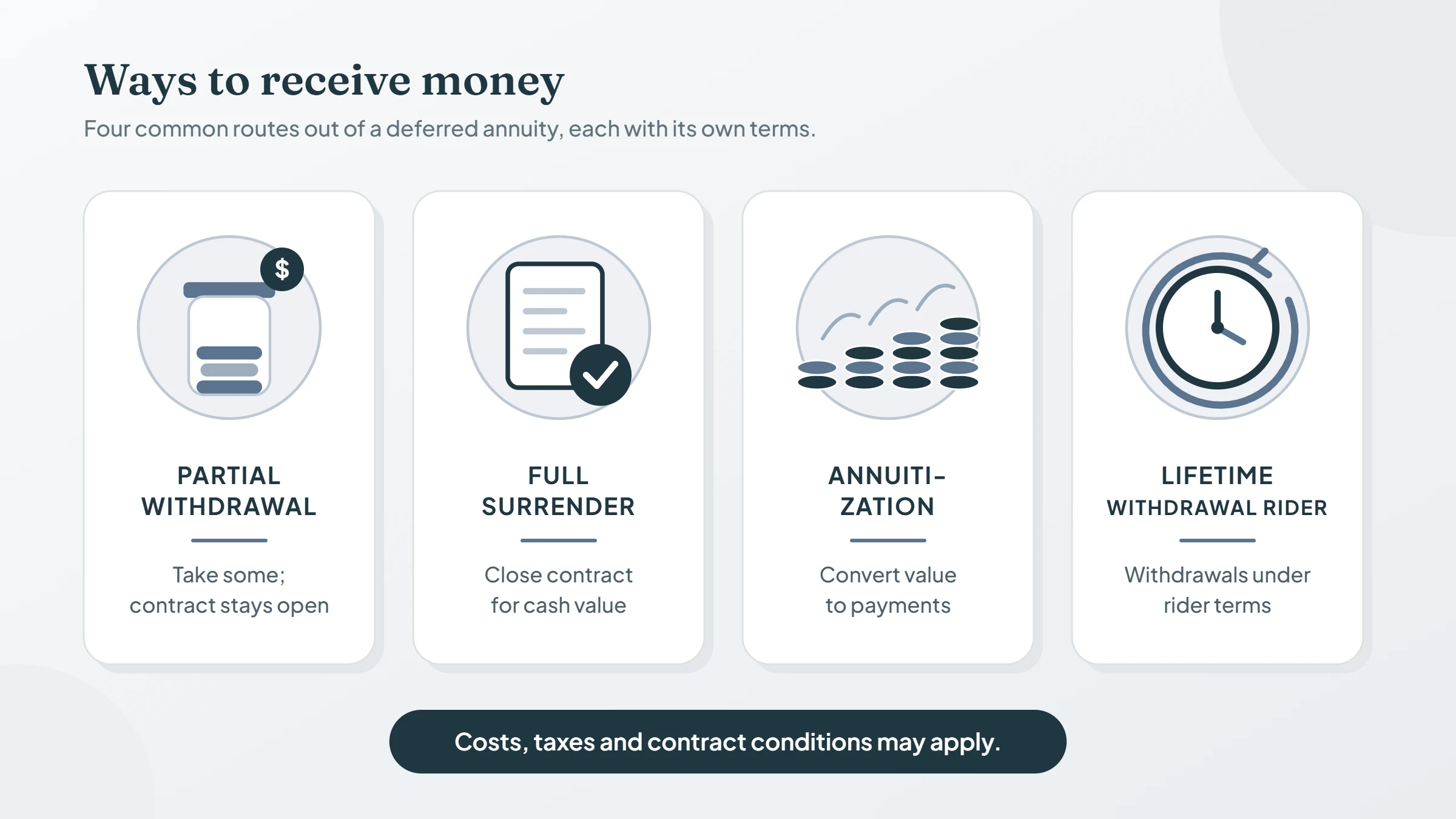
Income is not always a single decision made on the day you purchase the contract. An accumulation annuity may offer several ways to access its value, depending on its terms.
Partial Withdrawals
A partial withdrawal lets you take some money while keeping the contract open. The remaining value stays in the annuity, subject to its investment or interest-crediting rules.
A withdrawal can reduce future income and death benefits. It may also trigger charges or taxes.
Full Surrender
A full surrender generally closes the contract in exchange for its cash surrender value. That value can differ from the account value shown on your statement.
Surrender charges, market value adjustments, and other contract terms may affect the amount paid. A full surrender can also end valuable income or beneficiary benefits.
Annuitization
Annuitization converts an amount under the contract into a series of payments. Depending on the options available, payments might last:
- A specified number of years.
- Your lifetime.
- Your lifetime and, afterward, a surviving spouse’s lifetime.
- Your lifetime with a minimum guaranteed payment period.
The choice affects both your payment amount and what happens after your death. A life-only option may provide a larger initial payment than an otherwise comparable option that includes survivor protection.
Annuitization often limits later access to the amount converted. Review any available withdrawal or commutation provisions before choosing an income option.
Guaranteed Lifetime Withdrawal Benefits
Some annuities offer a guaranteed lifetime withdrawal benefit, or GLWB, through an optional rider. The rider can provide withdrawals for life under specified conditions, even if permitted withdrawals eventually reduce the account value to zero.
The rider may carry an additional fee. It can also use a separate income benefit base to calculate income.
That base is important, but it is not necessarily money you can withdraw. A statement might show a $150,000 income benefit base and a lower contract value. The larger number may determine a guaranteed withdrawal calculation; it does not automatically represent the cash available if you surrender the annuity.
Fidelity’s explanation of income riders describes the income benefit base as a calculation amount separate from the contract value.
Ask how withdrawals above the rider’s permitted amount affect future guarantees.
Deferred Annuity vs. Immediate Annuity
The main difference is the timing of scheduled income.
| Feature | Deferred annuity | Immediate annuity |
|---|---|---|
| Income start | At a future date under the contract | Typically within one year after purchase |
| Funding | One premium or, if allowed, multiple premiums | Typically one lump-sum premium |
| Accumulation account | Common in deferred accumulation contracts | Generally designed to begin income soon after purchase |
| Cash access | Depends on the contract | Often limited after the premium purchases income |
An immediate annuity may help someone who wants income soon. That does not necessarily mean it offers greater access to a lump sum. The payment schedule and any cash-access provisions still need review.
What Happens if You Need Money Early?
“Early” can refer to several different dates. You might withdraw before the surrender period ends, before an indexed term ends, or before age 59½. Each can have a different consequence.
Surrender Charges
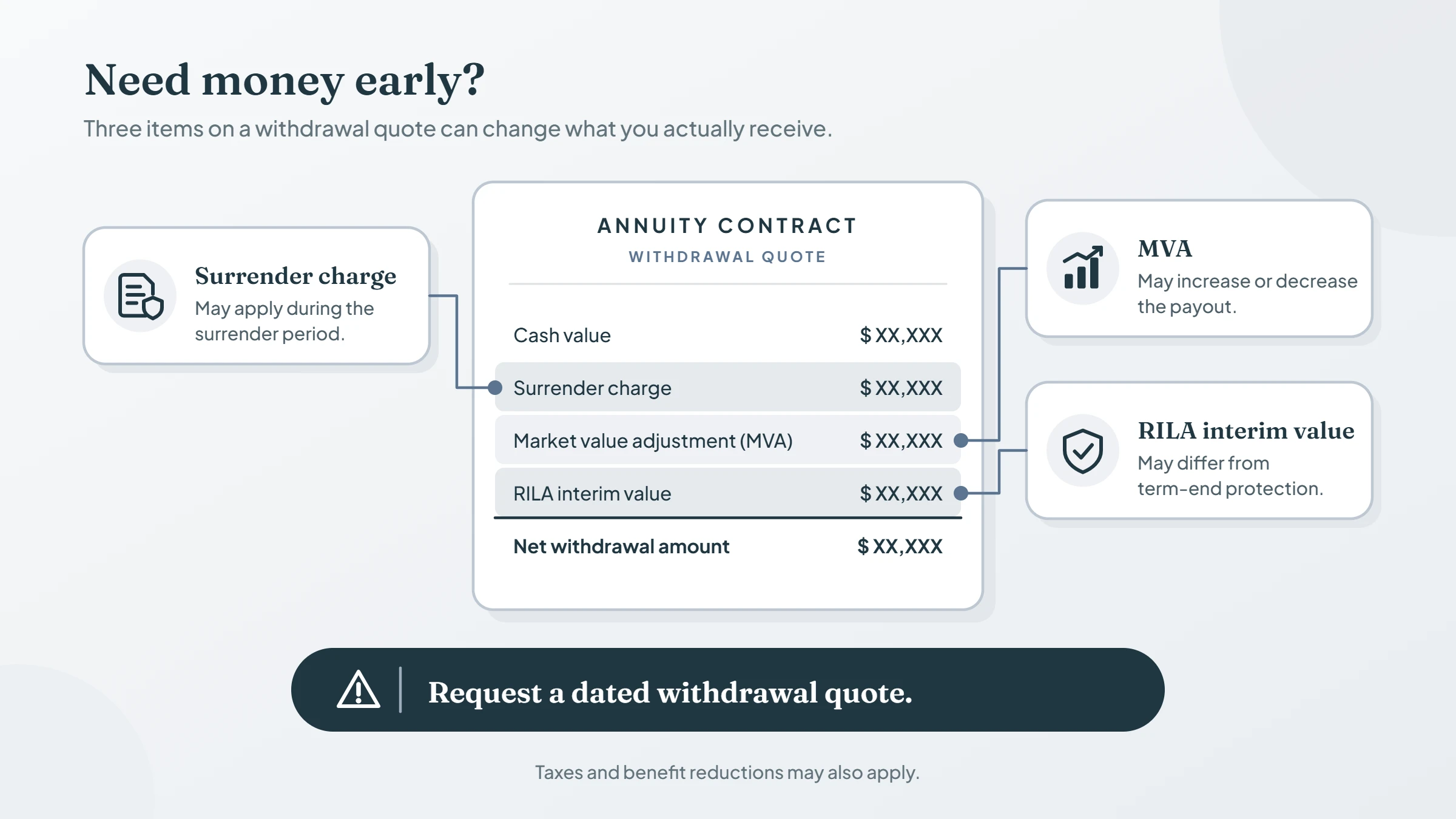
A surrender charge is an insurer charge that may apply when you withdraw money during a specified period. The percentage often declines over time.
Some contracts permit an annual free withdrawal up to a stated limit. That phrase generally refers to a waiver of specified contract charges. Taxes can still apply.
Ask how the allowance is calculated. A 10% allowance might be based on account value, premiums, or another figure defined in the contract.
Market Value Adjustments
A market value adjustment, or MVA, can change the amount available when you withdraw during an applicable guarantee period. Depending on the formula and changes in interest rates, the adjustment may increase or decrease the amount paid.
An MVA is separate from a surrender charge. Some contracts waive both on certain permitted withdrawals; others apply different conditions.
Interim Value Adjustments
A RILA may use an interim value adjustment, or IVA, when money is accessed before an index segment ends. The interim calculation can produce a different result from the strategy’s advertised term-end protection.
FINRA’s 2026 annuity oversight report warns that accessing a RILA mid-segment can result in a significant loss.
Request a dated quote before deciding. Ask the insurer to show the account value, applicable charges, adjustments, and the effect on any remaining benefits.
How Are Deferred Annuities Taxed?
Tax treatment depends on how the annuity was funded and how money is distributed.
Nonqualified Deferred Annuities
A nonqualified annuity is generally purchased with money outside a tax-qualified retirement arrangement. Its after-tax investment and earnings are treated differently when money comes out.
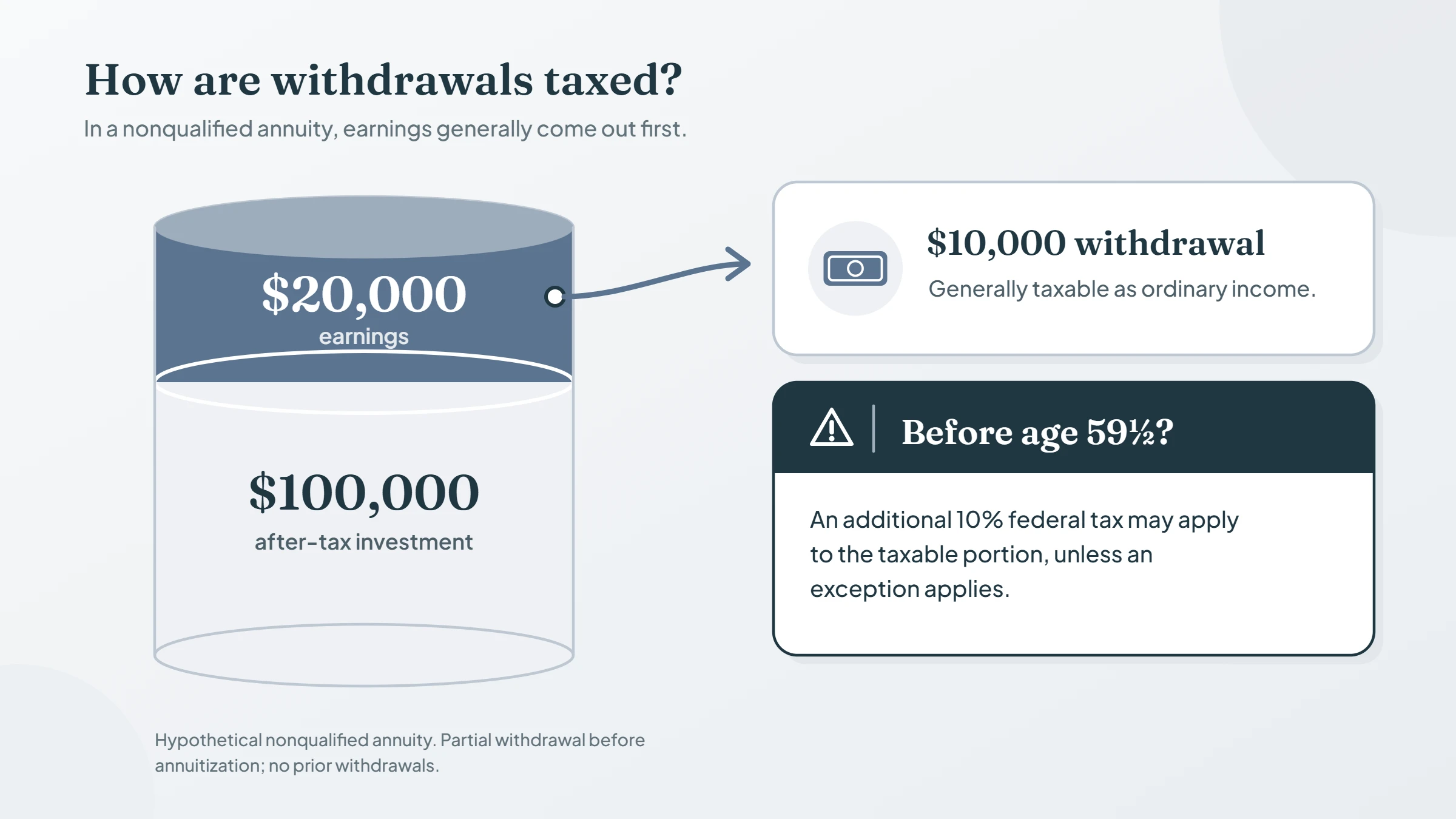
A partial withdrawal before the annuity starting date generally takes taxable earnings out first. Once those earnings have been distributed, additional amounts may be treated as a return of the investment in the contract.
Suppose you contributed $100,000 in after-tax money and the contract’s value is now $120,000. A $10,000 partial withdrawal before annuitization would generally be allocated entirely to the $20,000 of earnings. The $10,000 would therefore generally be taxable as ordinary income.
The example assumes a modern nonqualified contract and no previous withdrawals. Older contracts and other circumstances can follow different rules. The IRS explains these allocation rules in Publication 575.
A full surrender follows its own calculation. Generally, the amount received above your remaining investment in the contract is taxable.
Annuitized Payments
Payments received as an annuity can follow different rules from partial withdrawals.
The IRS’s General Rule allocates eligible payments between taxable income and recovery of investment. Once the applicable investment has been recovered, later payments generally become fully taxable. Variable annuities can require a different computation. See IRS Publication 939 for details.
Annuities Inside Retirement Accounts
An annuity can also be held inside a traditional IRA or another eligible retirement arrangement. Distributions from an account funded entirely with pretax money are generally taxable as ordinary income.
After-tax basis and Roth arrangements require separate treatment. A qualified Roth IRA distribution is generally tax-free when the applicable requirements are met.
An IRA already provides its own tax treatment. Placing an annuity inside it does not create an additional layer of tax deferral. The annuity’s insurance features, costs, and restrictions still matter.
Withdrawals Before Age 59½
A 10% additional federal tax may apply to the taxable portion of a distribution taken before age 59½, unless an exception applies.
That tax is separate from:
- Ordinary income tax.
- A surrender charge.
- An MVA or IVA.
- Any applicable state tax.
An insurer’s decision to waive a surrender charge does not automatically waive the federal tax. Section 72 of the Internal Revenue Code contains exceptions with specific requirements.
What Happens to a Deferred Annuity When You Die?
The answer depends on the contract, the person whose death triggers the benefit, and the payment option selected.
An accumulation annuity may pay a death benefit to a named beneficiary before annuitization. The amount might be based on the account value, a contractual minimum, or an enhanced benefit purchased through a rider.
A deferred income annuity can work differently. A life-only contract may stop when the covered person dies, potentially leaving no payment to beneficiaries. Other options may provide a refund, a period of guaranteed payments, or income for a surviving annuitant.
Beneficiary distributions can also have tax consequences. The rules for a personally purchased nonqualified annuity differ from those for an inherited IRA. The relationship of the beneficiary, the timing of death, and the contract’s distribution provisions all matter.
Ask for written answers to two questions:
- What would my beneficiary receive if I died before income begins?
- What would my beneficiary receive if I died after income begins?
Benefits and Drawbacks of Deferred Annuities
| Potential benefit | Tradeoff to consider |
|---|---|
| Earnings can grow tax-deferred | Taxable distributions generally receive ordinary-income treatment |
| A contract may offer future lifetime income | The income guarantee has conditions and depends on the insurer |
| Fixed and indexed contracts may offer specified protections | Charges, adjustments, or withdrawals can affect cash value |
| Some contracts offer beneficiary benefits | Extra protection may cost more or reduce initial income |
| A delayed start gives time to plan future income | Access to cash may be restricted during the waiting period |
Inflation deserves attention, too. A fixed payment of $1,000 may buy less over time as prices rise. Some income options offer scheduled increases, though a contract with an increase feature may begin with a lower payment than a comparable level-payment option.
Annuities are insurance contracts and are not FDIC-insured bank deposits. Contract guarantees depend on the issuing insurer’s ability to meet its obligations. State guaranty association protections may apply if an insurer fails, subject to state limits and exclusions.
Questions to Ask Before Buying a Deferred Annuity
The most useful question is often the one that turns a percentage into a dollar amount. Ask the insurer or financial professional:
- Is this an accumulation annuity or a deferred income annuity?
- How does the contract earn interest or experience investment gains and losses?
- How long is the stated interest rate guaranteed?
- What can I withdraw during the surrender period, and which charges would apply?
- Could an MVA, IVA, or lost interest affect an early withdrawal?
- Does an advertised income base represent cash I can withdraw?
- What fees apply to the contract, investment options, and optional riders?
- What income choices will be available, and can I change them later?
- What happens if I die before or after income begins?
- What is the free-look deadline, and how would my refund be calculated?
A free-look period gives an owner a limited opportunity to review and return a newly received contract under applicable rules. The deadline and refund calculation vary, so check both when the contract arrives.
Can You Exchange a Deferred Annuity?
An owner may consider replacing one annuity with another. A qualifying Section 1035 exchange can allow certain annuity-to-annuity exchanges to occur without recognizing gain at the time of the exchange.
The transaction must meet the applicable requirements. Receiving a check yourself and using it to buy another annuity does not automatically qualify. IRS Revenue Ruling 2007-24 addresses that situation.
Tax deferral is only one part of the decision. Compare surrender charges on the existing contract, a possible new surrender period, rider fees, and any benefits you would give up.
What If You Need a Lump Sum?
Start by asking the insurer about your contract’s withdrawal, surrender, acceleration, or commutation options. Request the amount available in writing and review the effect on future payments and benefits.

Selling payment rights to a third party is a separate transaction. Eligibility depends on the annuity, ownership structure, transfer restrictions, and applicable law. An annuity held in an IRA can have additional restrictions.
MySettlement purchases eligible annuity payment rights. You can discuss your arrangement through our annuity purchasing service and confirm whether it qualifies. A current insurer quote can help you compare the available options.
Common Questions About Deferred Annuities
Can a Deferred Annuity Lose Money?
Yes. Variable annuities and RILAs can lose value because of investment or index-related performance. Charges and adjustments can also reduce what you receive from other deferred annuities.
Does a Deferred Annuity Have to Start Paying at Age 59½?
No. Age 59½ is relevant to the potential additional federal tax on certain early distributions. Your income-start date depends on the contract and any applicable retirement-account requirements.
Can I Withdraw Money During the Accumulation Phase?
Many accumulation annuities permit withdrawals before annuitization. Charges, adjustments, taxes, and benefit reductions may apply. A deferred income annuity can have much tighter restrictions.
Are Deferred Annuity Contributions Limited?
Insurers can set minimum and maximum premiums. A personally purchased nonqualified annuity generally does not have the same annual contribution limit as an IRA, but an annuity held inside an IRA remains subject to the IRA’s applicable rules.
Is a Deferred Annuity the Same as a QLAC?
A qualified longevity annuity contract, or QLAC, is a specific type of deferred income annuity that must meet federal requirements. Not every deferred income annuity qualifies.
A QLAC can receive special treatment when calculating required minimum distributions from eligible retirement funds. Premium limits and other conditions apply. The IRS instructions for Form 1098-Q explain the requirements.
Can I Keep My Money in a Deferred Annuity Indefinitely?
Check the contract’s maturity or annuitization date. Retirement-account distribution rules can also require payments to begin under applicable federal requirements. Your available choices depend on both the contract and how it is owned.