
- Structured Settlements
- What are Structured Settlements
- Best Structured Settlement Buyers
- How Selling Works
- Eligible Cases
- Eligibility Criteria
- Structured Settlement Regulations
- J&J Settlement
- Maui Wildfire Settlement
- Types of Structured Settlements
- Guaranteed Structured Settlements
- Increasing Structured Settlements
- Deferred Structured Settlements
- Life-Contingent Structured Settlements
- Future Lump Sum Settlements
- Annuities
- What Is An Annuity
- Guide to Selling an Annuity
- Income Annuities
- How Are Annuities Taxed?
- 7 Common Annuity Mistakes & How to Avoid Them
- Annuity Beneficiaries
- Types of Annuities
- Fixed Annuities
- Fixed Index Annuities
- Variable Annuities
- Immediate Annuities
- Deferred Annuities
- Registered Index-Linked Annuity
- Pre-Settlement Funding
- What is Pre-Settlement Funding
- How Pre-Settlement Funding Works
- Eligible Cases for Pre-Settlement Funding
- Pre-Settlement Funding Criteria
- Pre-Settlement Funding Regulations
- Types of Pre-Settlement Funding
- Non-Recourse Cash Advances
- Structured Pre-Settlement Funding
- One-Time Lump Sum Cash Advances
- Compounding Interest Funding
- Flat-Fee Structured Funding
- Structured Settlement Calculator



One specialist stays with you from your first call through funding.
November, 2026
A pending legal claim can take time to resolve. Meanwhile, rent, groceries, medical bills and other expenses keep coming.
A non-recourse cash advance gives you access to funding based on the potential proceeds of your claim. The defining feature is how repayment works: if your case produces no recovery, you generally do not repay the advance or funding charges under an ordinary case loss.
At My Settlement, we connect you with multiple non-recourse funding options, so you can review the available offers and choose one that fits your needs.
What Does Non-Recourse Funding Mean?
Non-recourse funding is an arrangement in which a funder provides money now in exchange for a right to receive an agreed amount from the potential proceeds of your legal claim.
If your claim resolves successfully and money is recovered, the funder receives its agreed payment from the applicable proceeds. If your case ends with no recovery, the funder generally receives no repayment for an ordinary case loss.
The advance can help cover expenses while your claim is pending. The amount you receive, the charges and the repayment terms depend on the offer and agreement.
How Does a Non-Recourse Cash Advance Work?
The process starts with your pending claim and your attorney’s information.
- Share your case details. Tell My Settlement about your claim and the funding you need.
- Explore funding options. Funders review information about the claim, often with help from your attorney.
- Review the available offers. Compare the amount provided, charges and repayment terms before accepting an agreement.
- Receive funding if approved. The agreed amount is sent after the required documents are completed.
- Resolve the claim. If money is recovered, the agreed payoff is handled from the applicable proceeds.
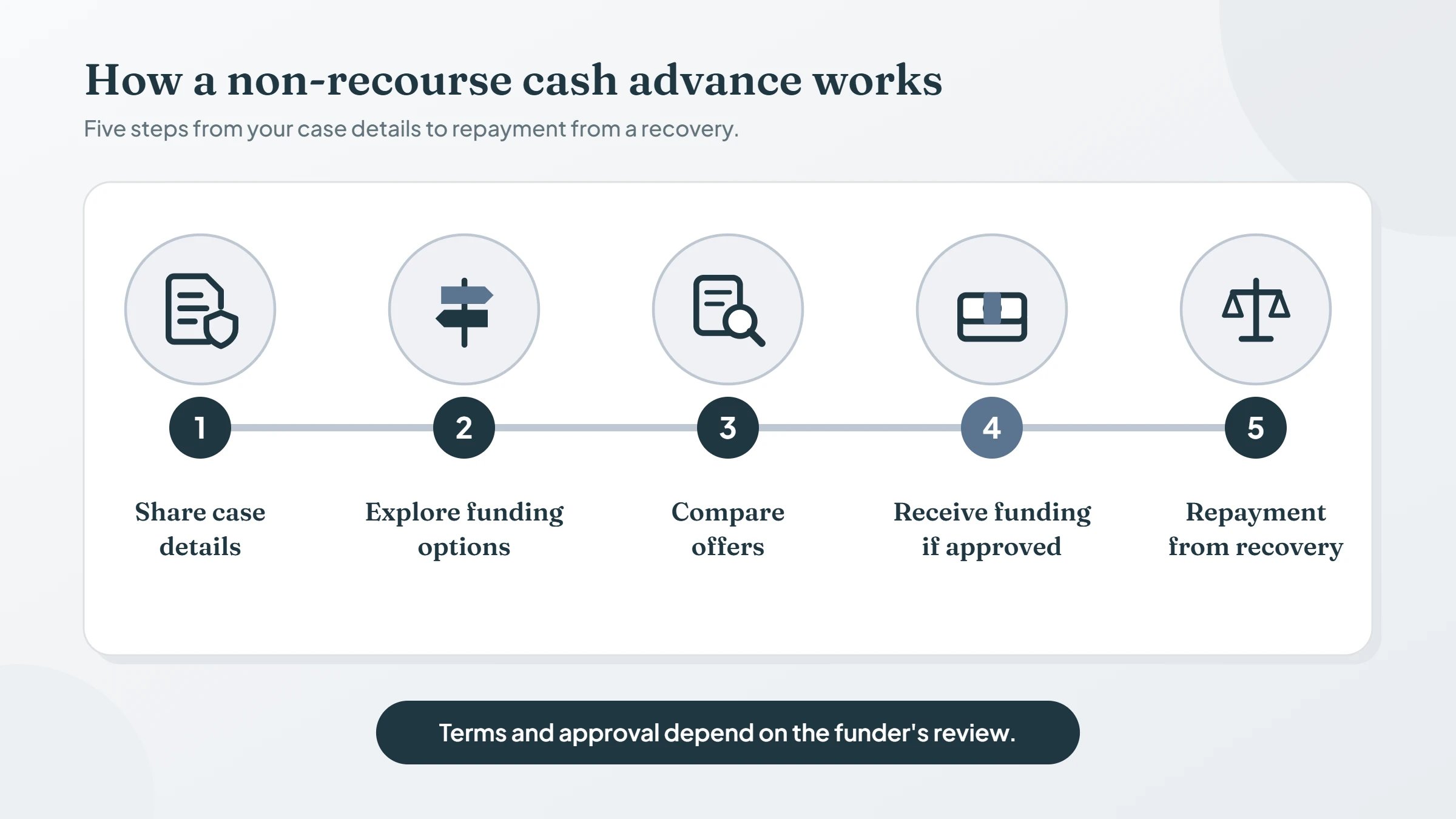
Approval depends on the funder’s review. Your attorney can help you understand the agreement and how repayment may affect the money you ultimately receive.
What Happens When Your Case Ends?
The outcome of your claim determines what happens to the funding.
| Case outcome | What happens to the advance? |
|---|---|
| You recover no money | An ordinary case loss producing no recovery generally means no repayment of the non-recourse advance or its funding charges. |
| You receive a settlement | The agreed payoff is paid from the applicable settlement proceeds. |
| You receive an award | Repayment is handled according to the agreement and available proceeds when the recovery is obtained. |
| You recover less than expected | The contract, available proceeds and applicable payment priorities determine what the funder receives and what remains for you. |
A successful outcome does not have to mean winning at trial. A negotiated settlement can also produce the proceeds used to repay funding.
A smaller recovery deserves a closer look. Attorney fees, case expenses, liens and the funding payoff can all affect what remains. Ask your attorney to explain the expected distribution before agreeing to funding.
How Much Does Non-Recourse Funding Cost?
The funding amount and the amount due at resolution are different figures.
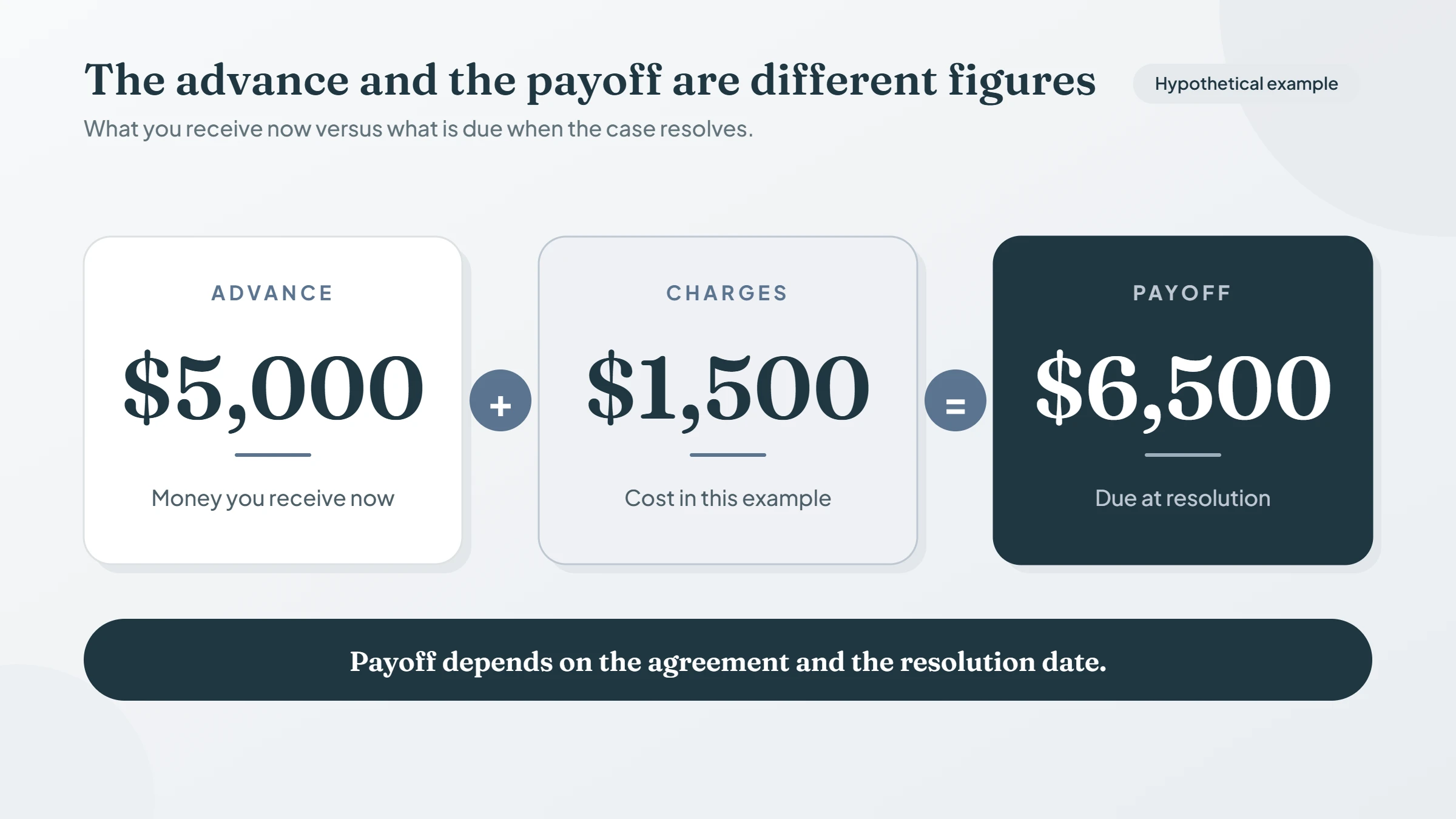
Your agreement should explain the advance, any applicable charges and how the payoff is calculated. Some charges may increase over time; others may follow a different structure.
Suppose you receive a $5,000 advance. An illustrative agreement shows a $6,500 payoff if the case resolves on a specified date. The $1,500 difference represents the charges in that example.
The figures are hypothetical. Your actual payoff depends on the offer, resolution date and agreement.
Questions to Ask Before You Accept
- How much money will I receive?
- What charges apply?
- What would the payoff be at different resolution dates?
- Is there a maximum amount or a limit on how long charges accrue?
- What happens if my recovery is smaller than expected?
- What cancellation rights apply?
Non-recourse protection is valuable, but the cost still matters when a claim succeeds. Compare the offers with your attorney before choosing one.
Are There Any Conditions to Non-Recourse Protection?
The agreement should clearly explain what happens if your case produces no recovery. It should also identify your responsibilities and any provisions concerning fraud, misrepresentation or material breach.
An ordinary case loss is different from a dispute over those provisions. Ohio’s consumer legal funding law, for example, recognizes possible penalties involving material breach, fraud or misrepresentation.
State rules also differ. Ask your attorney to review the agreement and explain which requirements apply to your funding.
Is Non-Recourse Funding a Loan?
You may hear terms such as lawsuit loan, settlement advance and legal funding used for similar arrangements.
The question is how repayment works under your agreement. A non-recourse advance generally depends on a recovery from the claim. A personal loan typically follows its own repayment terms regardless of the case outcome.
Legal classifications also vary by state. The Colorado Supreme Court, for example, treated the non-recourse litigation funding transactions before it as loans under Colorado’s consumer credit law.
Who May Qualify?
Funders commonly review the claim’s circumstances, potential recovery and available documentation. Many work with applicants who have an attorney representing them.
Each funder has its own requirements, and submitting a request does not guarantee approval. Visit our pre-settlement funding page to learn more about exploring your options.
Compare Non-Recourse Funding Options
My Settlement connects you with multiple pre-settlement funding options. That gives you an opportunity to review the available offers and consider the amount provided, charges and repayment terms.
Your attorney can help you compare the agreements alongside your expected case expenses and other obligations.
Frequently Asked Questions
Do I Repay the Advance if I Lose My Case?
An ordinary case loss producing no recovery generally means you do not repay the non-recourse advance or its funding charges. Review your agreement with your attorney to understand its terms and conditions.
What if My Case Settles Before Trial?
A negotiated settlement can produce a recovery. If it does, the agreed funding payoff is handled from the applicable proceeds according to the agreement.
Is Non-Recourse Funding Free?
No. An offer can include funding charges payable when the claim produces a recovery. Those charges reduce the amount available from the proceeds.
Am I Guaranteed to Be Approved?
No. Funders review claims and apply their own requirements before making an offer. The available options depend on your circumstances and the funders’ assessments.