
- Structured Settlements
- What are Structured Settlements
- Best Structured Settlement Buyers
- How Selling Works
- Eligible Cases
- Eligibility Criteria
- Structured Settlement Regulations
- J&J Settlement
- Maui Wildfire Settlement
- Types of Structured Settlements
- Guaranteed Structured Settlements
- Increasing Structured Settlements
- Deferred Structured Settlements
- Life-Contingent Structured Settlements
- Future Lump Sum Settlements
- Annuities
- What Is An Annuity
- Guide to Selling an Annuity
- Income Annuities
- How Are Annuities Taxed?
- 7 Common Annuity Mistakes & How to Avoid Them
- Annuity Beneficiaries
- Types of Annuities
- Fixed Annuities
- Fixed Index Annuities
- Variable Annuities
- Immediate Annuities
- Deferred Annuities
- Registered Index-Linked Annuity
- Pre-Settlement Funding
- What is Pre-Settlement Funding
- How Pre-Settlement Funding Works
- Eligible Cases for Pre-Settlement Funding
- Pre-Settlement Funding Criteria
- Pre-Settlement Funding Regulations
- Types of Pre-Settlement Funding
- Non-Recourse Cash Advances
- Structured Pre-Settlement Funding
- One-Time Lump Sum Cash Advances
- Compounding Interest Funding
- Flat-Fee Structured Funding
- Structured Settlement Calculator



One specialist stays with you from your first call through funding.

November, 2026
An annuity’s advertised rate tells you only part of the story. You also need to know when you can access your money, what each payment represents, and which benefits depend on following specific rules.
Two contracts offering lifetime income can work very differently. One may allow withdrawals under an income rider. Another may exchange your premium for scheduled payments that are difficult to change.
The following seven annuity mistakes can affect both new buyers and existing owners. Each comes with practical steps to help you check the details before committing money or changing a contract.
Common Annuity Mistakes at a Glance
| Mistake | What to check |
|---|---|
| Choosing a product before setting a goal | Income needs, timing, risk and the insurer |
| Focusing on the biggest advertised number | Interest rates, payout rates, benefit bases and bonus conditions |
| Committing money you may need soon | Cash reserves, withdrawal access and surrender terms |
| Overlooking costs and benefit rules | Charges, calculation bases and withdrawal limits |
| Misunderstanding taxes | Funding source, taxable gains and applicable exceptions |
| Leaving family protection to chance | Payout options and beneficiary designations |
| Changing or cashing out too quickly | Net proceeds, lost guarantees and future income |
1. Choosing an Annuity Before Deciding What It Needs to Do
Start with the purpose of the money. Someone who needs income next month faces a different decision from someone saving for retirement in 15 years.

A contract designed to accumulate savings may offer flexibility that a lifetime income arrangement does not. A variable annuity can expose the account value to investment losses. A fixed indexed annuity uses a crediting formula and does not provide direct ownership of the index’s stocks.
The label “annuity” covers different arrangements. Understanding what an annuity is helps you compare the features that matter to your situation.
How to Avoid This Mistake
Write down:
- When you expect to need income.
- Which expenses that income should cover.
- How much money must remain accessible.
- How much investment risk you can accept.
- Who may depend on the payments after your death.
Then ask why the recommended contract fits those needs. Verify the insurer’s and agent’s licensing through your state insurance department, and review the insurer’s financial strength.
Ask how the person recommending the annuity is compensated. A professional title alone does not explain their obligations or financial incentives.
2. Treating Every Advertised Rate as Investment Growth
A large percentage can look attractive, but you need to establish what it measures.
| Figure | What it generally describes |
|---|---|
| Credited interest rate | Interest added to the applicable contract value under its terms |
| Income-rider roll-up rate | Growth in a calculation base used to determine future income |
| Payout rate | Annual payments expressed as a percentage of a premium or other stated base |
| Bonus | A credit whose value depends on where it applies and its conditions |
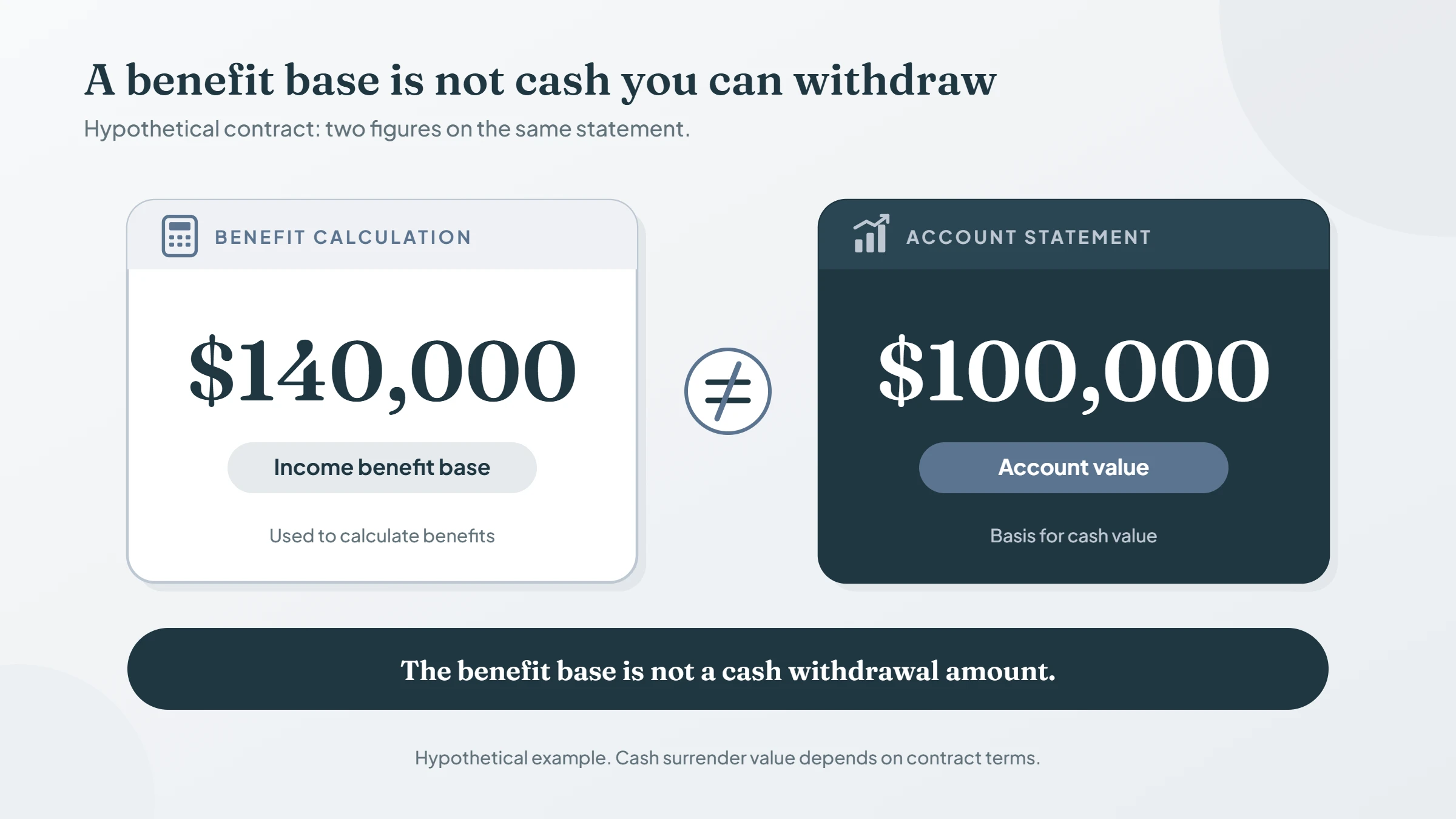
An income benefit base can differ from your account value and cash surrender value. It may help calculate lifetime withdrawals but cannot itself be withdrawn as a lump sum.
Suppose a hypothetical contract shows a $140,000 income benefit base and a $100,000 account value. The larger figure does not establish that you can surrender the contract for $140,000. The actual surrender amount depends on the contract and applicable adjustments.
A Payout Rate Is Also Different From Interest
A hypothetical $100,000 premium producing $600 monthly pays $7,200 annually: a 7.2% payout rate.
That does not establish a 7.2% investment return because payments include a return of premium.
How to avoid it: Ask which value each percentage affects. Check the guarantee period, renewal terms, and conditions attached to bonuses. Request an explanation of guaranteed and illustrated results separately.
3. Committing Money You May Need Soon
A home repair, medical bill or change in employment can make access to cash more important than expected.
Many deferred annuities impose surrender charges on withdrawals exceeding an allowed amount during a specified period. Some also apply a market value adjustment, which can increase or decrease the amount available.
Income annuities can be more restrictive. Some provide little or no ordinary surrender access, even when you are willing to pay a charge.
What a Surrender Charge Could Look Like
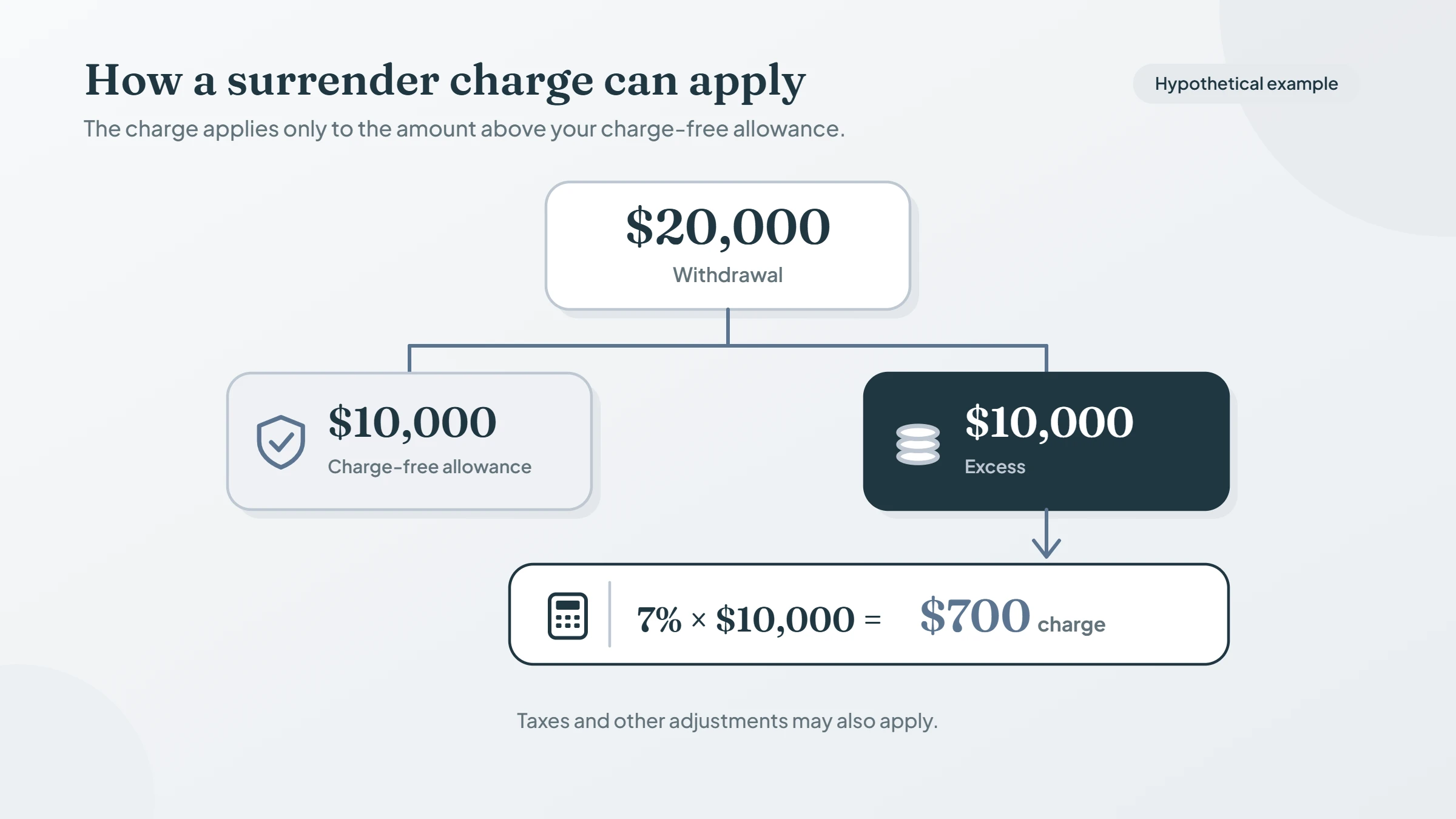
Assume a hypothetical contract permits $10,000 of surrender-charge-free withdrawals that year. You withdraw $20,000, and its terms apply a 7% charge only to the $10,000 excess.
The surrender charge would be $700. Taxes and any other adjustments would need separate consideration.
This example does not describe every contract. Allowances, calculation methods and withdrawal restrictions vary.
How to Avoid This Mistake
Keep suitable funds accessible for expected expenses and emergencies. Ask the insurer:
- How much can I withdraw this year?
- Which withdrawals trigger surrender charges or adjustments?
- Does the allowance change over time?
- How would a withdrawal affect income guarantees or death benefits?
A withdrawal described as “free” may still create taxable income or reduce benefits. Get the current figures before submitting a request.
4. Overlooking Fees and the Rules Behind Optional Benefits
The cost of an annuity depends on the product and the features selected.
A variable annuity may include mortality and expense charges, administrative charges, underlying investment expenses and optional rider fees. Other annuity types use different pricing arrangements. A list of variable annuity charges should not be treated as a universal fee schedule.
Ask what benefit each charge purchases and when that benefit becomes available. An income rider may require a minimum age, a waiting period, or limits on annual withdrawals.
A withdrawal that exceeds the rider’s permitted amount can reduce future guaranteed income under its terms. The reduction may be more significant than the immediate charge you expected.
How to Avoid This Mistake
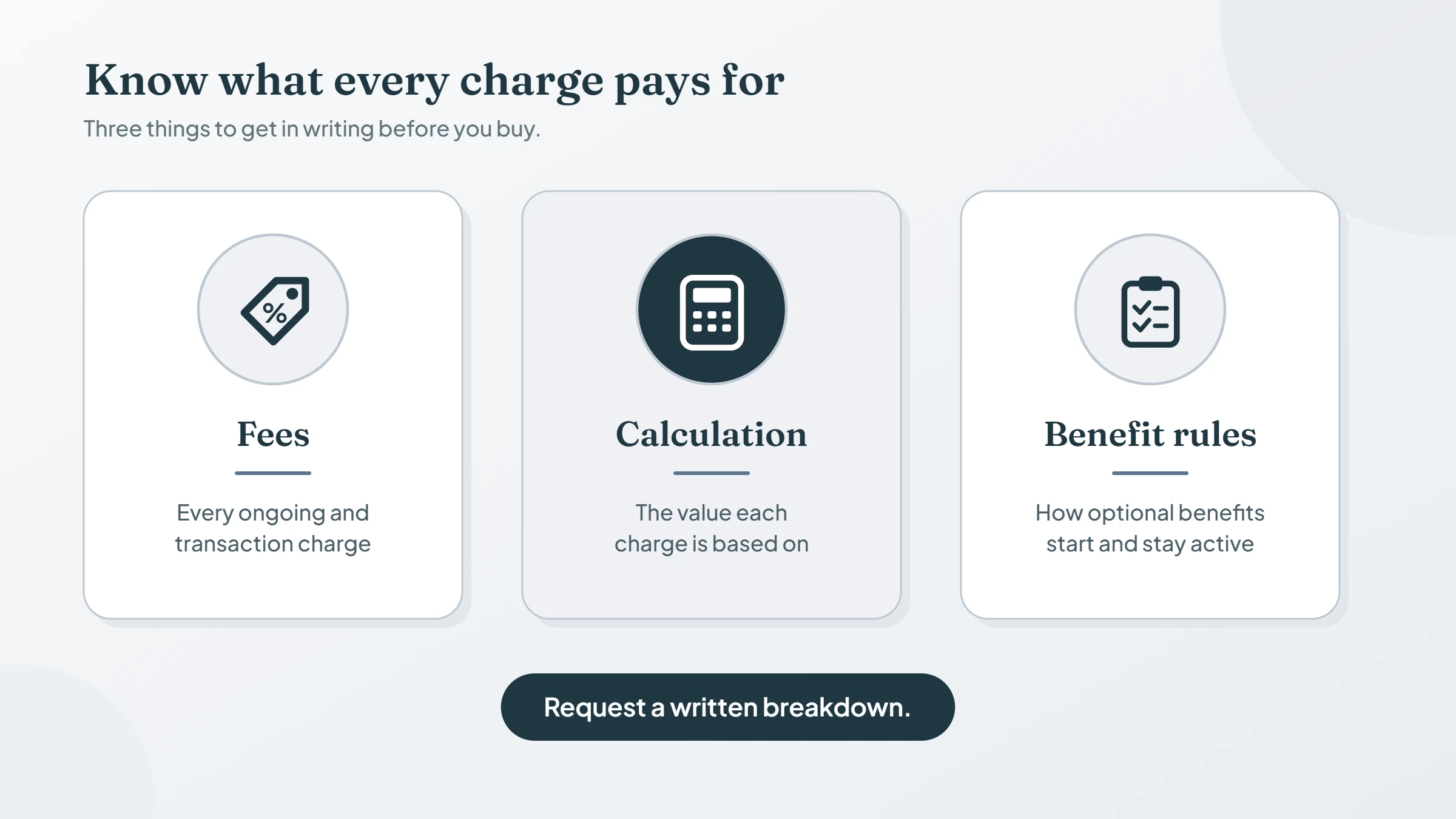
Request a written breakdown showing:
- Every applicable ongoing and transaction charge.
- The value used to calculate each charge.
- Which charges can change.
- The rules for activating and maintaining optional benefits.
An income-rider fee may be calculated using a benefit base that differs from account value. Also distinguish expenses from crediting limits: an index cap limits credited interest, while a charge deducts money under the contract’s terms.
Compare contracts using equivalent features and income start dates.
5. Assuming Tax-Deferred Means Tax-Free
Tax treatment depends on the funding source, the payment method and the transaction you are considering.
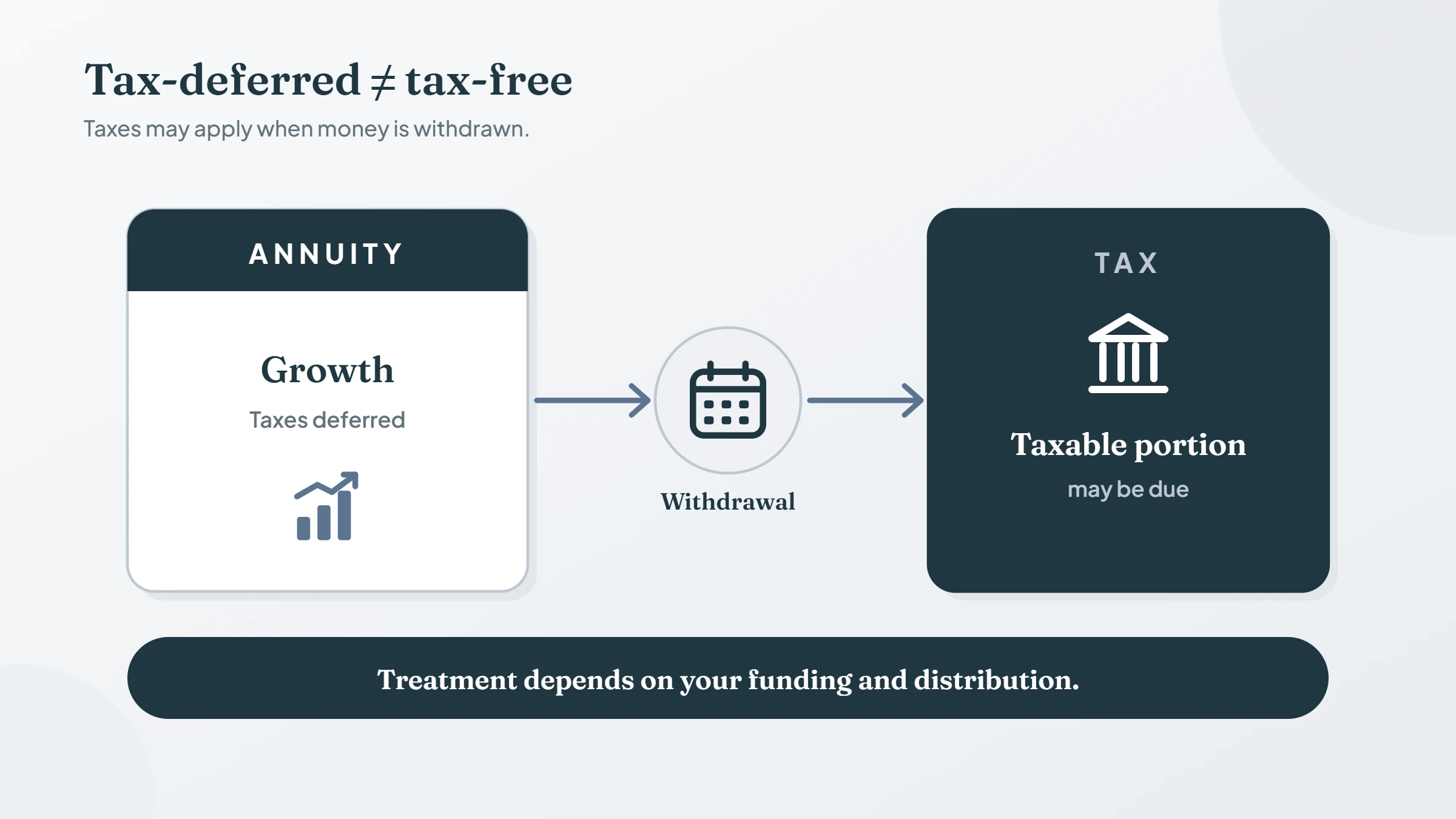
A non-qualified annuity is generally purchased with after-tax money outside a retirement account. Earnings are generally taxable as ordinary income when distributed.
Withdrawals before annuitization generally come from taxable earnings first. Once a contract is annuitized, a different calculation may allocate each payment between taxable income and recovery of the investment in the contract.
Check the Funding Source
| Arrangement | General tax consideration |
|---|---|
| Non-qualified annuity | Tax treatment distinguishes earnings from unrecovered investment |
| Traditional IRA or retirement-plan annuity | Distributions follow the account’s rules, including any after-tax basis |
| Roth arrangement | Qualified distributions can be tax-free; qualification requirements matter |
Putting an annuity inside an IRA does not create additional tax deferral simply because it is an annuity. Income guarantees or other insurance features may still be relevant reasons to consider it.
An additional 10% tax may apply to certain taxable distributions before age 59½. Exceptions exist, and the applicable rules depend on the arrangement.
How to avoid it: Confirm the tax status and investment basis before requesting money. Ask a tax professional to review the proposed transaction, including its timing and withholding. An insurer’s surrender-charge waiver does not establish an exemption from income tax or additional tax.
6. Choosing Payout and Beneficiary Terms That Leave Family Needs Uncovered
The highest initial payment may provide less protection for someone who depends on your income.
A life-only annuity generally stops payments when the covered person dies. A joint-and-survivor option continues payments to the surviving covered person under the selected terms, potentially at a reduced amount.
A life annuity with a guaranteed period provides lifetime income plus a minimum payment period. Refund options offer another form of protection, subject to the contract.
What a Guaranteed Period Means
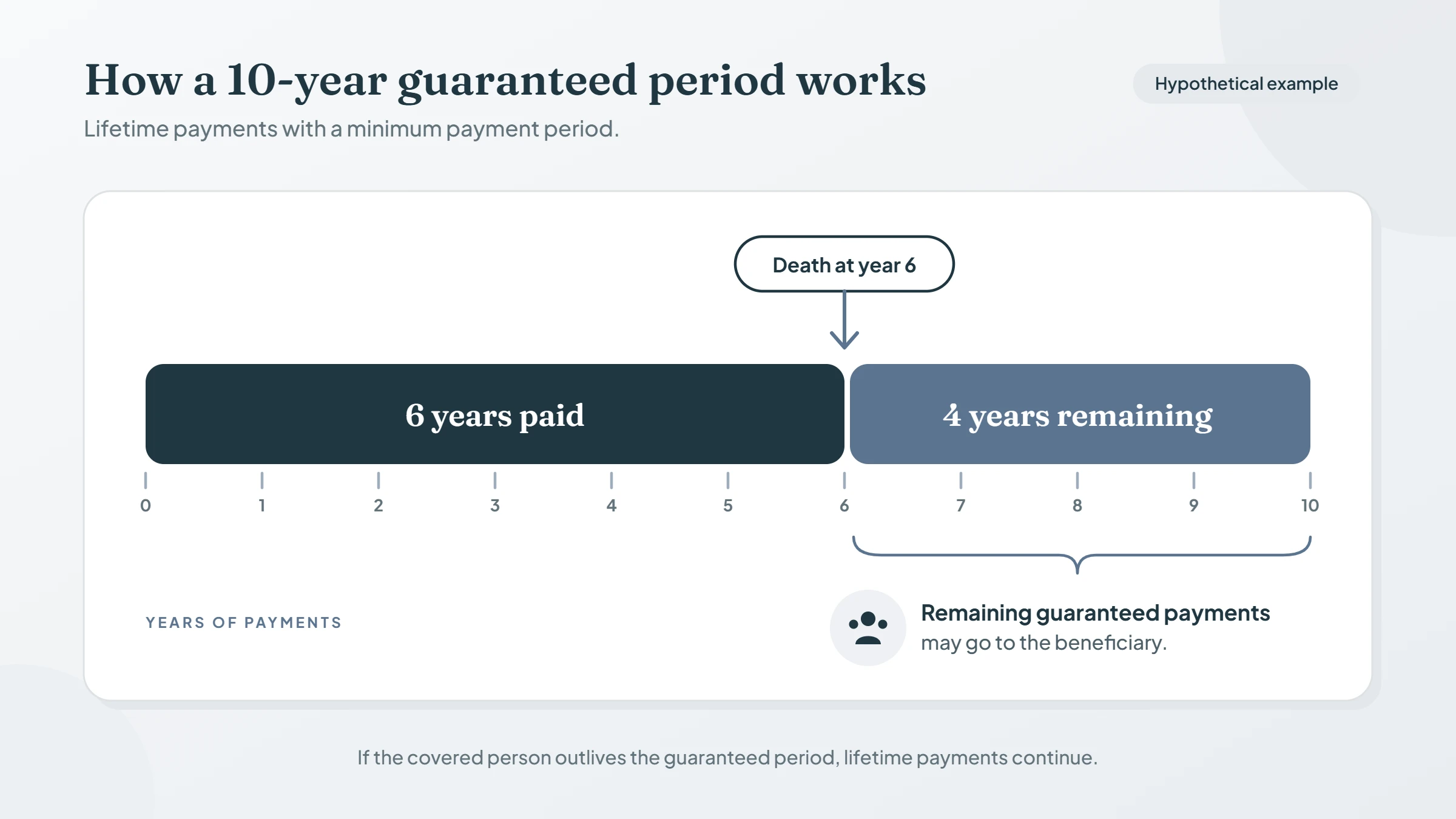
Suppose lifetime payments include a 10-year guaranteed period. If the covered person dies after six years, the remaining four years of guaranteed payments may pass to the beneficiary.
If the covered person lives beyond the guaranteed period, lifetime payments continue. That expired guarantee provides no additional payments after death.
Naming a beneficiary does not create a death benefit that the contract lacks. A joint annuitant’s survivor rights also differ from being named as a beneficiary.
How to Avoid This Mistake
Compare the income and death benefits for each available option. Consider how level payments would meet expenses if prices rise.
Review primary and contingent beneficiaries after marriage, divorce, a birth or a death. Submit changes through the insurer’s required process; updating a will generally does not replace updating the contract designation. Required consents and other restrictions may apply.
7. Replacing, Cashing Out or Selling Before Comparing What You Give Up
A new contract or lump-sum offer deserves the same care as the original purchase.

An older annuity may contain guarantees or rider provisions that are valuable to you. Replacing it can introduce new charges, restart surrender restrictions or remove benefits that cannot be restored.
Understand Which Transaction You Are Considering
- Surrender: You end the contract through the insurer and receive its applicable surrender value.
- Section 1035 exchange: You exchange an eligible contract through a transaction meeting federal tax requirements.
- Sale of payment rights: A buyer purchases eligible future payments for an agreed discounted lump sum.
A qualifying Section 1035 exchange can defer recognition of gain, but it does not eliminate insurer charges or preserve every existing benefit.
Cashing out a non-qualified annuity and buying another does not automatically qualify. IRS Revenue Ruling 2007-24 addresses a check issued to the owner and endorsed to another insurer; that transaction did not qualify as a tax-free exchange.
How to Avoid This Mistake
Compare the net amount available, future income lost, charges and tax consequences. Ask which guarantees would end.
A payment-rights sale also requires eligibility review. Individual retirement annuities have statutory transfer restrictions, so an IRA annuity should not be assumed eligible for an ordinary sale to a third-party buyer.
Already Own an Annuity? Start With These Documents
A current review is easier when you have the figures in front of you. Gather:
- Your contract and any riders.
- The latest statement.
- A current surrender-value or benefit quotation.
- The withdrawal and surrender-charge schedules.
- Beneficiary information.
- Tax-basis records, if applicable.
Check the contract’s free-look provision promptly if you recently purchased it. The deadline and refund calculation depend on the applicable rules and contract. Confirm the return procedure before the deadline expires.
Considering a Lump Sum From Your Annuity Payments?
My Settlement purchases eligible annuity payment rights for a discounted lump sum. The amount paid is less than the combined scheduled value of the payments sold.
Our team can review your payment documents and explain the proposed purchase terms. Compare the offer with any cash-access options available directly through your insurer, along with the income you would retain.
Visit our annuity purchasing service to learn more.
Frequently Asked Questions
Can I Cancel an Annuity After Buying It?
A contract may provide a free-look period during which you can return it under the applicable rules. After that period, cancellation or surrender depends on the contract and may involve charges, tax consequences or limited access.
Are All Annuities Protected Against Investment Losses?
No. Variable annuities expose account value to investment risk. Other products provide different contractual protections and limitations. Insurer guarantees also depend on the issuing company’s ability to pay claims.
Is Selling an Annuity Always a Mistake?
No. A sale of eligible payments may suit a specific need, but the decision should account for the discounted purchase price, taxes, restrictions and future income given up. Comparing the actual options helps you assess the trade-offs.