
- Structured Settlements
- What are Structured Settlements
- Best Structured Settlement Buyers
- How Selling Works
- Eligible Cases
- Eligibility Criteria
- Structured Settlement Regulations
- J&J Settlement
- Maui Wildfire Settlement
- Types of Structured Settlements
- Guaranteed Structured Settlements
- Increasing Structured Settlements
- Deferred Structured Settlements
- Life-Contingent Structured Settlements
- Future Lump Sum Settlements
- Annuities
- What Is An Annuity
- Guide to Selling an Annuity
- Income Annuities
- How Are Annuities Taxed?
- 7 Common Annuity Mistakes & How to Avoid Them
- Annuity Beneficiaries
- Types of Annuities
- Fixed Annuities
- Fixed Index Annuities
- Variable Annuities
- Immediate Annuities
- Deferred Annuities
- Registered Index-Linked Annuity
- Pre-Settlement Funding
- What is Pre-Settlement Funding
- How Pre-Settlement Funding Works
- Eligible Cases for Pre-Settlement Funding
- Pre-Settlement Funding Criteria
- Pre-Settlement Funding Regulations
- Types of Pre-Settlement Funding
- Non-Recourse Cash Advances
- Structured Pre-Settlement Funding
- One-Time Lump Sum Cash Advances
- Compounding Interest Funding
- Flat-Fee Structured Funding
- Structured Settlement Calculator



One specialist stays with you from your first call through funding.
November, 2026
Suppose a funding offer lists “2.5% per month.” You work out $200 on an $8,000 advance and expect that charge each month.
A compound-interest agreement works differently. After the first $200 is added, the next month’s calculation starts at $8,200. That month adds $205.
The difference looks small at first. Give it time, and it can substantially change your payoff.
What Does Compound Interest Mean for Your Advance?
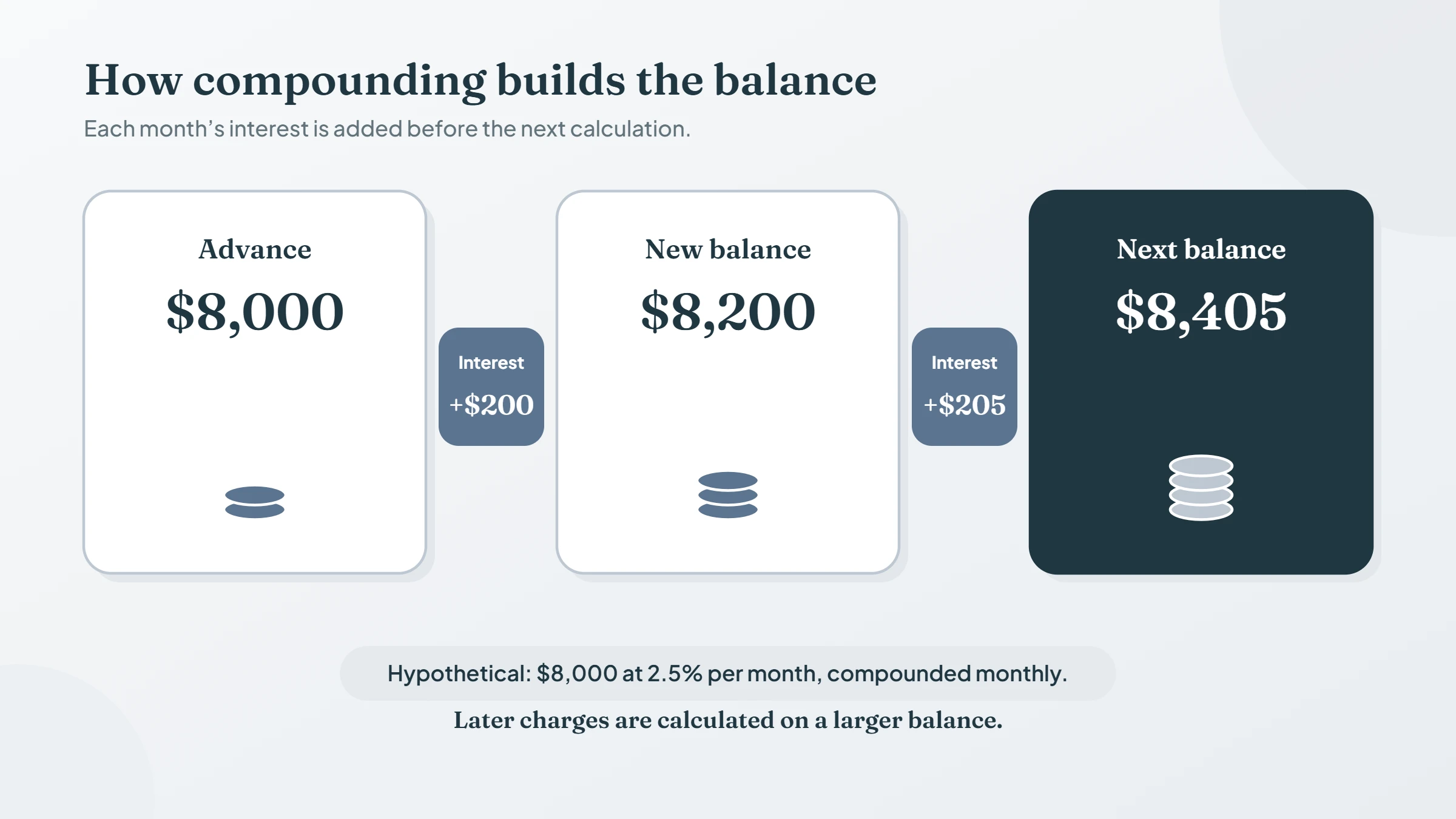
It’s pre-settlement funding with charges calculated on a balance that includes earlier interest. The SEC’s Investor.gov glossary describes compound interest as interest paid on principal and accumulated interest.
The principal is the original advance. As interest is added to the balance, later calculations use a larger amount.
Compounding describes pricing. You could receive the money in one lump sum or through scheduled advances, depending on the offer. Non-recourse describes a different feature: the circumstances in which repayment is owed.
Check each feature separately. A payment schedule alone won’t tell you how charges grow.
How Much Could Compounding Add?
Let’s keep the original advance and quoted monthly rate the same so you can see the effect of compounding.
Simple vs. Compound Interest at the Same Rate
These examples assume an $8,000 advance at 2.5% per month, no additional fees or advances, no interim repayments, and no cap affecting the figures.
| Time until repayment | Simple monthly interest | Interest compounded monthly |
|---|---|---|
| Six months | $9,200 | $9,278 |
| Twelve months | $10,400 | $10,759 |
| Eighteen months | $11,600 | $12,477 |
| Twenty-four months | $12,800 | $14,470 |
Figures show the total payoff, including the original $8,000, rounded to the nearest dollar. They illustrate the math, not MySettlement rates or terms available in every state.
Simple interest adds $200 each month in this example. Compound interest adds progressively larger charges as the balance grows.
After two years, compounding produces about $1,670 more in charges than simple interest at the same monthly rate.
A Lower Rate Can Cost More Later
Now compare two hypothetical offers on the same $8,000 advance:
| Repayment date | 2.5% compounded monthly | 3% simple monthly |
|---|---|---|
| Twelve months | $10,759 | $10,880 |
| Twenty-four months | $14,470 | $13,760 |
The lower compound rate costs less at twelve months. At twenty-four months, the simple-interest offer costs less.
These figures also exclude fees and caps. They show why a single percentage can’t settle the comparison. You need payoff amounts at several dates, especially when your case timeline is uncertain.
What Else Can Change the Payoff?
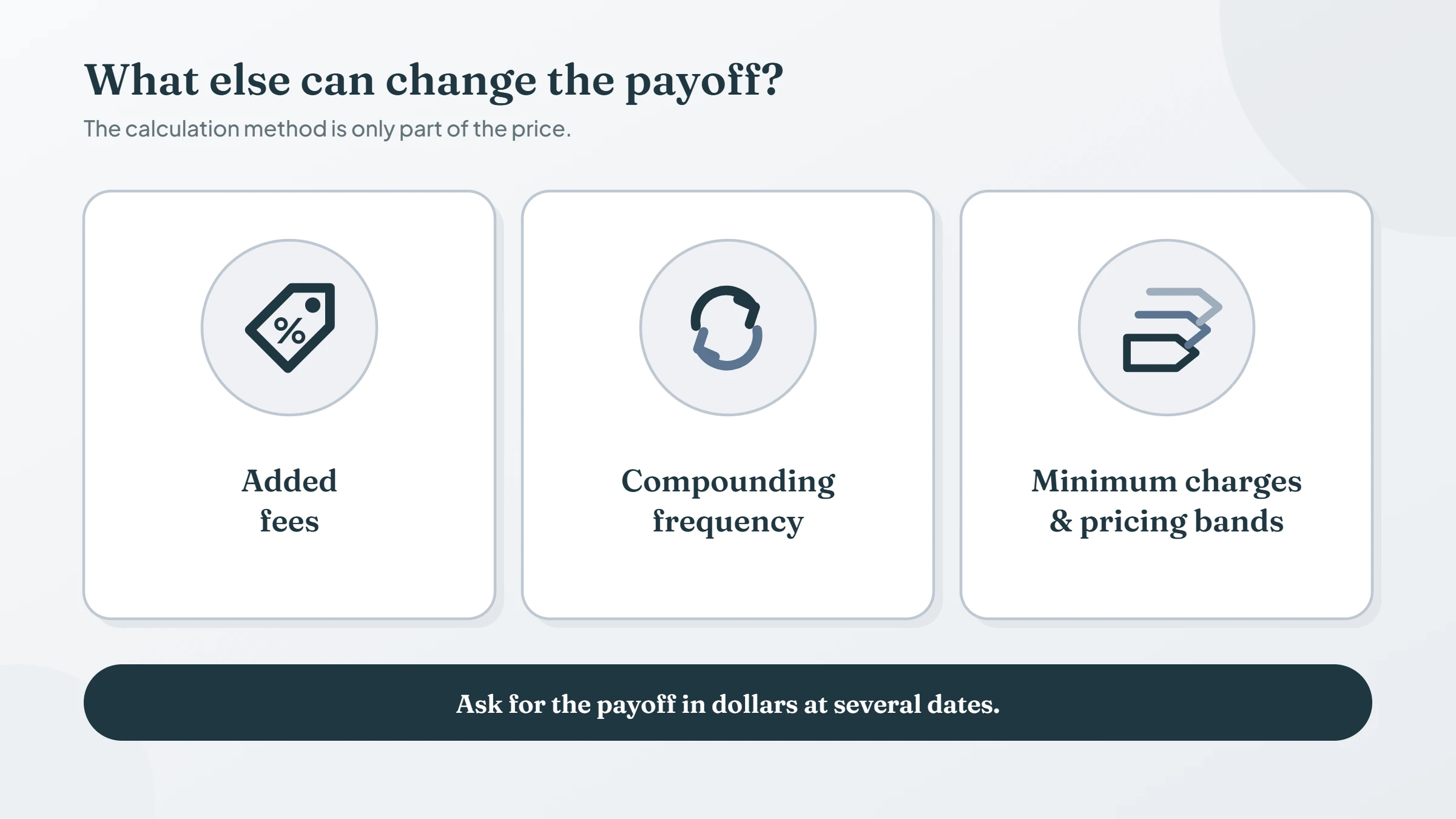
The calculation method is only part of the price. Ask what else the agreement includes.
Fees Added to the Balance
An origination, processing, or other permitted fee may increase what you owe. Ask when each fee is charged and whether it becomes part of the balance used to calculate further interest.
Also check how much cash you receive. An offer showing a larger funding amount may include money paid elsewhere on your behalf.
Compounding Frequency
Monthly compounding adds interest to the calculation balance each month. Other agreements may use a different interval, subject to state law.
Ask two questions: What period does the quoted rate cover, and how often is interest added to the balance? A monthly rate and an annual rate aren’t directly interchangeable.
Minimum Charges and Pricing Bands
Some agreements calculate charges for completed days or months. Others use pricing bands with a specified payoff during each period.
Ask what happens if repayment falls shortly after a new period begins. Does the agreement charge for that whole period or only part of it?
A payoff that jumps every six months doesn’t automatically prove compounding. The key detail is whether the next charge uses the original advance or a balance that includes earlier charges.
What Does a Funding Cap Actually Limit?
“Capped” sounds reassuring. You still need to know what the cap covers.
- An interest-rate cap limits the percentage charged.
- An accrual-period cap limits how long specified charges can build.
- A total-payoff cap limits the amount payable, according to its terms.
Those protections do different jobs.
Ask which fees count toward the limit. If you later request another advance, check how that affects the combined payoff and any applicable time limits. A cap on one part of the cost may leave other charges outside it.
Is Compounding Allowed Everywhere?
State rules can affect permitted charges, compounding frequency, and how long fees may accrue.
West Virginia Code § 46A-6N-9, for example, permits covered fees to compound semiannually, but not at shorter intervals. It also limits fee assessment to forty-two months from the contract date.
That’s why a monthly-compounding example should never be treated as a nationwide offer. The agreement must fit the rules that apply to the transaction.
What Happens When Your Case Pays?
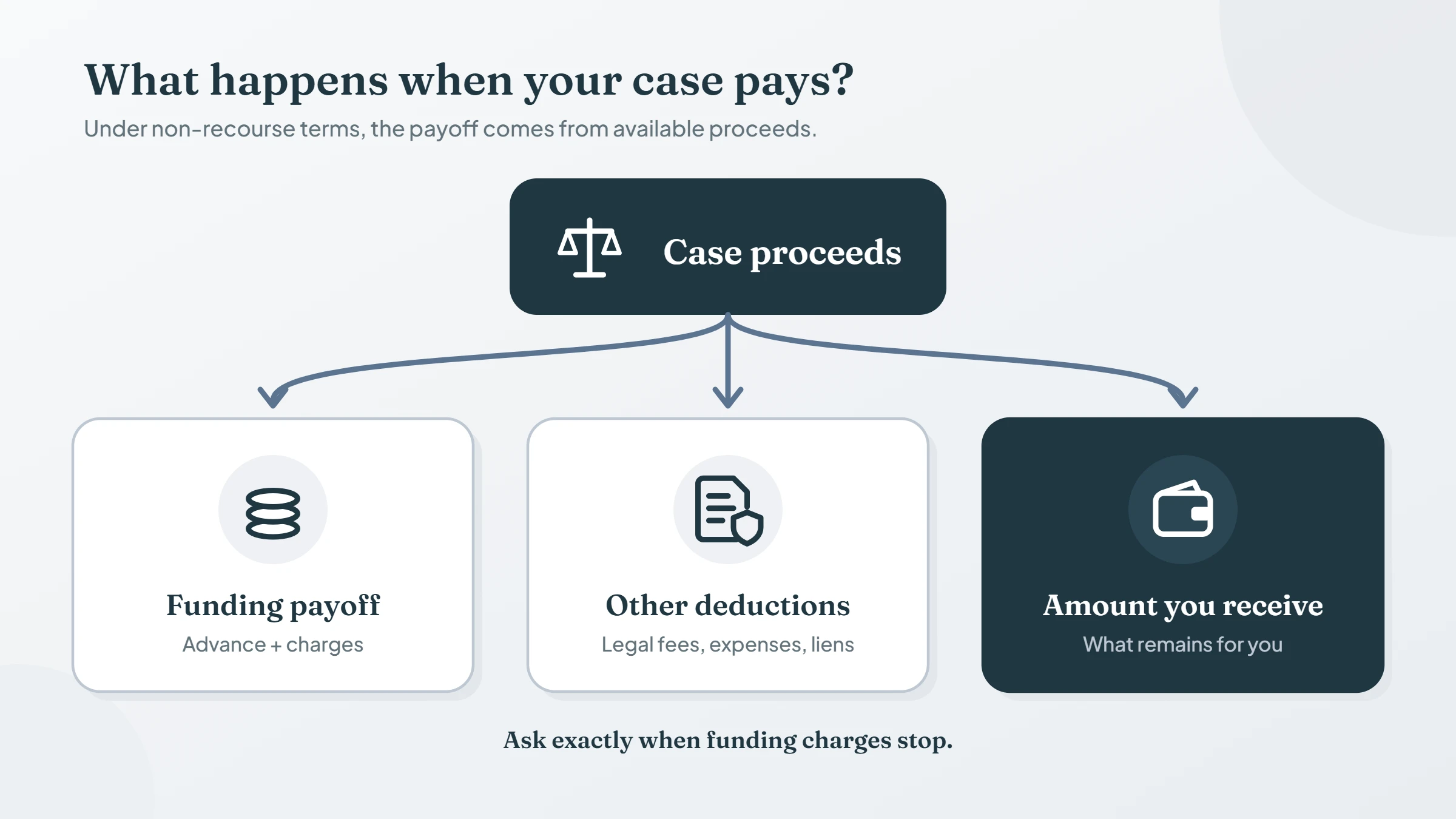
Under non-recourse terms, the funding payoff generally comes from available case proceeds after a successful recovery. Your attorney usually coordinates that payment when distributing the recovery.
The payoff includes the original advance and the charges due under the agreement. You already received the advance earlier; it isn’t paid to you again at distribution.
Ask your attorney how funding, legal fees, case expenses, and liens could affect the amount you receive at the end. Their amounts and payment priorities depend on your circumstances.
Also ask exactly when funding charges stop. The date a settlement is signed and the date the funder receives payment can be different. Check how the agreement and applicable law handle that interval.
How Should You Compare Offers?
Start with the same cash amount and matching repayment dates. Then ask each funder for a written breakdown showing:
- Cash you receive: Separate it from fees and payments made elsewhere.
- The calculation method: Identify the rate period, compounding interval, and balance used.
- Payoffs at several dates: Six, twelve, eighteen, and twenty-four months are useful comparison points.
- Limits and conditions: Check caps, minimum charges, additional fees, and the effect of another advance.
If a number isn’t clear, ask the funder to calculate it in dollars. “What would I owe if repayment happens next November?” is often more useful than another explanation of the advertised rate.
Compare Pre-Settlement Funding Offers Through MySettlement
MySettlement connects you with multiple pre-settlement funding offers, giving you options to compare before choosing.
Tell us how much you’re looking for and disclose any existing funding. Compare available offers by cash amount, pricing method, repayment terms, and payoff limits.
The participating funder determines approval and the terms available for your case and location.
Frequently Asked Questions
Does monthly compounding mean I make monthly repayments?
No. Compounding describes how charges are calculated. Your repayment schedule is a separate term. A non-recourse agreement may defer payment until your case produces proceeds even while charges accrue.
Does compound interest change the protection if I lose?
Compounding alone doesn’t determine repayment responsibility. Under non-recourse terms, an ordinary unsuccessful claim producing no recovery generally means no repayment. Review exceptions involving fraud, misrepresentation, or material breach, and ask how an insufficient recovery is handled.
Is 2.5% monthly compounding the same as 30% growth per year?
No. Multiplying 2.5% by twelve gives 30%, but monthly compounding increases the balance used each month. Under that calculation, the balance grows about 34.5% over twelve months, before additional fees. This describes balance growth, not necessarily the legally disclosed APR for a particular agreement.